Sunday, August 10, 2014

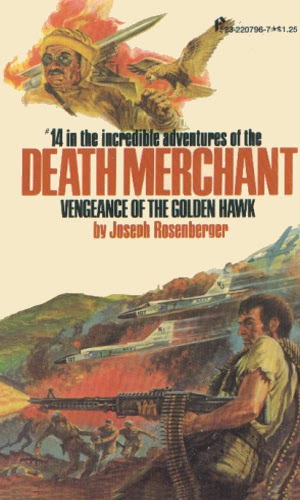
Death Merchant #14: Vengeance Of The Golden Hawk

Richard Camellion (aka the Death Merchant) infiltrates a Palestinian terrorist group known as Vengeance of the Golden Hawk, in order to locate and destroy a nerve gas missile the VGH is planning to detonate over Tel Aviv. It could kill upwards of 300,000 people, and if that happens, Israel will retaliate with nuclear weapons, and that would be the start of World War III.

The book begins with Camellion and a Jordanian agent named Yassine Bahnassi being placed in an Amman jail cell that also houses three members of the VGH. Camellion engineers a breakout (when he explains his plan, one of the men says, "The scheme is so crazy it might work" (!)), and the five men stick together in a safe house on the outskirts of Jordan.

Camellion's cover story is that he is a semi-rogue US military explosives expert and is looking to sell some stolen weapons. The three VGH members are impressed with Camellion ("The organization could use a man of your unique talents") and agree to take him and Bahnassi to the Mountains of the Moon, the VGH's headquarters in Syria - which is also (handily) were the missiles are stored.

At this point, it's clear that the main action of the book will be when Camellion gets to the Mountains of the Moon and swings into action. But author Joseph Rosenberger has pages to fill, so we get a couple of shootouts as the five men, in disguise, make their way to Damascus, where they are ambushed in Mina Square. They also fight a bunch of PLO soldiers while crossing a wadi. Finally, they get to MotM, where they meet the head of VGH: Faraq al-Khatid. Some of Al-Khatid's men believe Camellion is a "Jew spy", but the story the three men tell of Camellion's bravery during their travels is convincing.

Camellion and Bahnassi are supposed to meet up with a Harquad agent who has infiltrated the VGH, but it takes six days for Assaf Budny to make himself known. Finally, the three men begin their raid on the radio control room, the first step towards destroying the arsenal. The initial shoot-out was pretty convoluted. Honestly, it would have helped if Rosenberger included a map of the cliff dwellings. There are buildings above and below - and to both sides - of the arsenal from which the DM and his two cohorts are fighting off the VGH. Since Rosenberger is intent on describing every bit of action from every angle, it gets a bit confusing.
The Death Merchant and the two Jordanian Harquad agents with him could see quite clearly by the tunnel's upper opening from the northwest window of the arsenal's rear room. While Camellion and Budny held down the fort in the front room, in the arsenal proper, Yassine Bahnassi took a position by the northwest window ...

Budny, who had taken a position by the west wall, by the center window. Assaf was watching the west side balcony of the building above the arsenal. ... Budny had a clear view not only of the east side porch but also a portion of the steps [from the east balcony to the arsenal] ...

[A] roar of gunfire from the back room and from the first house to the west of the arsenal. ... [T]he Fedayeen in the west side house had begun to toss automatic rifle and submachine gun steel at Assaf Budny. A moment later, Fedayeen in houses to the east of the arsenal opened fire. ...
Rosenberger is on clearer ground when it comes to describing the gore, as Camellion sends an assortment of VGH fanatics on a "one-way passage to deathland":
Three guerrillas, butchered by slugs, danced a quick jig of death and fell over the railing of the long balcony. A man on the steps took a slug in the gut, one in the chest, and three more in the face. Without a head, his brains flowing down ahead of him, he pitched off the steps, hit the west edge of the roof, bounced off, and kept falling, trailing a stream of blood like the red tail of a comet.
(Rosenberger often gives names to all of the bad guys, even if they get "cowboyed" in the same paragraph. I suppose since he's intent on describing the layout and how everyone is shooting, it helps to identify people if they have a name.)

After they get out of the arsenal and climb down the cliffs, the Death Merchant still has to contend with a French Panhard armoured car with a 60mm turret cannon and a Soviet BTR-40 personnel carrier. Fortunately, he's carrying some blocks of RDX explosives.

Finally, Rosenberger delivers his expected mention of fruit, though he waits until page 173, seven pages from the end of the book: "Kaouki died faceless and brainless. The Death Merchant's chain of 7.65mm slugs exploded his head, which flew apart like a rotten melon."

Friday, August 01, 2014

Death Merchant #13: The Mato Grosso Horror

In The Mato Grosso Horror, Richard Camellion heads an "archeological expedition" that is trying to locate a group of former Nazis, headed by Doctor Klaus von Linderbock, who have constructed a laboratory in the "hell-hot" Brazilian jungle and are working on a powerful mind control drug. They have been secretly testing the drug on the Carajas natives. With the drug, the Nazis plan to unite Germany and regain Europe - and then the world!

From various reviews of the Death Merchant series, I know that author Joseph Rosenberger filled more of the later books with his own political and social beliefs, from straight American ultra-conservatism to the occult. (His anti-religion stance has been crystal clear since the first book. Here, Camellion dismisses missionaries who venture into the jungle - "one of the most unexplored regions on earth" - armed with little more than Bibles as "idiots to begin with".)

Early in the book (published in September 1975), Camellion opines on the feminist movement while the members of the expedition are double-checking their cache of supplies. The narrative suddenly stops after Major Ryan refers to Monica Belone, an anthropologist, as "Miss Belone". She replies that, "if you don't mind, I prefer to be addressed as 'Ms.'"
[Major] Ryan looked startled. Then he looked as if he wanted to laugh.

"Oh, that 'Ms.' business!" He grinned broadly. "To me that means either 'manuscript' or 'multiple sclerosis!' but if you want to be called 'Ms.,' that's okay by me."

Monica didn't appreciate Ryan's comments, and her brown eyes flashed in anger. She folded her arms over her breasts (which were slightly larger than two fried eggs) and said stiffly, "It's gratifying to know that some men have the good sense to realize male supremacy is on its way out in all the industrialized nations, that it was just a phase in the evolution of culture."

Relighting his cigar, Ryan did not reply. But Camellion did.

"Maybe so, but I'm not very optimistic about the net results of the democratization of sex relations," he said, his eyes on the planes, rather than on 'Ms.' Belone. "The death of male supremacy may simply mean that the sexes become equally powerless, rather than equally powerful. For example, if we continue with the present economic system, the sexual democratization of the labor market will result not in women improving their position, but in a period of worsened conditions for both sexes."

The Death Merchant turned and raked Monica with his icepick-like gaze. "To be specific, the kinds of advantages that have been obtained by women act against the better interests of black women and poor women. I say that because mobility for women depends on education; and it is middle-class women who get the best educations, the most opportunities, and the best jobs."

"Apparently, Richard, you are not familiar with the work of Claude Levi-Strauss and the French structuralists. The emic-etic debate has . . ."

"I'm not interested in self-appointed messiahs who prefer theories and ignore facts. One of those facts is that middle-class families will have both marriage partners working, and that will pull their incomes even farther away from those of working-class families. In short, Ms. Belone, the opening up of certain jobs for limited categories of women may actually mean more economic deprivation for poor people in general!"

He smiled at the angry but subdued young woman. "But all that doesn't have anything to do with this expedition, does it?"
And with that dismissal, the main story continues.

Also, Rosenberger must have done a ton of research on the jungles of Brazil - and he was clearly determined to put it all into the book. The Mato Grosso Horror is packed with information about Brazil, its wildlife and plants. However, Rosenberger isn't really able to integrate his research materials smoothly into the narrative. Here is some info snakes and other hazards of the jungle:
There were more than thirty species of poisonous snakes in that special kind of Hades, divided into two general families: the colubrids and the vipers, such as the corals, short-fanged, which caused them, to hang on and chew after striking. The pit vipers were much worse - two subfamilies or genera; first, the many tropical cascabelas, like bushmasters (aggressive, extremely vicious, no rattles to warn you with); the fer-de-lance, a long-fanged killer, called the jararaca, a night rover and 94 percent fatal; and, of course, the yacu maman, or anaconda, so huge it could swallow a man whole!

The forest would be denuded of game and other foods. There was El Tigre, the man-eating jaguar, hunting in singles or in pairs; crocodiles; pana - two varieties, first cousins of the meat-eating piranha; the ten-foot cannibal zungaro or tiger fish; and giant electric rays capable of electrocuting a man. There were scores of jungle diseases. Ants whose single bite could cause blindness. In short, just staying alive and halfway healthy was a full-time job in the Mato Grosso!
Besides the snakes and other dangerous animals, there are also two tribes of "savages" to contend with. The Carajas are cannibals and "the most warlike tribe in South America". While providing pages of information about the fictional tribe, what they wear and how they paint their faces, Rosenberger helpfully notes that the women are "attractive for savages ... some of them were quite shapely".

At one point, Rosenberger has one of the Carajas alert the Nazis as to Camellion's group's progress: "Drums they say white man-devils close to the land of the Muraitos. Drums they say Muraitos plenty mad and make chop-chop-kill of white devils." Rosenberger also indulges in some casual racism, having the explorers battle the "jungle lollipops", "painted gooks", and "South American jungle bunnies".

The death count in this book is well over 1,000. The various battle scenes are more one-sided than usual, as the DM and his cohorts have automatic weapons and grenade launchers, while the Muraitos and Carajas natives have only spears and arrows. (The Carajas guarding the village in which the Germans are located have modern weapons, however.)

As they make their way through the jungle, our heroes have to take refuge in a cave while battling two bands of Carajas warriors. The Germans then set off some explosives, sealing off the cave's entrance with tons of rocks! It's the end of a chapter - and when the next chapter begins, the group is out of the cave and has made several days' progress towards the Germans' village. ?!?! It's a total cop-out by Rosenberger, as he explains how they escaped being buried alive in only a few sentences.

The Nazis are found, and the DM and his team of 10 men split into two groups and attack the compound from two sides. (Ms. Belone does not participate in the final battle.) During the all-out fire-fight, Camellion narrowly survives a hail of slugs (naturally):
The Germans open fire! In the center of a hurricane of hot steel, he reached the top, jumped over the rim, and zigged and zagged, moving at a left angle on a one-way route for life. A nine-millimeter Heckler & Koch slug sang sinisterly by his left ear. Hot steel from a 7.92mm Krieghoff automatic rifle came within half an inch of drilling a couple of bloody tunnels through the top of his cap-covered skull. Damn! I should have gone into the hardware business with my father! A loud zinggg as steel smashed into steel and his right hip felt as if it had been hit with the head of a hammer. But it hadn't been. A 7.92mm from a St.G. Mauser assault rifle had cut through the metal sheath and had struck the steel blade of his M-4 bayonet-knife. Another 7.92 blob of steel barely raked across his left hand.
Also, Rosenberger adds to his list of food used to describe carnage: "Three more [Walther slugs] opened up his chest and split his skull the way a macana would chop apart a kisva melon!"

Friday, July 25, 2014

Death Merchant #12: The KGB Frame

In a summary of the Death Merchant series, the writer of Spy Guys And Gals, notes: "Extremely little is recorded about the man nicknamed the Death Merchant. His early years are a total mystery as are the means he used to acquire his awesome killing abilities. For a series with 70 different adventures, this is remarkable."

All we know (through the first 11 books) is that Richard Camellion used to be a high school history teacher in St. Louis. We have a basic physical description: "a lean almost-handsome face - straight nose, firm, determined jaw, eyes as blue as polar ice. Brown hair clipped in a two-inch crew cut."

But we get a lot of circumstantial information about Camellion in the early pages of The KGB Frame (published in July 1975). First of all, the Death Merchant has owned an 81-acre ranch seven miles south of Votaw, Texas (an actual small town roughly 75 miles northeast of Houston), for at least six years. The ranch is named Memento Mori ("Remember Death"). Jesus Sontoya, a trusted friend of the DM, lives on the ranch.

Camellion also has four "safe houses" in the United States, each with a sizeable hidden cache of weapons, disguises, etc.: (1) one in Alhambra, a suburb of Los Angeles, (2) a four-room brick house in Arlington Heights, north of Chicago, (3) "a neat cottage" in Sioux Falls, Iowa, and (4) an apartment on Vermilyea Avenue in upper Manhattan. Unfortunately, Camellion ends up having to destroy (by planted explosives) the New York apartment house, which he owned under the name Corliss Durbenten.

Also, it is revealed that Camellion knows (or can speak) 11 languages!

In The KGB Frame, the Russians want to get rid of the Death Merchant, so they create a recording of him supposedly admitting to being a double agent for the Soviets. When the CIA hears the tape - and its experts determine that the recording is genuine - they send several assassins to kill the traitorous Death Merchant. After figuring out that he has been "netted" by the KGB, Camellion travels to both New York and Mexico City in an effort to clear his name. (The final shootout is among the ruins of the Pyramid of the Sun outside of Mexico City.)

Rosenberger engages in some American exceptionalism:
[Belov] like [sic] the country and he liked Americans. In the two years that he had been stationed at the Soviet embassy in Washington, D.C., he had come to learn that Americans are the happiest, the best fed, the best-dressed people in the world.

Belov thought of the large apartment near the embassy that he and Elana rented. Every single piece of furniture was American and fifty times better than similar items manufactured in the Soviet Union. The refrigerator was a General Electric, the vacuum cleaner a Hoover, the color television set an RCA, the stereo a Philips. Why, even the shower head had come from Sears & Roebuck! Then there were those little everyday things that Americans took for granted, like American cigarettes, ballpoint pens, hot dogs, cola drinks and - Nescafe!
But not all of the United States is super-amazing. For example, New York City is referred to as "the land of freaks and ripoffs, with more kooks per square mile than even L.A.!" Camellion later muses: "If God existed and ever wanted to give the world an enema, New York City is where he'd stick the nozzle!"

One aspect of some men's adventure paperbacks is what is described as "gun porn", in which the author describes - at length - the various weapons used, the caliber of the shells, and how the various guns work. So far, Rosenberger is more apt to over-describe the gore than the specific firearms. Nevertheless, no one in these paperbacks simply fires a gun. It's a "9mm Spanish Astra Condor pistol equipped with a Bennim-Molig silencer" or a "9-MM Tula Tokarev TT pistol". In addition to his trusty shoulder-holstered .357 Magnums, Camellion uses an Ingram M10 .45 ACP caliber submachine gun with a Sonics silencer, and a silenced 9-millimeter Hi-Power Browning. At various points in the book, he carries SIG 7.65-millimeter pistols, a Colt AR-18 rifle (5.56MM slugs), a Remington 870 Wingmaster shotgun, and two .45 Mexican Obregon automatics.

Rosenberger continues his use of racial slurs. During a shootout at a Mexican whorehouse, Camellion refers to gunning down some "chili peppers" and "hot tamales". He also refers to the Russians as both "Ivans" and "pig farmers". The latter insult - which, perhaps in ignorance, I really don't understand - will be used throughout the entire series.

And this volume's food/fruit metaphors: "Dyudin's head exploded from the impact of the Super-Vel .357 slug that split open his skull like a watermelon kicked by an angry mule." ... A gunshot victim's legs give out from under him like "soggy breadsticks".

Saturday, July 19, 2014

Death Merchant #11: Manhattan Wipeout

Manhattan Wipeout is a sequel of sorts to the previous Joseph Rosenberger volume, The Mainline Plot. After busting up Joey Pineapples' mob and destroying $300 million in heroin, Richard Camellion - the infamous Death Merchant - stays in New York and goes after another of the city's mobsters: Salvatore Giordano, perhaps the most dangerous gangster in the U.S.

This book is one of the weaker volumes in the series so far. While Rosenberger's action scenes are as lengthy and gory as usual, there is very little resolution after the mad shootout at the meeting of the various mob heads on Long Island. Camellion indulges in all sorts of murderous mayhem, killing mobsters and their bodyguards, but he makes his escape before he can kill Girodano, after hearing approaching police sirens. And then the book ends. But apparently, the secret recordings Camellion was able to make of the meetings is enough for the feds to move against some of the surviving mobsters, so the Merchant of Death will earn his standard $100,000 fee.

While the action scenes in these books are clearly not meant to be believed - and I'm fine with that - the way that Rosenberger handled the secret recordings really bugged me (pun intended). One device hidden at Krantz, Koonze, Rosenthal & Lebokowski (Giordano's attorneys) picks up "every word uttered in the offices of the high-powered law firm". How is this possible? The firm is likely using multiple floors of a large Manhattan office building. But this is how Camellion finds out about the big meeting Giordano is planning. And then when Camellion stakes out the meeting house on Long Island, he ends up shooting about a dozen dart-bugs outside various windows. Once again, I had serious doubts about how well these mics would pick up sounds within the walls of the house (there is also the howling mid-February winds along the water to consider).

However, you don't expect realism when you read about the "incredible adventures" of the Death Merchant. What you do expect - and what you get, over and over again - are hilarious turns of phrase, some godawful writing, and a bit of casual racism.

One hood is describes as being "uglier than a week old pastrami sandwich", while another one "looked like a man who would use Janitor in a Drum for a cologne". After the Death Merchant fires a few slugs into one bad guy, he acts "like he had a wasp in his underwear, he jumped, jerked, and died." And in seemingly every book of the series, at some point Rosenberger describes someone's shot-up head by referring to smashed fruit. This time: "The back of his head resembled a burst pomegranate ..."

The violence is, as usual, minutely described, with Rosenberger outlining exactly what the DM's many slugs do to the human body:
Two slugs missed Provanzano. Two didn't. One hit him in the left shoulder and tore off his arm. The second hollow-point struck him in the left side, flattened out, and tore all the way through him, taking chips of rib bone with it. ...
Al Ponzi tried to escape through the kitchen door, going through it in a dive. Half of him made it; the rest of him caught a .357 slug that tore off his left foot, and four 9mm pieces of steel which hacked through his stomach, his liver, and his gall bladder. Ponzi died in midair.
Elsewhere, Rosenberger describes Camellion firing his submachine gun ("the chatterbox"): "a whining symphony" of slugs, "the hot hornets of ricocheting steel". Rosenberger even teaches us a little bit about Italian food: "... fresh fettucini, boiled al dente European style, twice as tasty and chewy as al dente American style".

Rosenberg's racism is usually so over-the-top that it makes you shake your head in amazement rather than anger. In this book, he refers to Harlem as "coconut-land" and "apeland" and mentions "a coconut dishwasher" working in a restaurant's kitchen. While describing the events of the previous book, Rosenberger recalls the "slant-eyed monkeys from North Korea". He also describes the "spic areas" of Manhattan and refers to Italians as "garlic-snappers".

Other References?: Rosenberger refers to the Chicago mob as "the Outfit", which could be a nod to Richard Stark and his superb series of Parker novels. Elsewhere, someone is called Hardin, which is the last name of another crime fighter in another series: Mark Hardin, The Penetrator (so named because he was an expert at penetrating enemy lines in Vietnam, not due to any sexual prowess (though his last name might hint otherwise)).

Monday, July 14, 2014

Death Merchant #10: The Mainline Plot

Communists in North Korea have created a super-potent, super-addictive strain of heroin called Peacock-4. It only takes one shot to become an addict for life. The North Koreans intend to introduce the heroin into the U.S. and enslave a generation of young adults. As The Mainline Plot's back cover states: "Wreck the youth of a nation and you wreck its future."

So the North Koreans forge a three-way alliance with the Corsican mob in France and the Pinappello mob family in the New York area, to transport 1,000 kilograms of heroin halfway across the world. It's Richard Camellion's job - as the infamous Death Merchant - to bust up the deal and recover the drugs. (This was the fourth Death Merchant book to be published in 1974. Rosenberger was really cranking them out.)

Camellion begins the book in Seoul where he is being followed in his car by Wan Kwo-Do, North Korea's counterintelligence group. He ditches the car at a farmers' market and runs into a teahouse. After gunning down a team of eight assassins, Camellion is off to France to meet with CIA agents and undercover agents of the US Narcotics Bureau.

This time, a seven-man murder squad is waiting in his hotel room. Camellion, tipped off to the instrusion by his E.I.D. device, comes into the hotel room via the fire escape, surprising the goons. He kills all seven and high-tails it out of the building before the cops arrive.

We then get a couple of chapters of exposition, as we go to the House of Fouche, a small winery run by Roger Fouche, the most powerful syndicate boss in southern France. He and four other men are talking about the operation. He is meeting with two North Korea agents and two Mafioso from New York. It is during this meeting that Fouche gets the bad news that the DM waxed seven of his finest assassins in the hotel room. (At one point, Rosenberger actually writes that the North Koreans "remained silent, their almond features inscrutable".)

More information is given - including the six stages of preparing heroin (it's practically a how-to guide) and background on the New York mobsters - as Camellion visits an apartment in Marseille where the undercover US agents are working. The DM sees Fouche as the link and so he proposes to go to the winery and get some information.

After a couple of shootouts, Camellion captures Fouche and gets him to spill the beans on the heroin deal, how it was arranged, and how it will be shipped. He tells the DM the drugs will be hidden in the gas tanks of Renaults in the hold of a certain vessel, but this turns out to be a lie. (The drugs are moved several times from a seaplane to a cabin cruiser to other vessels before being delivered safely to Joey Pineapples' Jersey City estate.)

Camellion arranges a massive ambush on the Pineapples estate and the drugs, hidden under the floorboards in the stables, are destroyed in a fire. The mission is a success, but the Death Merchant realizes that there are four more powerful Mafia families in the New York area ("he had only begun"). And so it looks like that will be the DM's next target: "There's going to be a Manhattan wipeout!"

Joseph Rosenberger has devoted far more pages in this book to fight scenes and shootouts than in the previous volumes. At every stop Camellion makes, he has to blast his way out. (The Death Merchant actually gets shot in this book, but he is wearing a vest, so he survives.) At one point, Camellion is using something called The Blaster, a submachine gun developed by the CIA with a whopping 3,117 (!) cartridges in the magazine! As Rosenberger describes the damage that the dozens of slugs do, he showcases his unique style of writing:
The tornado of Blaster bullets did more than wreck inanimate objects; it found three of the troops. One man, to the side of a small sofa, simply fell back dead, his face a bloody pulp, his brains smeared all over the Persian rug. The second man cried in pain, jumped a foot, rolled over, and wondered if there could be life after death. He found out a few seconds later. The third man also had a very important question: could a man live without his stomach, with half his insides scattered all over the floor? Then he passed out and found out that a man could not ...

Saturday, July 05, 2014

Death Merchant #9: The Laser War

In 1941, Nazi scientists developed a laser gun capable of utterly destroying whatever it was aimed at. They had taken it to North Africa for testing but were forced to abandon the weapon, buring it near a series of ancient tombs near Al-Jaghbub, a village in Libya. In The Laser War, Richard "The Death Merchant" Camellion's job is to find and bring Die Brandwunde ("The Burn") back to the United States.

When the book begins, Camellion is on his way to see Otto Frenswagger - one of the only men left in the world who knows where the weapon is buried. However, Egyptian agents from Bureau 7 have reached him first and kidnapped him. Camellion wastes the agents who are remaining in the apartment - and soon decides that he must break into the fairly impenetrable Egyptian Embassy (where he believes Frenswagger is being held) before the Egyptians are able to get the laser gun information.

Armed with two 9mm Soviet Stechkin APS machine pistols and a short-barreled Colt AR-18S (a submachine gun with 30 5.56 mm cartridges) - Rosenberger is very specific about the firearms - Camellion gets inside the embassy via a roof skylight and advances from room to room, his quick reflexes saving his life time and time again, while his 5.56 slugs do their destructive, deadly work. He finds Frenswagger, who has been roughed up but has not talked, and they escape.

Camellion travels to Cairo, disguised as Osgood Godfrey Rodley, a British professor of "Egyptology". He goes to the home of Magdi Al-Shafik, a rugmaker, who is also the section chief of the local Shin-Bet cell. As they are talking about setting up a meeting with Okba Bin Naffa, who would guide the DM to the laser gun location, the house is raided by Egyptian police. Al-Shafik is killed and Camellion (unrecognized by the police) is taken to jail. They know his ID is fake, but they do not know his real identity; they believe he is an Israeli agent. So they handcuff him to a pole in a room where four guards play cards nearby.

Thankfully, the Death Merchant has a tiny lock pick "buried" in his left forearm, between his flesh and the latex scar tissue (which looks like a healed knife slash). While the men are distracted by their card game, Camellion gets the pick out and works it into the left cuff keyhole. Soon he has the cuffs off and he lunges at the men "with the speed of a meteor". With no weapons, he gives a four-finger strike to the throat of one man, kicks another in the kidneys, uses an "axe-hand Judo chop" on a third, and a back-breaking kick to the spine of the fourth agent. Once they are subdued, he grabs their weapons. He also creates some chlorine gas with some extremely handy cleaning supplies (bleach and vinegar)! He puts the mixture near the A/C vent and distributes the gas throughout the building. With other Egyptian agents overcome by the gas, he's able to shoot his way out of the building.

After lengthy discussions about how to get close to the location of the laser gun, the Death Merchant and eight others parachute out of an F-82 a few miles outside of Al-Jaghbub "into a night so dark that not one man could have found his mouth with a five dollar pizza!" They meet up with Okba Bin Naffa and his tribe at the tombs of the Ksar Mara Wadi, north of Al-Jaghbub. In no time at all, they find the buried weapon. It's as if they had a detailed map with an X on it!

Rosenberger cops out when the final battle is about to start. The Egyptians have four helicopters of troops (75 in each helicopter) ready to attack the DM and his small band of men. It is at this moment that the DM decides to try to fire the laser gun, which two of his commandos have been trying to assemble. The batteries, buried in the sand for roughly 30 years, appear to be fully charged (!) and the beam of green light coming out of the laser is at maximum strength. Aiming at one helicopter, the laser evaporates it. It is there one minute, then gone! They do that to two more helicopters, leaving just one to land and send its men to battle the DM. They kill many of them, but are forced to retreat into the underground chambers of a fort. There is one long hallway in the fort, with some rooms off to the side. The bad guys come down both ends of the hallway, but the DM has a flamethrower with him (pages ago, when they rattled off what weapons they were bringing, the flamethrower seemed odd; here is why it was mentioned). They roast dozens of Egyptians and many others flee from the flames. (There is also some hand-to-hand combat, intricately and minutely described - it goes on for 9 pages.)

Rosenberger has not offered much biographical information about the Death Merchant in the previous eight books, but here he identifies him as "Richard Joseph Algernon Camellion, the ex-school teacher from St. Louis". Camellion continues to enjoy eating raisins and blurting out unasked-for opinions about religion. When one of the DM's commandos makes a crude remark about some nearby Arab women, Camellion says, "I'd say they are pretty useless. About as useless as a professor of moral theology, or any other idiot who rearranges man's superstitious fears about gods and devils and calls it 'religion'!"

Monday, June 23, 2014

Stephen King: The Dark Tower V: Wolves Of The Calla (2003)

After nearly being killed by a van while walking by the side of a road in Maine in June 1999, Stephen King realized that he could have died before he finished writing what he has referred to as his magnum opus - The Dark Tower series. And so, in the summer of 2001, he got to work.

Wolves of the Calla was published in November 2003 and the final two volumes came out the following year. King also went back and revised the first volume, The Gunslinger, to bring it into line with the future plots of his extensive story; he added material, while cutting off some loose, dead ends. Finally, he gave the novels subtitles beginning with "R": Resumption, Renewal, Redemption, Regard, and Resistance.

The Wolves story has very little to do with the actual quest for the Dark Tower. Roland Deschain and his ka-tet are following the Path of the Beam, when they come upon the farming town of Calla Byrn Sturgis, and are asked by the townspeople to help them fight against the Wolves, strange creatures on horseback who come once every generation and steal away one-half of the town's many twins. While the children eventually return, something has been done to them ("whatever spark makes them a complete human being, is out forever"). They grow to gigantic proportions, live for only a few more years, and die painful deaths.

King's story covers the events in the month before the Wolves are scheduled to attack the town. Since we know early on that there will be a climatic battle, much of what happens until then is simply King telling us stories - about past battles with the Wolves, Jake's friendship with a local boy, Susannah's strange pregnancy. The New York Times faulted King for "endless pages of 'palaver', as Roland would say" and of immersing readers in the political intrigues of Calla Bryn Sturgis when we all know the ka-tet will leave the town behind and continue their quest after (Spoiler Alert!) defeating the Wolves. At 709 pages, this book could definitely have been much shorter.

King notes in his Afterword that Wolves of the Calla is his tip of the hat to Akira Kurosawa's 1954 film The Seven Samurai (which was adapted into the western The Magnificent Seven, directed by John Sturgis. (The other part of the Calla's name comes from actor Yul Byrnner.) King also mentions the work of Sergio Leone, Sam Peckinpah, and Howard Hawks.

One of the more interesting subplots concerns the town's white-haired priest, who turns out to be Donald Callahan, one of the characters from King's 1975 novel, 'Salem's Lot. Callahan's story of the intervening years is related in detail, and although it is interesting and well-told, it doesn't have much to do with the main plot. King has claimed that all of his books (and their myriad characters) are part of Roland's world(s) and this is further evidence of that interconnectedness. Callahan actually thumbs through a copy of 'Salem's Lot late in Wolves and is astounded to read about himself and his experiences in Jerusalem's Lot. "A novel is fiction! ... I can't be in a book. I am not a fiction ... am I?"

For all of its build-up, the fight against the Wolves happens pretty quickly (King describes it all in only eight pages, "one of the briefest appearances you'd expect from an antagonist", according to one reviewer) and with minimal casualties on the Calla's side.

Matthew Peckham, SF Site:
[WotC is] a collage of action, western, romance, science fiction, fantasy, meta-narrative, suspense, and horror. In addition to cinematic homage, King culls from a mix of themes: a coming of age tale with no easy transitions; an examination of village life, its politics, its gossips and cowards, and the rituals of inclusion and exclusion; the slow and vexing process of recovery (its second appearance in the series) from substance addiction. Most of all, the book circles back time and again to a theme Kurosawa first explored in Seven Samurai, the traditionalist notion of caste, fate, and acceptance of station or duty.
All of that is true, though King has done all of this much better in his earlier books.

Kevin Quigley writes:
Where Wolves of the Calla mainly succeeds is in its functionality. It neatly sums up the important themes of the first four novels and forwards those of the final two. ... It introduces storylines that will flow through the final books of the series, making these last three books read like a trilogy within the series. ... [WotC] never achieves the resonance or significance [of] the other six Dark Tower novels. Perhaps overly long and lacking cohesion until the final third of the novel, Wolves is, though crucial, the weakest book in the series.
A Book Slut reviewer said King was "remarkably slipshod when it comes to time and place". When various members of the ka-tet travel back to New York City circa 1977, they encounter things that were not present until the 1980s and 1990s (AIDS, advertisements on city buses, fanny packs).

[Baseball Note: Callahan died and entered Mid-World in 1983, so when he hears Eddie is from 1987, he has to ask: "Had the Red Sox won the World Series yet when you left?" Eddie, a New Yorker, explains all about 1986, the Mets, and Bill Buckner.]

I started reading Wolves in late March, but was bored and put it down for a few months before reluctantly returning in June. I'm not much of a fan of the series, but I am interested in the sixth volume because King is going to get seriously meta-fictional - and become a character in his own book (and Roland's quest)!

Next: The Dark Tower VI: Song Of Susannah.

Monday, June 16, 2014

Monday, June 09, 2014

Death Merchant #8: Billionaire Mission

I don't have Death Merchant #7 (The Castro File), so I will proceed to the eighth number in Joseph Rosenberger's long-running series: Billionaire Mission.

Cleveland Winston Silvestter is a paranoid, misanthropic billionaire businessman who, after much deep study of the occult, "discovered" that Satan is the true God and controller of the world and that he, Silvestter, is his chosen disciple. Silvestter believes the complete destruction of the human race is necessary to make a new beginning - a new dawn - for Lucifer, with CWS as the new Adam!

His plan to bring it about: assassinate various world leaders and blame enemy nations. When the book begins, several leaders are already dead and only two assassination plots remain: the U.S. President and the Russian Premier. Silvestter plans to retreat to his 850,000-acre sheep ranch in northeast Australia and sit tight as the nations of the world annihilate each other with atomic weapons.

Richard Camellion, the Death Merchant, argues with the CIA about the best way to go after Silvestter. The DM wants to infiltrate his Manhattan skyscraper, but the decision is ultimately made - early in the book, page 44 - to waste him in Australia. So we know that the ultimate battle will come with Camellion travelling Down Under. Camellion first goes to Rome, to meet up with agents from Russia, Britain, France, and Australia, who will assist him in storming Silvestter's massive compound.

Camellion and the other assassins fly from Rome to Bombay and then are transported by yacht to Brisbane, which leaves plenty of time for conversation. And considering Silvestter's religious beliefs are key to the book, Rosenberger has the Death Merchant engage in not one, not two, but three separate arguments about religion. One of the discussions (which becomes a lecture when Camellion is talking) goes on for seven pages!
Whether it's Satanism or Christianity, each form of belief is based on the acceptance of sheer myth as concluded fact. Each is a narrow form of belief, and both are childish. ...

The world would have been spared a lot of pain and suffering if Christianity had evolved into a religion of tolerance as, say, Taoism or Buddhism. Instead the religion of the Bible is as intolerant and militaristic as any Hitler ... a religion that has to go out and conquer the world - and God help those who disagree with it, if you'll pardon the pun! ... The great tragedy is that none of it, not a damned bit of it, has anything to do with the real creator of this universe! ...

I deal only in facts! And I have refused to let myself be influenced by a religion that is more interested in money than men! Behind the Biblical idea of 'Jehovah' stands a political pattern of tyranny, of rule by violence, of mental and moral slavery.
Camellion does not elaborate on "the real creator of the universe". During the debate, the Russian agent discourses on the "sociopolitical domination" of organized religion and points out various inconsistencies in the four "inspired" gospels.

During the voyage to Brisbane, they are met by a large enemy ship sporting an antiaircraft gun on its deck (a German 5.5-cm Gerat 58-AA). After a lengthy shootout - in which Rosenberger tells us what kind of gun each man is using - and some fancy maneuvering by the yacht's captain, Camellion actually leaps aboard the enemy vessel. In no time at all, he has killed everyone on board. Then, after pouring shark repellent over his body, he leaps into the sea and swims back to the waiting yacht!

When the men are back again on dry land, they are flown to within sixty miles of New Eden, and they set off in armoured jeeps. They are met with resistance once they cross over into Silvestter's land, but they get through and storm the main compound. There is a fierce shootout in a gym/pool area: "Pavel [the Russian agent] gave the last rites ... sprinkling them with holy lead from his blessed submachine gun ... From then on, the devil dunces would have to do their calisthenics in Hell ..."
[In the building's hospital] Two patients in bed were too ill even to hold weapons, but that didn't prevent Pavel from giving them shots not called for on their charts - a prescription of 9-mm slugs guaranteed to cure any aliment! No one ever complained about the dosage ...
Rosenberger also delivers his usual hilarious (and often racist) descriptions of the goons and boobs gunning for the DM. This time, they are Italian: "spaghetti elbow bender ... garlic gobblers ... wop cops ... goofy guinea". Also, Silvestter's group of believers are described alliteratively as "Satan saps", "demonologist dummies", and "Lucifer lunatics". My favourite line, which came completely out of the blue: "The old bastard looked about as intelligent as a high-school football coach."

After driving into the underground compound and wasting everyone on the first floor, Camellion and his men quickly race through the other floors, making their way to the sixth and final level and the Hall of Conjuration. The DM and four men blast in, outnumbered 2:1 and quickly out of ammo. What follows is 12 pages of intricately described hand-to-hand combat! One of Silvestter's men catches a knife in the neck, his blood "spurting as thick as a pencil".

The Death Merchant emerges victorious. The CIA wanted Silvestter taken alive, but that was not possible. The epilogue has Camellion already contemplating his next mission: "I've got to go waste some sandcrabs!", i.e., Arabs in North Africa.

Saturday, May 31, 2014

Death Merchant #6: The Albanian Connection

In the sixth number of Death Merchant, Joseph Rosenberger has his hero, Richard Camellion, in West Germany at the request of the CIA. The Spider, a world-wide organization of ex-Nazis who escaped Germany toward the end of WWII, have been plotting for 28 years (the book was published in 1973) to gain control of, and reunify, Germany and again seek domination of Europe.

The Spider has been paying millions to the tiny nation of Albania to have its headquarters in a huge cavern in the Alps. But the Albanians - and the rest of the world - are unaware of the true activity going on at Spider HQ: the Nazis are assembling seven atomic bombs, four of which are meant for London, Paris, New York, and Los Angeles, if they do not get their way.

"A fantastic scheme? Camellion readily agreed that it was. But then, the followers of Adolf Hitler had never been noted for having common sense, or any other human quality. The plan was just crazy enough to work."

Yes, Rosenberger actually wrote that last sentence. (Perhaps it wasn't such a cliche 41 years ago.)

The Nazis plan to smuggle in the last of the necessary plutonium - and Camellion's first task is to find and thwart that shipment. Camellion is a master of disguise and so he attends a meeting disguised as a Spider agent from London. However, the plan fails as he does not have the "microdot" - and Camellion has to fight his way out (which he does). He also gets info from one of the goons on when and from where the plutonium is being shipped. He heads to Marseilles and interrupts the shipment.

A few weeks later, Camellion plans to kidnap the Chief of Albania's Secret Police, Colonel General Epineska, and fly him to Greece in a stolen jet, to squeeze him for more information on the base. Two cars of men invade Epineska's country home and a terrific gun battle ends with the DM driving a tractor into the house and setting it on fire. Epineska escapes, so they take Lt. Korfuska as prisoner. (During the battle, the Death Merchant reveals to the Albanians that the Nazis are constructing atomic bombs in their Mount Karob hideaway.)

Epineska spends the next two weeks tearing the countryside apart, torturing and murdering innocent people for information, looking frantically for the DM. He also goes to Falcon I (the Nazis headquarters) for a surprise inspection. He orders the Nazis to dismantle their bombs, and they laugh at him. Meanwhile, Camellion meets with the heads of BND and outlines his plan to attack Falcon I. The other leaders call it a foolhardy plan - "why, such a venture is an affront to heaven". But can they sit idly by and/or negotiate with the Nazis? They cannot. Camellion's plan is to use only Russian arms and equipment, along with GRU-forged papers - so Russia will get the blame if the attack fails.

And so the Death Merchant and 15 others jump out of a plane in darkness, landing in the North Albanian Alps three or four miles away from the Falcon base. They initially plan on destroying a bridge along the one road up the mountain, cutting off the Nazis' supply lines. What the DM actually ends up doing is setting off a mammoth landslide, exploding thousands of tons of rock that come crashing down on tanks and trucks crossing the bridge, killing hundreds of "Heil Hitler halfwits" and "Master Race morons" and collapsing the bridge.

The DM and his men meet resistance when Epineska and about 80 soldiers land nearby and pour out of a helicopter, charging at the commandos. "The Albanians ran straight into a solid steel wall of 7.63 slugs, going down faster than haystacks in the path of a tornado!" The survivors get close enough that both sides are forced into hand-to-hand combat, with Camellion fighting Epineska, eventually throwing him off the edge of the cliff to his death.

When the fight is over and the Albanians dead, the question becomes: Can the Death Merchant fly the helicopter? Of course, he can! As they approach the Falcon base, it looks like a victorious Epineska is returning ... until the copter's guns open fire on the Nazis and tear shit up! After a rough landing, they commandeer two tanks and blast the mountain retreat's huge steel doors wide open and pour in, headed in with an armoured car and the tanks, guns a-blazing!

The Nazis are defeated. And although one atom bomb does explode afterwards, it is far enough underground or within the mountain that it apparently does no damage. Men on the surface feel only a "loud and mighty rumbling" of the ground. ... And the Death Merchant's mind is already filled with thoughts of his next mission - in Cuba.

Rosenberger outdoes himself when describing the Death Merchant's awesomeness:
He had heard about Le Marchard du Mort and didn't have to be reminded that the man before him was the world's deadliest man hunter and the most efficient killing machine in existence. ...

Camellion had an aura of violence around him that was almost physical, a power that left one confused and helpless. ... brooding, almost hypnotic eyes ... a power that was almost diabolical, a magnetism that was irresistible.
Rosenberger refers to Death as the "Pale Priest of the Mute People". It's an odd phrase. An internet search leads me to believe it's from Sir Frederic George Kenyon's poem "The Working Of Robert Browing":
Leave, as ye witness, all my wonted joy
In this dear dwelling. Ay - for here comes Death
Close on us of a sudden! who, pale priest
Of the mute people, means to bear his prey
To the house of Hades.
Although Rosenberger never gives readers any real idea of where the Death Merchant came from or why he does what he does, we learn in this book that Camellion lived in St. Louis, Missouri, as a young boy.

Monday, May 26, 2014

C.S. Lewis: Reading and "Escapism"

C.S. Lewis, An Experiment in Criticism (1961):
[W]hat shall we say about the stigma of "escapism"?

Now there is a clear sense in which all reading whatever is an escape. It involves a temporary transference of the mind from our actual surroundings to things merely imagined or conceived. This happens when we read history or science no less than when we read fictions. All such escape is from the same thing; immediate, concrete actuality. The important question is what we escape to. . . .

Escape, then, is common to many good and bad kinds of reading. By adding -ism to it, we suggest, I suppose, a confirmed habit of escaping too often, or for too long, or into the wrong things, or using escape as a substitute for action where action is appropriate, and thus neglecting real opportunities and evading real obligations. If so, we must judge each case on its merits. Escape is not necessarily joined to escapism. . . .

Since the charge of escapism against a very unrealistic work is sometimes varied or reinforced with that of childishness ... [t]wo points need to be made.

First, the association between fantasy and childhood, the belief that children are the proper readers for this sort of work or that it is the proper reading for children, is modern and local. Most of the great fantasies and fairy-tales were not addressed to children at all, but to everyone. . . . If few but children now read such stories, that is not because children, as such, have a special predilection for them, but because children are indifferent to literary fashions. What we see in them is not a specifically childish taste, but simply a normal and perennial human taste, temporarily atrophied in their elders by a fashion. It is we, not they, whose taste needs explanation. And even to say this is to say too much. We ought, in strict truth, to say that some children, as well as some adults, like this genre, and that many children, like many adults, do not. For we must not be deceived by the contemporary practice of sorting books out according to the 'age-groups' for which they are supposed to be appropriate. That work is done by people who are not very curious about the real nature of literature nor very well acquainted with its history. . . .

Secondly, if we are to use the words childish and infantile as terms of disapproval, we must make sure that they refer only to those characteristics of childhood which we become better and happier by outgrowing; not to those which every sane man would keep if he could and which some are fortunate for keeping. . . . [W]ho in his sense would not keep, if he could, that tireless curiosity, that intensity of imagination, that facility of suspending disbelief, that unspoiled appetite, that readiness to wonder, to pity, and to admire? The process of growing up is to be value for what we gain, not for what we lose. Not to acquire a taste for the realistic is childish in the bad sense; to have lost the taste for marvels and adventure is no more a matter for congratulation that losing out teeth, our hair, our palate, and finally, our hopes. . . .

When we accuse a work of infantilism we must, therefore, be careful what we mean. If we mean only that the taste for which it caters is one that usually appears early in life, that is nothing against the book. A taste is childish in the bad sense not because it develops at an early age but because, having some intrinsic defect in it, ought to disappear as soon as possible. We call such a taste 'childish' because only childhood can excuse it, not because childhood can often achieve it. . . . If you are going to call a taste for the marvellous childish in the same sense, you must similarly show its intrinsic badness. The dates at which our various traits develop are not a gauge of their value.

If they were, a very amusing result would follow. Nothing is more characteristically juvenile than contempt for juvenility. The eight-year-old despises the six-year-old and rejoices to be getting such a big boy; the schoolboy is very determined not to be a child, and the freshman not to be a schoolboy. If we are resolved to eradicate, without examining them on their merits, all the traits of our youth, we might begin with this – with youth’s characteristic chronological snobbery. And what then would become of the criticism which attaches so much importance to being adult and instills a fear and shame of any enjoyment we can share with the very young?
In On Three Ways of Writing for Children, Lewis - who wrote, as you may know, The Chronicles of Narnia (among many other books), mentions "that particular type of children's story which is dearest to my own taste, the fantasy or fairy tale":
Now the modern critical world uses 'adult' as a term of approval. . . . Hence a man who admits that dwarfs and giants and talking beasts and witches are still dear to him in his fifty-third year is now less likely to be praised for his perennial youth than scorned and pitied for arrested development. If I spend some little time defending myself against these charges, this is not so much because it matters greatly whether I am scorned and pitied as because the defence is germane to my whole view of the fairy tale and even of literature in general. . . .

Critics who treat adult as a term of approval, instead of as a merely descriptive term, cannot be adult themselves. To be concerned about being grown up, to admire the grown up because it is grown up, to blush at the suspicion of being childish; these things are the marks of childhood and adolescence. And in childhood and adolescence they are, in moderation, healthy symptoms. Young things ought to want to grow. But to carry on into middle life or even into early manhood this concern about being adult is a mark of really arrested development. When I was ten, I read fairy tales in secret and would have been ashamed if I had been found doing so. Now that I am fifty I read them openly. When I became a man I put away childish things, including the fear of childishness and the desire to be very grown up.

The modern view seems to me to involve a false conception of growth. They accuse us of arrested development because we have not lost a taste we had in childhood. But surely arrested development consists not in refusing to lose old things but in failing to add new things?

Saturday, May 24, 2014

Death Merchant #5: Satan Strike

In Satan Strike, the dictator of Bonheur, a small Caribbean country, develops a highly-infectious and deadly virus he dubs "the Satan Virus".

Jean Pierre Duvessalines's plan is to release the fast-acting virus in a handful of Soviet cities and blame the United States for the millions of deaths. Russia will then retaliate against the U.S with nuclear weapons, and the U.S. will defend itself similarly. After the two superpowers are destroyed, the megalomaniac Duvessalines, armed with the virus as the ultimate weapon, will rule the planet.

While Duvessalines's plans for world domination are somewhat dubious, Joseph Rosenberger still comes through with a solid installment of The Death Merchant, mainly because several battle scenes are so good.

Bonheur shares a 129-mile border with the Dominican Republic, and is clearly meant as a stand-in for Haiti. Duvessalines gets his name from Jean-Jacques Dessalines (Haiti's first leader, who led the first successful slave army revolution, defeating the French at the Battle of Vertières in 1803) and François "Papa Doc" Duvalier, who ruled Haiti from 1957 until his death in 1971, a couple of years before this book was written. For anyone who has still missed the similarities, Duvessalines is nicknamed "Papa Pierre". (Also, the name of Duvessalines's virus recalls Alistair MacLean's The Satan Bug (1962), a thriller that also featured an infectious, fast-killing virus.)

Satan Strike begins with a bang, as Richard "DM" Camellion and a group of Libre Nationales are under heavy gunfire from the Tonton Macoutes as they try to break Joseph Parsi out of prison. Unfortunately, Parsi - who discovered the virus plot - dies before he can reveal any additional information about Duvessalines's plans.

The CIA has (in good faith) told the Russians about the existence of the plot and the two governments have agreed to secretly work together to stop Duvessalines. The two Russians agents are Boris Yushkik, who has a reputation nearly as famous (or infamous) as the Death Merchant, and Irina Golbov, who can speak seven languages and is "more than adept at the ageless art of seduction". I'm not clear why Rosenberger bothers to mention this, as it doesn't come into play at all (although she and the usual asexual Camellion do apparently mess around).

Camellion and Golbov pose as American tourists who have come to Bonheur to see and collect butterflies. After meeting up with Father Georges (one of the prime contacts in town for Libre Nationale) at the Holy Name Basilica, they are ambushed by six men in their hotel lobby. Camellion and Golbov spring immediately into action, using specialized weapons like a cane with a six-inch switchblade and a cigarette lighter that fires small caliber bullets. They lay waste to the hit men - "Irina made them jerk and jump to a staccato dance of death, chopping them to morgue meat with a dozen or more slugs" - and kill several more that rush into the hotel from hiding places outside. They also blow up a packed car. In all, more than 20 Comites are killed.

Meanwhile, Duvessalines and his former college friend, Dr. Eugene Vismer, both experts in biochemistry and bacteriology, are testing a possible antidote on innocent Bonheurnians who have been seized and strapped to a conveyor belt in the sealed testing room. After being inoculated with the Cx4 vaccine, they are exposed to the Satan Virus. Victims usually die within minutes, but these men and woman live for nearly two hours before dying. (The conveyor belt then transports them to a crematorium.) So it's back to the drawing board for the evil JPD, who is described as "a midget Hitler, only ten times as cruel".

Camellion susses out that the lab is most likely hidden in the Citadel de la Mantaire, a former tourist attraction that has been shut down. After a series of epic shootouts, including one at a remote plantation in which Camellion and a Libre Nationale member end up wiping out 113 Comites (!), Camellion announces that an armed assault on the fairly impregnable Citadel is essential or the virus will be loosed upon the world. The plan ends up being very similar to what Rosenberger dreamed up in his previous volume, with a number of jets strafing the area with napalm and bullets before a bunch of DM-led commandos land at the Citadel and shoot and fight their way up to the fifth-floor lab.

The Russian agents plan to let the Death Merchant do his thing and save the day, and then steal the formula for the virus for themselves! But Camellion anticipates their double-cross and ends up destroying the filing cabinet containing the paperwork on the virus and the vaccine, stating:
The world's better off without that Satan Virus. We've enough instant death with thousands of H-bombs!
We also know from various comments in the earlier books that Camellion (i.e., Rosenberger) is virulently anti-religion. Camellion and Golbov - out in their disguise as vacationing Americans - observe a voodoo ceremony performed for the tourists. Irina remarks that it's
paradoxical that voodoo can exist side by side with Christianity. ... But I suppose that's only natural. Religious superstition and priestcraft have always been used by the capitalists as a means of motivating and controlling the proletariat.
Camellion says that in Bonheur, voodoo supplements Christianity. He adds:
"Not that it makes any difference because only a dedicated masochist could believe in either one!"

"Precisely!" Irina said smugly. "Religion is the opiate of the people!"

The Death Merchant smiled. "Marx would have done better to take a bath more often instead of rattling about things he didn't really understand. Man had to invent God. As man progressed in education, as he began casting off his ignorance, the Renaissance shift from God to humanism followed the reasoning of classical Epicurean nihilism."
Then they walk off and the main story picks up again! (Later books in the series have Rosenberger interjecting his own opinions on a variety of matters, complete with footnotes!)

In the first five books, Rosenberger has not revealed much about Camellion's background or how and why he became the Death Merchant. In this volume, we learn a few small factoids: Camellion enjoys cold tomato juice and eating raisins out of the box.

Nostalgia Note: There is an advertisement for Kent cigarettes bound into the book between pages 96 and 97! This was once common practice for certain paperbacks in the 1970s, after a federal ban on cigarette advertising on television and radio was instituted in 1969.

Tuesday, May 20, 2014

Death Merchant #4: Chinese Conspiracy

Chinese Conspiracy - my favourite of the four Death Merchant books so far - begins in a roadhouse just outside of Du Quoin, Illinois, where Richard Camellion is enjoying a cold glass of tomato juice. The Death Merchant is actually on vacation, working (for some unstated reason) as a game operator in a travelling carnival, "a holiday from intrigue, violence and sudden death".

[We get a decent description of the Death Merchant early in the book. He's in his mid-30s, weighs about 170, not big but well-muscled. "Kind of an ordinary-looking guy ... wore his hair in a kind of flattop, like a roof, over a face that was strong, the jaw firm, the nose rather delicate." And don't forget the chilling stare from his "icy blue eyes". We also learn that, in addition to tomato juice, he likes apricot juice. Still no background on his life or how he became the merchant of death, though.]

An attractive local woman needs help with her car and Camellion volunteers to help. Once outside and surrounded by five armed men, he realizes he has fallen into a trap. The Death Merchant's vacation is over! Camellion works steadily, incapacitating each goon, before getting some assistance from a mysterious stranger, who calls Camellion by name and says they need to leave the roadhouse at once. The stranger is Vallie "The Eye" West, a top CIA agent, and he tells Camellion that the Russians tipped off the CIA about a week ago that China sought to kill the DM because of his possible involvement in a CIA mission against China.

That mission, which Camellion accepts (of course) involves the launch of a U.S. space shuttle called Toro I, which will become the world's first space station. Dr. Berthram Goddard, the head of Project Toro, was recently kidnapped from Cape Kennedy by a "private" spy group hired by the Chinese. (Rosenberger makes a big point of noting that the "Orientals" were unable to pull off the kidnapping themselves, because they couldn't infiltrate Cape Kennedy undetected; they needed to hire some "white" agents that could blend in.) The kidnappers are under the direction of ex-Nazi Hans Hugo Kronsleiter, who tangled with the Death Merchant in Argentina six years ago. (We learn about this incident and why Camellion burns to exact revenge on Kronsleiter much later in the book.)

The U.S. believes Kronsleiter will try to smuggle Goddard back to China via Canada. China will then announce that Goddard has defected because he supposedly opposes the U.S.'s "imperialistic" actions in Vietnam - people will buy this line because his son is a conscientious objector living in Montreal - and when China destroys the space shuttle via missiles shot from a nuclear sub in James Bay, they will claim Goddard assisted in giving them vital information. The destruction of Toro I will be a huge blow to the U.S. space program and a tremendous propaganda victory for China. It's up to the Death Merchant to rescue Goddard and foil the plot.

I enjoyed this installment more than the first three. Because it's a given that the DM (who actually is referred to as the "DM" a couple times!) will survive and succeed - and so far (outside of the very end of The Psychotron Plot), he has not even been seriously wounded, which requires a huge suspension of belief - the fun in reading these adventure pulps comes from the intricacy and momentum of Rosenberger's plots and the utterly over-the-top descriptions of the Death Merchant's assaults and the resultant gore. A typical example:
The Death Merchant tilted the .357 and fired through the financial page of the Moosonee Herald, the blunt-nosed slug popping the Chinaman's head. Chips of skull bone and fragments of brain splattered against the door frame as - almost without a head - Chang melted to the floor, spraying fountains of blood which made a mess of his snow-white parka. He had been born without hope, in a no-name spot of northern China. Now he died without a whimper.
The narrative in Chinese Conspiracy zips right along and Rosenberger gets creative while describing the violence: "... his belch gun chattering faster than an auctioneer ... the slugs ricocheting and zinging like steel popcorn".

One aspect of these books that could get ridiculous after awhile (or, more likely, already has) is how close Camellion comes to getting shot. His secret for survival is to always keep moving, so that when the enemy fires "a line of slugs" or a "river of hot steel", the bullets hit in the spot he vacated only a fraction of a second before. Slugs whizz past his cheek or he feels the bullet nearly part his hair; they never do more than graze him, inflicting painful, but minor, wounds.

Also, Rosenberger calls upon every Asian slur he can think of. Camellion sprays bullets from his Schmeisser machine gun like water from a garden hose, chopping the Chinese gunmen "into Oriental goulash" and "chunks of chop-suey" and sending them instantly to all their "rice-eating ancestors". Later, after Camellion kills a female member of the Chinese contingent, Rosenberger writes: "Sorry, sister, but you should have stayed back home in the rice paddies!" The face of one of the Chinese generals is "shining like pale butter" and someone else is described as "lemon-faced".

In the previous book, The Psychotron Plot, Rosenberger threw epithets at the evil Russians, but since the Soviets are working with the U.S. in this volume, he's completely silent in that regard. Instead of "lovers of Lenin", we get "Mao-morons". At one point, Rosenberger writes that Camellion's submachine gun "chattered loudly, the .45 slugs snarling a Japanese-sandman song of death". ... Yeah, Japanese, Chinese - same difference!

There are three epic, highly-entertaining gun battles in Chinese Conspiracy: at the Chinese embassy in Ottawa, at an abandoned Canadian weather station on North Twin Island on the southern end of Canada's Hudson Bay, and on Dragonfly, the nuclear submarine carrying the missiles intended to bring down Toro I. [Wikipedia says the actual North Twin Island is uninhabited, but Rosenberger has a small tribe of Ontagla Indians (a fictional tribe, apparently) living on one side of the island.]

Finally, one completely unexpected scene: Fairly early in the book, Camellion is knocked unconscious in a fight and wakes up in a casket in a funereal home basement, with his hands cuffed behind him. Despite his limitations, he is able to access some lock-picking equipment that he has conveniently stored in his rectum! He forces the container of tools out, opens it up, and uses the proper tool to pick the handcuff lock. Then he puts the container back up his rectum, and awaits the return of the bad guys. Rosenberger presents this as nonchalantly as if Camellion had simply reached into his pocket.

Thursday, May 15, 2014

Death Merchant #3: The Psychotron Plot

The Russians have been doing significant research into "biochemistry, neurology, [and] electrical engineering" at a secret base in Egypt, experimenting with a machine known as the Psychotron - "a weapon that, by interfering with the electro-magnetic field of the human body, particularly of the brain, can cause delusions, hallucinations, and even death".

The Psychotron has already been tested on a small village in the Sinai desert, and more than 100 people were driven insane. At the present moment, the machine, colloquially known as the Mind Blaster, has a range of only 20-30 miles, but the Russians are working feverishly at expanding its range.

CIA Director Jacob Hemms, talking to Richard Camellion, aka the Death Merchant: "But I have more bad news ... When perfected, the Mind Blaster will be capable of telepathic hypnosis! Do I have to tell you what that means? Should the Russians ever be able to hypnotize thousands of people - even millions, to be able to turn entire populations into robots who would be complete mental slaves ... they could very easily enslave the entire world!"

Camellion is momentarily stunned at the thought of the Psychotron being aimed towards the large East Coast cities and tens of millions of Americans "helpless against the perverted will of their Communist masters". Hemms explains that the CIA wants the Death Merchant to travel to Israel and work with the Shin-Bet to (a) find the secret base in Egypt, (b) destroy the Psychotron, and (c) kidnap Dr. Yuri Popvikin, the machine's diabolical inventor.

The Russians attempt to kidnap the DM when he arrives in Tel-Aviv and while they get him in a car and drive away, he overpowers his attackers, killing one and taking the second gunman (and the driver) prisoner. When the kidnappers fail to arrive with Camellion in tow as expected, the Russians know something is up, and they fear the surviving gunman will talk. Camellion rightly intuits that the Russians will now close up their Tel-Aviv cell and "go deep black", setting back the CIA's search for the Psychotron; why the Israeli intelligence people do not also realize this obvious fact is a mystery.

The Death Merchant wants to raid the shop the Russians are running as a front ASAP. He and Israela Diamant, the head of the intelligence section in Jerusalem, pose an elderly couple, two tourists looking to purchase some religious items. (Camellion harbours serious doubts about working with a woman - they "were so damned undependable!" - but Diamant acquits herself well in the ensuing battle and the DM actually apologizes for doubting her!)
A voice of caution whispered within the Death Merchant's brain, quietly telling him that the Catholic Shop would not be easy to take, that the possibilities for the escape of the Russian agents were numerous. ... Richard knew that an old friend would be with him and Israela every second - DEATH!
Several "lovers of Lenin" are killed during the raid - one, shot in the head, "found himself in the middle of Hell, sitting stupidly on Stalin's hot lap" - and Camellion brings back two additional prisoners. One spills that the Russians are attempting to smuggle a portable Psychotron into Jerusalem. He also says only a few people know the location of the secret base: Colonel Kagorin and some of his aides, and Hasan El Assad, Egypt's Minister of the Interior (though El Assad doesn't know that he knows; he thinks the base is a meteorological station).

Someone laughingly suggests that all they need to do is go to Egypt, kidnap El Assad, and squeeze him for the location of the meteorological station.
"That's exactly what I plan to do!" the Death Merchant said ...

Five pairs of eyes turned to Camellion in amazement. "You can't - you're not really serious!" Langbein asked. "Such a wild scheme couldn't possibly succeed. Why, even you couldn't bring it off, Camellion."

Israela smiled softly to herself. She knew the Death Merchant meant what he said. He was that kind of man - to grab the impossible and twist it into reality!
It all works according to plan. A few more "hammer & sickle slobs" are wasted and, under threat of torture, El Assad gives the location of the supposed weather station.

A plan of attack on the Mind Blaster base is outlined. Five planes will attack the area with napalm and phosphorous bombs - "like avenging angels from some Jewish Apocalypse ... scattering death" - then three helicopters with roughly two dozen commandos will fly in for the ground attack.

Russians tanks greet the commandos, but our heroes have little problem blowing them up. They commandeer one tank and drive it into the compound. Amid the rubble of the base, Camellion spots a trap door that leads down into an anti-chamber and, further on, the Psychotron room. He says he'll go down alone: "I'll have more fun than a part-time sweet potato salesman". (??)

With the trap door closed behind him, it's pitch black, but Camellion has "The Box", a CIA radar penetration device that can see through brick and cement. It also works as an infra-red device, so he can see the various Russians hiding in the dark, waiting to pounce. He methodically kills the various agents (or "Ivans", as they are often called). "The Death Merchant almost felt pity for the Commie crackpots as he opened fire, his UZI chattering faster than a group of old maids discussing an X-rated movie!"

In the climatic battle, Camellion battles Colonel Kagorin in hand-to-hand combat before Kagorin falls back into the Psychotron's "furiously spinning balance wheel". His arm and leg are sliced off and he is decapitated, with his head flying across the room like "a comet with a spraying red tail". After Camellion's group apprehends Dr. Popvikin, the Death Merchant puts packs of explosives on the Psychtron and sets the timers.

The group has suffered casualties. Of the 27 commandos that began the fight, only seven remain, and all of them are wounded. Camellion himself has suffered several wounds, though none are life-threatening. However, soon after the copters take off, Camellion is hit with either a slug or shrapnel, and he passes out.

The story resumes as the Death Merchant decides he is well enough - he was taken to a hospital on a kibbutz and has been recovering from his wounds - and simply leaves the compound, literally walking off into the sunset, as the Chief of the Shin-Bet remarks:
It's a stupid world, a violent world filled with greed and hate and prejudice, but now and then there's a tiny flash of justice. I guess you could say that men like the Death Merchant are part of that justice.
This third installment sounded promising, but the book somehow never really got going. The back story of the Psychotron was weak - we don't see much of the Russians working on the machine at all - and the only time the narrative really came alive was during the climatic battle.

Friday, May 09, 2014

Death Merchant #2: Operation Overkill

Billionaire Cyrus Carey and the ultra right-wing group the Knights of Vigilance are plotting to assassinate the President and Vice President of the United States, and institute a fascist government. While the Halloway administration is aware of the plot, it does not have enough hard evidence to move on Carey or his group. So it's up to Richard Camellion - the Death Merchant! - to stop the planned bombing of Congress when the President opens the latest session in the fall.

After doing some dirty work for the Chicago Mafia in the previous book, Camellion is now working for the National Security Agency. He has spent six months attempting to infiltrate Group D in New York, the largest KoV cell in the United States. All that goes to shit, however, because there is a spy somewhere and Dana Redd, the leader of the Group D meeting, knows who Camellion is. While being taken down to the warehouse basement to be roughed up, the Death Merchant, who has a gun secreted on him, makes his move and slips out of the Knights' custody. A gun battle erupts in the warehouse and Camellion kills four men before setting fire to the whole place and escaping.

With his cover blown, the Death Merchant believes that his only option to prevent the assassination is to storm Carey's four-story stone castle, located on an island in Muscongus Bay, off the coast of Maine, a fortress the locals refer to as "our Alcatraz". But because of the existence of the spy, Camellion becomes tight-lipped about his plans, laying a cover story that he is lying low or perhaps even giving up. (The identity of the spy can be one of only three people, but Rosenberger draws out the mystery for nearly the entire book.)

Glorious Trash blogger Joe Kenney has reviewed a number of DM novels from much later in the series (as well as many other adventure series and assorted tawdry books from the '70s): "Rosenberger has a habit of using his books as forums for his own political and personal views." The action-adventure genre certainly leans towards U.S.-centric jingoism and gun-porn, so I assume that Rosenberger was seriously conservative. However, two books into the series may be too early to get a handle on Rosenberger's politics. Kenney also notes the similarities between the names Richard Joseph Camellion and Joseph Richard Rosenberger.

Because the book was published in 1972, communism takes more than its share of barbs. President Halloway is disturbed that "native-born Americans" are behind the assassination plan. "I can understand the Marxists and their subversive methods - but this!" Carey's plot will save America from "the hell of Socialism" that Halloway is trying to institute. Various high-ranking military officers, along with two Senators, are in on the plot, and at a meeting with Carey, they all bemoan the fact that America is losing to the Soviets because President Halloway has cut defense spending in favour of social programs and other reforms! (Man, this IS fiction!)

Carey wants to create the Nazi States of America. Under his rule, society's undesirables would be weeded out through a "Doctrine of Fatherly Neglect". Squads of Peace and Protection Watchers would limit dissent by machine-gunning protesters. It's all so over-the-top. I sensed a definite Dr. Strangelove vibe to this exchange:
Becoming emotional, Dana banged his fist on the table and half rose from his chair. "I'm telling all of you, we're going to take a lesson from what happened at Kent State! We're going to teach the college bastards that they can't revolt and throw bottles and bricks without expecting retaliation! I'm working on the practical theory that the only good revolutionary is a dead revolutionary. You cannot reason with violence. You stomp it out. You kill it!"

"Very logical," Senator Blair said with enthusiasm. He puffed contentedly on his cigar.
Camellion teams up with Luther Jackson, a former Vietnam vet and a sleeper agent running a pawn shop in Harlem as a front. Camellion shows up disguised as a black priest, having taken a pill - "a derivative of dichlorobenzene and benzenesulfonic acid" - that turns his skin pigment dark. (Jackson marvels: "You look more spade than I do!")

Camellion explains his high-risk plan to attack Carey's fortress. Jackson thinks he's totally nuts, but of course, he agrees to do it! Because of the Death Merchant's involvement in trying to smash the plot, Carey moves the assassination date up a week. At 3 AM of the day Holloway is to be murdered by two members of his Secret Service, Camellion and Jackson begin their mission. The two men scuba dive out to the island with various weapons, grenades, and whatnot. The attack goes smoothly, considering the supposed intensity of Carey's security team on the island, and is a bit anti-climatic.

Naturally, Camellion makes a mess of numerous goons throughout the book:
The big revolver boomed, and quite suddenly Scott Kaddle had only a part of a head! The big steel-jacketed slug slammed into his forehead, instantly erasing his ugly features and scrambling his brains like a couple of dozen eggs. ... Scott dropped from the world of the living, melting to the floor, then sliding into Hell with a swiftness that must have astonished the Fallen Angels.

Saturday, May 03, 2014

The Death Merchant #1

The Death Merchant is the first book in a series of men's action-adventure paperbacks written by Joseph Rosenberger and published by Pinnacle Books during (mostly) the 1970s.

In this debut volume, from 1971, Richard Camellion - known and feared as a master of "death, destruction, and disguise" - is hired by the head of the Chicago Mafia (referred to as "the Group") to track down and kill James "Fats" Regollanto, a mobster under federal indictment for interstate racketeering, before he can spill the beans about the Group's illegal operations.

When the book opens, Camellion is flying from Detroit to Chicago to report back to Mafia Don Anthony Demero about his killing of Stephen "Numbers" Bianco, the business partner of Regollanto. Bianco was killed to send a message to Fats that he ought to keep quiet. But to be absolutely sure of Regollanto's silence, Demero wants the Death Merchant to find and eradicate Fats, as well. And he's willing to pay the DM $150,000.

(We don't learn much about the Camellion's past or the circumstances that led him to becoming the infamous Death Merchant. One of his earlier jobs was to assassinate Fidel Castro at the Waldorf-Astoria, but the hit was called off by the CIA at the last moment. He likes steaks and drinks V-8, and is is well-read. He also has three suitcases that he has bobby-trapped in his apartment. One contains his many disguises, the second holds numerous electronic bugging devices and a small chemical lab, and the third is packed with firearms, packets of RDX, and bomb-making materials.)

One subplot is that Demero's nephew, Charley-Lucky, has designs on the top spot in the Group and reasons that keeping Fats alive (and talking to the Feds) will bring Demero down. So Charley wants to get rid of the Death Merchant. He hires three former Syrian hitmen to break into Camellion's apartment and await his return. The hitmen are not bothered by the DM's reputation as a killing machine*, reasoning that "he'll spurt red like anyone else". But Camellion becomes aware of the intruders because his remote "Electronic Impulse Detector", a device set up in his apartment which detects if anyone has been prowling around, starts beeping. Thus tipped off, Camellion bursts in and kills all three men, playing possum to lure the final guy out of hiding, before blowing him away.

*: At one point, Camellion successfully evades the guards patrolling outside Demero's estate and simply walks into the mobster's house. Later, three of the guards come into the room where Camellion and Demero are talking. "The three soldiers gawked at Richard Camellion ... in awe - as a newly released soul from Purgatory must gaze in rapture at the radiance of the Creator ..."

Camellion asks Demero for information on all FBI agents in the Chicago office, and asks - on a hunch - if they own any second homes or vacation cabins. The mob does some further research into three possibilities and they report a lot of activity at a cabin owned by Charlotte Holtzer, the personal secretary of Special Agent Leonard Dill. The Death Merchant suspects the Feds are hiding Fats in Holtzer's cabin.

However, there is a double agent in Demero's group of advisers, who is tipping off the Feds about the Death Merchant's plans. The FBI knows that Camellion wants to rent a cabin on the lake to scout out the Holtzer cabin, so Dill makes sure that a nearby cabin is available. ("He had been fortunate in that a cabin was available. Perhaps too fortunate!")

While at the cabin, Camellion meets and becomes somewhat involved with Jo Ann Christopher, a disabled woman who recognizes him as the Death Merchant from his picture in the newspaper. While there is no sex in the book, Camellion develops feelings for Jo Ann, and the attraction is mutual. Nothing happens, but it seems as though that's because of the Jo Ann's disability rather than the Death Merchant's chosen profession.

The FBI plans to nab the Death Merchant when he makes his assault on the cabin. And when that happens, and the FBI has the DM surrounded, his only escape is to throw some grenades and smoke bombs and escape the area. He hijacks a watermelon truck and drives back to Chicago. Without his disguises, which are back at the cabin, he can't risk going to his apartment, so he shows up at Jo Ann's door. She takes him in and bandages his wounds.

Camellion sneaks out of Jo Ann's apartment building dressed as a woman and registers at another hotel. (Camellion ends up dressing as a woman to evade the watchful eyes of the FBI no less than three times in the book. Rosenberger describes Camellion as "a not unattractive woman" with an "almost pretty" face.)

Meanwhile, Charley-Lucky is telling his girlfriend, Edie, that he has another plan to kill the Death Merchant: he and three other goons will ambush him in the parking garage of his apartment building and gun him down. Because Edie is drinking, she taunts Charley about not being able to kill the DM. Furious, he throws hot coffee on her, severely burning her face. To get back at Charley, Edie shows up at the DM's apartment and warns Camellion about the upcoming ambush. Thus, Camellion is waiting in the shadows in the garage. Naturally, he wastes the wannabe killers, though he also has to shoot two innocent bystanders who witness some of the slaughter.

Camellion goes to Charlotte Holtzer's apartment and forces her to tell him Fats's new location - a nearby hospital. Camellion impersonates a doctor to get access to the hospital's fourth floor. He has little trouble killing Fats, before dressing up as an elderly priest to escape the police's lockdown of the hospital.

Camellion may be a cold-blooded killer, but he's no low brow. He whistles Ravel and Wagner while on the job, and he recognizes Sergei Prokofiev's "Le Pas d'Acier" playing on the radio. For his stake-out of Fats's cabin, he brings Rosseau's Discours sue l'origine de l'inegalite des hommes for reading material (and discusses it with Jo Ann over dinner).

At one point in the story, he spies a music store and goes in and buys "Sibelius' Concerto for Violin and Orchestra, a rendition by Eugene Ormandy, conducting the Philadelphia Orchestra, with Jacob Ferlasky playing the Violin." (Ormandy was a real guy; not sure about Ferlasky.) At the end of the book, the Death Merchant has claimed his reward from Demero and is on a plane to Miami, reading Charles Baudelaire's Flowers of Evil, "in French, a language Camellion loved".

Rosenberger clearly enjoys writing the intricate fight sequences and describing the carnage. The gore is described in vivid detail.
The Death Merchant's second slug had drilled into the chest of the other hood standing by the open door, jerking the man as though he were a giant puppet ... Again Camellion's Walther spit flame and this time sent a slug into the face of the dying hood. There was a sound that resembled an egg shell's being stepped on ... as blood, bone and brains splattered into space.
and
He dropped to the floor by halts and staggers, rolled over - belching blood - and the Big Blackness closed in.

Joe The Pole Smolenski dropped into hell coughing! Richard's bullet caught him in the left eye. His head snapped around and blood and brains flew in all directions. ...

Twice more the German Luger whispered its requiem, a mechanical Mass for the Dead that sent two slugs tearing into the slob ...

Frank died hard, jets of dark red jumping from the maw of his throat, each spurt weaker that its predecessor as his heart slowed. Then the heart said The Hell With It and stopped.
This first book was entertaining, although some of dialogue spoken by the bad guys is pretty silly, just a notch or two above "You'll never take me alive, Death Merchant!":
You're running the show, Charley, but you've got to admit that the sooner we knock off this Camellion joker the better off we'll be, and the faster we'll be able to take over the Group. For my dough, the Death Merchant's got a partnership with the Devil - and don't underestimate him! Even Hoover and his boys can't nail the bastard!