Showing posts with label writing. Show all posts
Showing posts with label writing. Show all posts
Friday, September 30, 2022


Friday, September 23, 2022
Writer. Reader. Grouch.
I don't like the way tweets appear in Blogger, so I thought I would try Substack.
I subscribe to a few writers and I like how tweets look lean, with a minimum of text and whatnot.
So here is a post.
Wednesday, August 05, 2020
Pete Hamill: The New Yorker We've Lost

The New York We've Lost
Pete Hamill, New York Magazine, December 21-28, 1987
Once there was another city here, and now it is gone. There are almost no traces of it anymore, but millions of us know it existed, because we lived in it: the Lost City of New York.Pete Hamill died today in Brooklyn at the age of 85.
It was a city, as John Cheever once wrote, that "was still filled with a river light, when you heard the Benny Goodman quartets from a radio in the corner stationery store, and when almost everybody wore a hat." In that city, the taxicabs were all Checkers, with ample room for your legs, and the drivers knew where Grand Central was and always helped with the luggage. In that city, there were apartments with three bedrooms and views of the river. You hurried across the street and your girl was waiting for you under the Biltmore clock, with snow melting in her hair. Cars never double-parked. Shop doors weren't locked in the daytime. Bus drivers still made change. All over town, cops walked the beat and everyone knew their names. In that city, you did not smoke on the subway. You wore galoshes in the rain. Waitresses called you honey. You slept with windows open to the summer night.
That New York is gone now, hammered into dust by time, progress, accident, and greed. Yes, most of us distrust the memory of how we lived here, not so very long ago. Nostalgia is a treacherous emotion, at once a curse against the present and an admission of permanent resentment, never to be wholly trusted. For many of us, looking back is simply too painful; we must confront the unanswerable question of how we let it all happen, how the Lost City was lost. And so most of us have trained ourselves to forget. And then suddenly, you hear a certain piece of music and you are once again at the bar of the Five Spot on St. Marks Place. You are listening to Monk, of course, and working hard at being hip. On another afternoon, you see the slanting yellow light on 125th Street, and abruptly you are again leaving Frank's restaurant in the early sixties after lunch with a politician and you walk down to Michaux's bookstore to find that rare poem by Countee Cullen or read the news from Africa. You flick on the television set late on an exhausting night, and in the silvery images of some forgotten forties movie, you glimpse the Brevoort Hotel on Fifth Avenue and 8th Street and then you are at one of its sidewalk tables again with an impossibly beautiful girl on a cloudless summer afternoon. All the wars are over, you have an entire $30 in your pocket, and the whole goddamned world seems perfect. Who then resident in the Lost City could dare imagine a day when the Brevoort would be gone, along with the Five Spot and Monk, Frank's and Michaux's, and even that impossibly beautiful girl?
In the cross-cutting of memory, the Brevoort leads you down 8th Street when it was the splendid Main Street of the Village. You have come up out of the subway from Brooklyn or Queens or the Bronx and are engulfed by swarming crowds, lining up for Bergman or Fellini at the 8th Street or the Art, and the very air seems thick with sensuality. Old guys are selling lemon ices from carts. There's a Bungalow Bar truck down at the corner. Music is playing from upstairs apartments in this year before air-conditioning silenced the New York night: Symphony Sid or Jazzbo Collins, Alan Freed or Murray Kaufman (Mee-a-zurry, Mee-a-zurray, all through the night) … even, in memory, Jack Lacy on WINS before it became an all-news station (Listen to Lacy, a guy with a style, of spinning a disk with finesse, yes, yes). If it's warm enough, and the right year, you can hear the ball games too: Ernie Harwell and Russ Hodges bringing us the Giants (with Frankie Frisch the Fordham Flash on the post-game show), or Red Barber and Connie Desmond with the Dodgers, or hear the simulated crack of a bat and the simulated roar of a crowd, and Today's baseball, with Bert Lee and Marty Glickman, and the absent Ward Wilson, who is ailing… . Ward Wilson was always absent. Ward Wilson was always ailing. And nobody listened to the Yankees.
Across the street is Hans Hofmann's art school, in the building that used to be the Whitney Museum. Upstairs, you can see the backs of stretched canvases, the faces of people talking passionately about space and gesture, oblivious to the dense space and extravagant gestures of the street below them, but subliminally driven by its energy. There, wandering up from MacDougal Street: That's Joe Gould, who has translated Rimbaud into the language of seagulls and is writing the oral history of the world. You run into Hans Hess, the great émigré typographer from Huxley House, and he once more insists upon the obvious superiority of Caslon over Garamond, "except, of course, in boldface." Then you wander into the pulsing heart of the great crowded street: the Eighth Street Bookshop.
All here is intimidation, if you are young and recently arrived in the Village: Kafka and Brecht, Artaud and Ionesco glower from book jackets; the clerks look through you; Eli Willentz, the owner, sighs when you mispronounce a writer's name. But look: There is James Baldwin, home from Europe, talking near the counter to Eli—a man like any man, not a statue in the park; Robert Creeley is in from Black Mountain College; the small, dark man looking at the book of drawings by Heinrich Kley is Alfred Andriola, whodraws "Kerry Drake" in the Mirror; the thick-bodied man with the face of a disappointed stevedore is Franz Kline; and walking past the store, waving diffidently, is Harold Rosenberg. To make this a perfect New York evening, the next strolling New Yorker would have to be Sal Maglie.
They're all gone now. A Nathan's opened on the corner and the Eighth Street Bookshop closed and the street changed and everybody went away or died. They became part of the Lost City, along with the San Remo, where Maxwell Bodenheim wrote poems for bar change before he got himself murdered; the Rienzi; the Fat Black Pussy Cat; and the old Figaro, where the most beautiful waitresses worked and you read for hours over coffee or listened to old men with Austrian accents argue about Wittgenstein at the next table, without being pried from the chair. Maybe we broke them; we had no money then, and the owners didn't seem to care. Maybe the old refugees from Hitler made too much money and moved uptown; maybe the cops made life impossible; maybe the places just wore out. What matters is this: They are gone.
As are so many other things. No young New Yorker can ever go on a summer evening with a girl to listen to free concerts under the stars at Lewisohn Stadium. The young will not pay a dime to ride down Fifth Avenue in a double-decker bus (killed in '53) or race up Third Avenue on the el, gazing into living rooms out of John Sloan or Edward Hopper, propelled above Clarke's and Original Joe's and Manny Wolf's and the High Hat. Once, King Kong himself had assaulted the el and it had survived, with its rusting potbellied stoves in the waiting rooms. But in 1955, the last great el in Manhattan (there were others on Second Avenue, Sixth Avenue, Ninth Avenue) was torn down, vanishing into the Lost City, to be replaced with still another bland arroyo of steel and glass.
On the most basic level, of course, these were simply means of transportation. When better methods were invented, they were replaced. But alas, the double-decker buses were more than just a means of moving people uptown or down; they were also a ride, adding an element of play to the task of going to work. And the el was more than a people-hauling machine; it was at once monument, curse, shelter, frontier, and a roaring example of energy made visible.
Perhaps most stupid of all the stupidities inflicted upon the city in the years after the war was the destruction of the trolley-car system. Every time I see a groaning bus coughing fumes as it lumbers across three traffic lanes, I long for the trolley cars. They were electric and therefore didn't poison the air. They ran on steel tracks and so were unable to bully their way across other traffic; at the same time, they helped police that traffic, preventing by their implacable presence the infuriating double-and triple-parking that today clots so many of our streets. Some trolleys were chunky, square, steel-and-wood affairs that looked like the Toonerville Trolley in the comics; their geriatric cousins still live in San Francisco and New Orleans. Others were able to remove their side panels in the summertime. The newest ones were sleek and "streamlined." And they seemed to go everywhere. Within the limits of my own Brooklyn hamlet, we had eleven separate lines: on Flatbush Avenue, Union Street, Bergen Street, Vanderbilt Avenue, Church Avenue, 9th Street, 15th Street, Fifth Avenue, Seventh Avenue, McDonald Avenue, and, most gloriously, on Coney Island Avenue. The last was "streamlined," all silver and green, and it carried us from Bartel-Pritchard Square all the way to Coney Island, past row houses and strange chalky neighborhoods, through the last of the Brooklyn vegetable farms and then into an immense brightness, the sudden odor of the sea air and the beach beyond. No wonder that lost baseball team was once called the Trolley Dodgers. No wonder nobody I knew drove a car.
Coney Island is still there, of course. But in the summertime now, the girls don't dance beside the pool at Oceantide or pick up boys at Raven Hall. There is no line at Mary's Sandwich Shop. Nobody is at the bar at Scoville's, where my father and his friends did their drinking, or at McCabe's, where the younger crowd did theirs. Nobody listens to bands at Feltman's. You hear no laughter at Steeplechase the Funny Place, nor will you see sailors and squealing girls strapped together into the parachute ride. They're all dead or gone.
I remember being in Coney Island the day that Luna Park burned to the ground. The year was 1944. I was a boy. But there was a sudden stirring on the beach, a movement away from the surf to the boardwalk, and then great clouds of black smoke piling into the cobalt sky. You could hear voices: Luna Park's on fire. People were running then, and we could hear the sirens of the Fire Department and saw high arcs of water rising in a beautiful way and falling into the flames. Reporters were there and photographers with Speed Graphics, all of them wearing hats with press cards stuck in the rims, just as they did in the movies. We watched for hours, drawn as New Yorkers always are to the unity of disaster, and saw the rides and buildings collapse into black, wet rubble until there was no more Luna Park. The next day, we read all about it in the newspapers, and I felt for the first time that peculiar New York sensation: Something that was once in the world is now gone forever.
There is a photograph by Weegee, taken on V-E Day, 1945, that shows a man working at a newsstand. We can see three daily newspapers: the Journal-American, the World-Telegram, and PM; the magazines are Liberty, Air News, Argosy, Song Parade, American, Judy's, Crack Detective, Phantom Detective, Cartoon Digest, American Astrology, White's Radio, Magazine Digest, Popular Science, Mechanix Illustrated, Die Hausfrau, and Die Welt (must've been a Yorkville newsstand). We cannot see some other New York dailies that were publishing that year: the Herald Tribune and the Mirror, and in the outer boroughs, the Brooklyn Eagle, the Brooklyn Times-Union, the Bronx Home-News, the Long Island Press, the Long Island Star-Journal. They are now all dead, as is every other publication on that newsstand except Popular Science and American Astrology. It's one of the saddest photographs I've ever seen.
Around the time the newspapers began to die, the older New York started giving way to the new. Television was changing everything. Within a decade of its triumph in the mid-fifties, it killed the nightclubs and supper clubs: the Latin Quarter, the Stork, El Morocco, the Copa, Billy Rose's Diamond Horseshoe, the Astor Roof, Ben Maksik's out in Queens, the Elegante in Brooklyn (where I once saw a smashed Judy Garland perform for a roomful of gangsters), the Château Madrid, Sammy's Bowery Follies (which biographer Herbert Lottman tells us Albert Camus enjoyed so much, on his only trip to New York, that he had A. J. Liebling take him back twice), Nick's in the Village, Tony Pastor's, all the West 4th Street strip joints like the Heat Wave (run by Tony Bender), to mention only a few. Lindy's, made famous by Damon Runyon, wasn't a nightclub, but it was a night place, full of columnists (the old three-dotters), press agents, gangsters, and show-business people, and it survived into the sixties. For a while near the end, I worked for the Post outside the place in a radio car with photographer Artie Pomerantz and once saw Walter Winchell do a tap dance on the sidewalk. The old bebop palaces on 52nd Street turned into strip joints (Ah, Lily St Cyr! O, Winnie Garrett! And where is Evelyn West and her Treasure Chest?) and then fell before the developers. Bill Miller's Riviera, across the North River under the George Washington Bridge. Even Birdland closed. Many of these places were velvet-roped dives, run by wiseguy veterans of the Prohibition wars; to drop into the Copa upon a winter's eve was to risk an arrest for consorting. Some peddled junk and women; a few provided floating crap games in nearby hotels; they clipped customers, abused or exploited too many of the performers. But they had energy and color and a certain brutal style, and when they vanished, something went out of New York.
But television didn't just shutter nightclubs. The movie houses began closing, too. In my neighborhood, we had the RKO Prospect, the Venus, the Globe, the 16th Street, the Sanders, the Avon, and the Minerva: all gone. In downtown Brooklyn, the RKO Albee died along with the Fox (where Buddy Holly and Ritchie Valens and the Bopper played in the big rock-and-roll shows), the Brooklyn Paramount and the Duffield and the Terminal up on Fourth Avenue, beside the Long Island Rail Road, where you could see three movies for a half-dollar. Wandering through the souk of the Lower East Side, you could find the Palestine, the Florence, the Ruby, and the Windsor (among many others, most of which were nicknamed The Itch); they, too, died, driven into the Lost City with the great Yiddish theaters: the Grand, the Orpheum, the Yiddish Arts. Out in Queens, around 165th Street, the Loew's Valencia closed, along with the Alden, the Merrick, the Jamaica, the Savoy, and the Hillside. On East 14th Street in Manhattan, there was a place called the Jefferson, where we went to see the Spanish movies and vaudeville acts, improbably trying to learn the language from Pedro Infante and Jorge Negrete, lusting for Sarita Montiel, laughing at the comedy of Johnny El Men, while ice-cream vendors worked the aisles. Gone. In Times Square, the Capitol disappeared, the Roxy, the Criterion, the Strand. The Laffmovie on 42nd Street played comedies all day long, but now, where Laurel and Hardy once tried to deliver Christmas trees, the movies are about ripped flesh. Who now can verify the existence of the old Pike's Opera House on 23rd Street and Eighth Avenue (converted first to vaudeville and then to movies after the Metropolitan Opera established itself at 39th Street and Broadway)? It was torn down to make way for the ILGWU houses, thus eradicating the building where Jay Gould once had his office and where Fred Astaire learned to dance. And most astonishing and final of all, the Paramount itself was murdered in its sleep.
None of this was new. In Nathan Silver's elegiac 1967 book, Lost New York, we can see photographs of many of the vanished ornaments of our city: the beautiful Produce Exchange at Beaver and Bowling Green, destroyed in the mid-fifties; the three Brokaw mansions at 79th and Fifth, two of which were smashed into rubble in 1965, to be replaced by an ugly high rise; Rhinelander Gardens on 11th Street between Sixth and Seventh Avenues, with their cast-iron filigreed balconies and deep front gardens, demolished in the late fifties; the splendid Studio Building at 51-55 West 10th Street, designed by Richard Morris Hunt, inhabited by a string of artists, including John La Farge and Winslow Homer, until it was demolished in 1954; the elegant, high-ceilinged cast-iron buildings on Worth Street between Church and Broadway, torn down in 1963 to make way for a parking lot; the old Ziegfeld Theater at 54th and Sixth; the Astor Hotel on Broadway between 44th and 45th; dozens of others. A city is always more than its architecture, but to destroy the past that is expressed by enduring architecture is an assault on history itself. Growing up here, you learned one bitter lesson: Whenever something was destroyed for the crime of being old, what replaced it was infinitely worse.
All along, there were complaints from architects, historians, and a few concerned citizens about this municipal vandalism. Usually, they were dismissed as the sentimentalities of cranks. But after a group of dreadful men ordered the destruction of Pennsylvania Station in 1963 to make way for the equally dreadful new Madison Square Garden (they subsequently brought their gift for ruin to the railroad itself), there was a widespread sense of horror and fury. Outraged citizens fought for and won the establishment of a Landmarks Preservation Commission. Many buildings have been saved, including Grand Central Terminal and Radio City Music Hall. But when it was decided to slam the Marriott Marquis Hotel into Times Square a few years ago, it was still impossible to save the Astor theater (opened in 1906), the Bijou (1917), the Gaiety/Victoria (1909), the Helen Hayes (1911), and, most heartbreaking of all, the Morosco, which had survived wars, depression, and turkeys since 1917. They're gone. Forever.
But listen: Someone out in the street is playing an old tune. We are in a white, silent house in Gramercy Park in winter or out upon the granite cliffs of Fort Hamilton. Snow is falling. It is almost midnight. Listen: It's the sound of an organ-grinder. And if you surrender to the sound, you can go back… . You can still call down to a neighbor through the dumbwaiter shaft. You can go to Grand Central and pick up the 20th Century Limited for Chicago on Track 34. You can sip coffee at the Cafe Royal on 12th Street at Second Avenue and listen to the sound of Yiddish. You can celebrate St. Patrick's Day at Moskowitz & Lupowitz. You can gaze up at the Stuyvesant building at 142 East 18th Street and know that here Richard Widmark kicked that old lady down the stairs. You can go to a rent party on a Saturday night and then go to Minton's Playhouse and hear Art Tatum. You can shop at the Hester Street market or at Wanamaker's, at Namm's or Loeser's or Mays or Martin's in Brooklyn, at Gertz in Jamaica, at Best and Company or Ohrbach's, at Masters or Korvette's. You can still go to Gimbel's. If you are poor, you can go to S. Klein on Union Square and battle for bargains with the toughest women in the history of New York.
If it's very late and you are hungry, you can take a cab to the Belmont Cafeteria downtown or the Garfield on Flatbush Avenue. Better: Wait till tomorrow; there's a 99-cent hot lunch at the Tip Toe Inn on 86th and Broadway. Have the brisket and then drop a nickel in the subway and go downtown and take a walk. The old socialists are still discussing the imminent collapse of capitalism with the writers from the Forvetz at the Garden Cafeteria. In Union Square, they are arguing about surplus value, the Spanish Republic, and the true meaning of Marx's Grundriss.
Or wander through midtown. That's Frankie Carbo, the gangster, at the bar of the Neutral Corner, up the block from Stillman's Gym, and if you don't like his company, and you've already seen the fighters work out at Stillman's, you can go up to Harry Wiley's in Harlem and catch Sugar Ray Robinson or go down to 14th Street, where Cus D'Amato has a kid named Patterson in the Gramercy Gym. You can get into a big old Packard, as I did with my father and his friends once during the war, and ride out to the Gym at Georgia and Livonia in Brownsville, where Bummy Davis trained under the agate eyes of the hoods from Murder Incorporated. You can see fights at the St. Nicholas Arena on West 66th Street, at the Eastern Parkway Arena, the Ridgewood Grove, the Coney Island Velodrome, Fort Hamilton Arena, the Broadway Arena, the Star Casino in the Bronx, or the Jamaica Arena. Or if it's a Friday night, you can go through the lobby of the old Garden at Eighth Avenue and 50th Street, past the detectives and the wiseguys and the fight managers, past the bronze statue of Joe Gans, and into the great smoky arena.
In the Lost City of New York, the subway will be a nickel forever, and if you fall asleep and travel to the end of the line, you will still have your wallet and your life. In the Lost City, you can still go to Dexter Park on Eldert's Lane on the Brooklyn-Queens border and see the amazing players from the Negro Leagues, maybe even Josh Gibson, who once hit a ball out of there that traveled more than 600 feet; you can see the Bushwicks play baseball, hoping for a call from Branch Rickey; you can watch the House of David baseball team and the best of the immigrant soccer teams. We still have the Polo Grounds. We still have Ebbets Field. We still have Willie Mays.
If it's a sultry August evening, you will be able to hurry down to Sheepshead Bay and step up to the Clam Bar at Lundy's. Or you can drive out to Rockaway, get on the rides at Playland, drink cold beer and eat pig's feet at Fennessey's, Gildea's, or Sligo House, McGuire's or the Breakers, and look at the girls outside Curly's Hotel at 116th and the ocean.
If that is too long a journey, you can ride one of the many ferries that cross the Hudson each day to Jersey. You can swim in the rivers without fear of disease, and even swim at night with the seals in the Prospect Park Zoo. You can trust the oysters from Long Island Sound. You can spend an entire Saturday among the used bookshops along Fourth Avenue. You can watch seaplanes flying down the East River, dipping elegantly under the bridges and out to the vast harbor. Listen: You might even hear the Pan Am Clipper leaving from Floyd Bennett for Lisbon.
The Lost City is full of forgotten common and proper nouns: Red Devil paint, Cat's Paw soles and heels, Griffin All-Black might still exist, but I don't see them anymore. Nor do I see beers called Trommers White Label, Ruppert's, and Rheingold, candies called Sky Bars, Houten's, and B-B Bats. And for young men going out on dates, a repulsively flavored package of licorice microchips called Sen-Sen that is guaranteed to keep your breath sweet while kissing. In some lost year, Junior Persico is in Rosie's Royal Tailors next to the 72nd Precinct in Brooklyn, being measured for pants with a three-inch rise, pistol pockets, saddle stitching, a balloon knee, and a thirteen peg. He will walk home looking like an Arabian prince.
Meanwhile, the eternal New York war against the cockroach is being waged with J-O Paste and Flit. The men are smoking Fatimas and Wings. In the candy stores, they are selling loosies (2 cents apiece, two for 3), mel-o-rolls, Nibs, hard car'mels, Bonomo Turkish taffy, long pretzels, Mission Bell grape and Frank's orange soda, twists, egg creams, lime rickeys, and a nice 2-cents plain. Everybody knows what a skate key is and what it means when your wheels get "skellies." A pound of butter is carved from wooden tubs. Here, your only jewelry is a code-o-graph or a whistling ring. And here you always have spaldeens. An endless supply. Pink and fresh and beautiful. Spaldeens: made no longer by the A. G. Spalding Company; street kids now would rather smoke crack than hit a ball three sewers. But we still have them here in the Lost City. Spaldeens: traveling high into the sky of a thousand neighborhoods in the game called stickball. The game is almost never played anymore, except by aging men. In the Lost City of New York, we will play it forever.
In this New York, you can still wander through the stalls of the Washington Market. You can get your hair cut for a quarter at the barber schools on Third Avenue and the Bowery. You can watch the leather-workers ply their trade at the foot of the Manhattan Bridge or watch the old craftsmen roll cigars on Astor Place or see an old Italian shoemaker working in a window with his mouth full of nails. You can bring your kitchen knives down to the truck to be sharpened. You can watch the iceman make his deliveries, stronger than any other man on earth. You can wait for the "rides" to come around in the evening: the Whip and the Loop-the-Loop. You can hang out at the pigeon coop on the roof. You can put your groceries "on the bill." If you get sick, the doctor will come by in an hour. You can sit at the Battery and watch the ocean liners cleave through the harbor, stately and powerful among their court of tugboats, heading for berths on the North River (the reporters have arrived on the launch, with their press cards in their hats, and they are interviewing the Duke and Duchess of Windsor, or propping a movie staron top of a steamer trunk). You can walk out on the white porch of the Claremont Inn on Riverside Drive and 125th Street and watch the cruise boats move north to Bear Mountain. On Sunday nights, you will almost certainly turn on the radio and hear that staccato voice: "Goodevening Mr. and Mrs. NorthandSouthAmerica and alltheshipsatsea… . Thisis Walter Winchell and the Jergens Journal—let's go to press… . "
Or you can meet that girl in the polo coat who is arriving at Penn Station from college in Vermont or Ohio or Philadelphia. And if you're lucky, if all goes well at Seventeen Barrow Street or the Bijou or the Olde Knick or the Fleur de Lis, if you have enough money and courage, you might succeed in taking her to the old Ritz Carlton and wake up with her in the bright, snowy light of New York. If it isn't that easy, you will postpone everything. You will take her to Condon's. Or to hear Miguelito Valdes sing "Babalu" in the club at the Great Northern Hotel, knowing that upstairs in 1939 William Saroyan wrote The Time of Your Life in five days and maybe the two of you could find the room (in the interests of literature, of course). Maybe you'll get a sandwich at Reuben's or stroll through Times Square and look at the Camel sign with the guy blowing smoke rings into the night or the two huge nude statues flanking the waterfall of the Bond Clothes sign and then slip into Toffenetti's for coffee or head east to Glennon's for a few final beers. Take your time. All of this will be here tomorrow too. Yeah.
I suppose that 30 years from now (as close to us as we are to 1958), when I've been safely tucked into the turf at the Green-Wood, someone will write in these pages about a Lost New York that includes Area and the Mudd Club and Nell's, David's Cookies and Aca Joe and Steve's ice cream. Someone might mourn Lever House or Trump Tower or the current version of Madison Square Garden. Anything is possible. But if so, I hope that at least one old and wizened New Yorker will reach for a pen and try to explain about our lost glories: and mention spaldeens and trolleys and—if he can make it clear, if he has the skill and the memory—even Willie Mays.

Wednesday, August 14, 2019
Robert Caro: "I'm Not Sure I Ever Think The Writing Is Going Well ... I'm Naturally Lazy"
I am reading Working: Researching, Interviewing, Writing, by Robert Caro, which, at about 220 pages, is a mere post-it note when compared to his lengthy biographies of Robert Moses and Lyndon Baines Johnson. (The first four volumes of The Years of Lyndon Johnson total more than 3,300 pages.)
Working is a brief, but illuminating, peek behind the curtain at how Caro works, and how he feels about non-fiction, and some remarkable examples of the breadth and depth of his research.
Caro talks a lot about power in Working. It can corrupt, yes, but not always.
Caro has twice won the Pulitzer Prize for Biography (1975 and 2003), three times won the National Book Critics Circle Award for the Best Nonfiction Book of the Year, and has won virtually every other major literary honor, including two National Book Awards (one for Lifetime Achievement) and the Gold Medal in Biography from the American Academy of Art and Letters. He received the National Humanities Medal in 2010.
In 2016, he was interviewed by James Santel of The Paris Review. A portion of the interview closes Working:
Working is a brief, but illuminating, peek behind the curtain at how Caro works, and how he feels about non-fiction, and some remarkable examples of the breadth and depth of his research.
Caro talks a lot about power in Working. It can corrupt, yes, but not always.
Once you get enough power, once you're there, where you wanted to be all along, then you can see what the protagonist wanted to do all along, because now he's doing it. What power always does is reveal.Caro is 83 years old and working on the fifth volume of his epic biography of Lyndon Johnson. The first four volumes are: The Path to Power (1982), Means of Ascent (1990), Master of the Senate (2002), and The Passage of Power (2012). In January 2018, Caro said the fifth and final volume could be completed in anywhere from two to ten years. Caro also plans to write a lengthy memoir.
Caro has twice won the Pulitzer Prize for Biography (1975 and 2003), three times won the National Book Critics Circle Award for the Best Nonfiction Book of the Year, and has won virtually every other major literary honor, including two National Book Awards (one for Lifetime Achievement) and the Gold Medal in Biography from the American Academy of Art and Letters. He received the National Humanities Medal in 2010.
In 2016, he was interviewed by James Santel of The Paris Review. A portion of the interview closes Working:
I can't start writing a book until I've thought it through and can see it whole in my mind. So before I start writing, I boil the book down to three paragraphs, or two or one—that's when it comes into view. That process might take weeks. And then I turn those paragraphs into an outline of the whole book. That's what you see up here on my wall now—twenty-seven typewritten pages. That's the fifth volume [of his Lyndon Johnson biography, which he has been working on since 1976].In another part of Working, Caro writes:
Then, with the whole book in mind, I go chapter by chapter. I sit down at the typewriter and type an outline of that chapter, let's say if it's a long chapter, seven pages—it's really the chapter in brief, without any of the supporting evidence. Then, each chapter gets a notebook, which I fill with all the materials I want to use—quotations and facts pulled from all of the research I've done.
The boiling down entails writing those paragraphs over maybe . . . I can't even tell you how many times, over and over and over. The whole time, I'm saying to myself, No, that's not exactly what you're trying to do in this book.
If you saw me during this process, in the first place you'd see a guy in a very bad mood. It's very frustrating. I can't actually say anything nice about this part of the work. It's a terrible time for me. I sometimes think, You're never going to get it. There's just so much stuff to put in this book. You're never going to have a unified book with a drive from beginning to end, a single narrative, a single driving theme from beginning to end. There's just too much stuff.
I come home and Ina doesn't even want to see me for several hours, because I'm all wound up. I get up during the night to write that couple of paragraphs. I think, Oh, I've got it, I've got it, and then I get up in the morning and I look at it and I say, No, this isn't it. ...
Getting that boiled-down paragraph or two is terribly hard, but I have to tell you that my experience is that if you get it, the whole next seven years is easier. When you have it, it's so comforting, because you're typing away, and you can look over—it's usually stuck on the wall right there, but I don't want you to see it, actually. I put it away. I don't like anyone to see my notes. ...
I'm not sure I ever think the writing is going well. Every day I reread what I wrote the day before, and I've learned from hard experience that it's a real mistake to get too confident about what I've written. I do so much writing and rewriting. And Knopf knows. I rewrite the galleys completely. I even rewrite in page proofs, which they don't actually allow you to do, but they've been very good to me. I'd rewrite in the finished book if I could.
[You start writing in longhand, correct?] Yes. I write on white legal pads. I seldom have only one draft in longhand—I'd say I probably have three or four. Then I go and do the same pages over on the typewriter, and then I throw them out. I go chapter by chapter. I can't go on to another chapter until I feel this chapter is done.
I generally get up around seven or so, and I walk to work through Central Park outlining the first paragraphs that I'm going to write that day. But the thing is, as you get into a chapter, you get wound up. You wake up excited—I don't mean "thrilled" excited but "I want to get in there," so I get up earlier and earlier. ... I work pretty long days. If I'm doing research, I can have lunch with friends, but if I'm writing, I have a sandwich at my desk. ...
[Do you set daily quotas?] I have to, because I have a wonderful relationship with my editor and my publisher. I have no real deadlines. I'm never asked, When are you going to deliver? So it's easy to fool yourself that you're really working hard when you're not. And I'm naturally lazy. So what I do is—people laugh at me—I put on a jacket and a tie to come to work, because when I was young, everybody wore jackets and ties to work, and I want to remind myself that I'm going to a job.
I have to produce. I write down how many words I've done in a day. Not to the word—I count the lines. I do it as we used to do it in the newspaper business, ten words to a line. I do a lot of little things to try to make me remember it's a job. I try to do at least three pages a day. Some days you don't, but without some kind of quota, I think you're fooling yourself.
People are always asking me what my daily schedule is. It's not fixed. I write each day as long as I can. As I've said, I write my first drafts in longhand—pen or pencil—on white legal pads, narrow-lined. ... [When I type the drafts] I triple-space the lines the way I did as a newspaperman, so there will be plenty of room to rewrite in pencil. I rewrite a lot. Sometimes I look at a page I typed but have reworked in pencil, and there's hardly a word in type left on it. Or no words in type left at all—every one has been crossed out. And often there's been so much writing and rewriting and erasing that the page has to be tossed out completely.
Tuesday, July 03, 2012
Not An Original Idea
My little project of reading Stephen King's books in published order (and blogging about them) is far from an original idea.
Dan at "Stephen King Reviewed" got off to a decent start, but apparently stopped in 2009 after 16 books.
Jamie Todd Rubin is also reading King's books in order, but not blogging about each one.
In May 2011, Suzanne Johnson at Tor.com began reading The Dark Tower series for the first time. It looks like she has been reading at a comfortable pace to have people reading (and commenting) along with her. The schedule of what she has done so far is here.
James Smythe (or is it Smith?) of The Guardian (UK) began reading King's books in order in late May. He (assuming Smythe and Smith are the same person) has read four books so far.
Dan at "Stephen King Reviewed" got off to a decent start, but apparently stopped in 2009 after 16 books.
Jamie Todd Rubin is also reading King's books in order, but not blogging about each one.
In May 2011, Suzanne Johnson at Tor.com began reading The Dark Tower series for the first time. It looks like she has been reading at a comfortable pace to have people reading (and commenting) along with her. The schedule of what she has done so far is here.
James Smythe (or is it Smith?) of The Guardian (UK) began reading King's books in order in late May. He (assuming Smythe and Smith are the same person) has read four books so far.
Tuesday, May 15, 2012
Books
Books are the perfect entertainment: no commercials, no batteries, hours of enjoyment for each dollar spent. What I wonder is why everybody doesn't carry a book around for those inevitable dead spots in life.
Stephen King
Saturday, February 18, 2012
Frightened By Fiction
Can I be frightened by a book?
Whether it is age, my experience as a writer, or simply the way my brain works, I don't think I can. When I'm reading fiction, some part of my brain is always dissecting the sentences and thinking about how the author put everything together. I get analytical, looking at the book as a created object, rather than as a world to disappear into. I often feel like I'm reading the book over the writer's shoulder, while he or she is banging it out on the typewriter/keyboard. (Movies are another matter entirely.)
I have wanted to read a few of Stephen King's books for awhile. I read On Writing last November and I recently found some of his books in the communal eating area at work, and gave them a nice home! Since the start of the year, I have read both It and The Stand. Both novels qualify as the type of doorstops I like spend time with and they are generally regarded as two of his finest books.
A blogger named Dan began a project of reading every King book in chronological order – he hit a wall after about a year – and re 'Salem's Lot, he wrote: "Much is made of the necessity for suspension of belief among the main characters (i.e., if you refuse to even entertain the possibility of vampires, you've already lost), and this lesson is not lost on the reader: we must accept that these things are real if we are to truly feel a chill down our spines when a branch scrapes the window in the dead of night."


While I enjoyed (generally speaking) both It and The Stand, I was not anxious or scared or afraid to read on, as many people say they are with King's books. (Perhaps these books do not lend themselves to those emotions?) King is eminently readable, a masterful storyteller, and I was drawn back to the books night after night. I am not completely against the supernatural; there is a wraith interacting with various characters in Infinite Jest, after all. I suppose it's a matter of degree. But that might be enough of a nail in the coffin for a lot of King's work.
Parts of It were wonderfully written, the camaraderie of the characters at age 11-12 was fantastic. But the climatic showdown with the murderous evil that haunts Derry was too much. It ended up being mere words on the page.
I had better luck with The Stand. Originally published in 1978, King came out with a "complete, uncut" version of the novel in 1990. It was (more or less) what he first submitted to his publisher. With roughly 400-500 manuscript pages added back in, my paperback totals 1,141 pages. Many sections went on and on, and I felt King could have told us more than enough in five pages rather than 12. But when I slowed down and read each sentence carefully, it did not seem indulgent or redundant or excessive. King was simply taking his time, relishing the details of his apocalyptic tale. If you concentrated, he wasn't boring. I simply wanted the story to move along at a much quicker pace.
I read a handful of King's books as a teenager in the early '80s and I want to go back to some of that early stuff and give it another shot. I also want - in the wake of On Writing - to read the books in which he explores the idea of creativity, or writing itself – Misery, The Dark Half, and Duma Key, among others. And I'm curious about the shorter novels he published under the name Richard Bachman in the late '70s.
Whether it is age, my experience as a writer, or simply the way my brain works, I don't think I can. When I'm reading fiction, some part of my brain is always dissecting the sentences and thinking about how the author put everything together. I get analytical, looking at the book as a created object, rather than as a world to disappear into. I often feel like I'm reading the book over the writer's shoulder, while he or she is banging it out on the typewriter/keyboard. (Movies are another matter entirely.)
I have wanted to read a few of Stephen King's books for awhile. I read On Writing last November and I recently found some of his books in the communal eating area at work, and gave them a nice home! Since the start of the year, I have read both It and The Stand. Both novels qualify as the type of doorstops I like spend time with and they are generally regarded as two of his finest books.
A blogger named Dan began a project of reading every King book in chronological order – he hit a wall after about a year – and re 'Salem's Lot, he wrote: "Much is made of the necessity for suspension of belief among the main characters (i.e., if you refuse to even entertain the possibility of vampires, you've already lost), and this lesson is not lost on the reader: we must accept that these things are real if we are to truly feel a chill down our spines when a branch scrapes the window in the dead of night."


While I enjoyed (generally speaking) both It and The Stand, I was not anxious or scared or afraid to read on, as many people say they are with King's books. (Perhaps these books do not lend themselves to those emotions?) King is eminently readable, a masterful storyteller, and I was drawn back to the books night after night. I am not completely against the supernatural; there is a wraith interacting with various characters in Infinite Jest, after all. I suppose it's a matter of degree. But that might be enough of a nail in the coffin for a lot of King's work.
Parts of It were wonderfully written, the camaraderie of the characters at age 11-12 was fantastic. But the climatic showdown with the murderous evil that haunts Derry was too much. It ended up being mere words on the page.
I had better luck with The Stand. Originally published in 1978, King came out with a "complete, uncut" version of the novel in 1990. It was (more or less) what he first submitted to his publisher. With roughly 400-500 manuscript pages added back in, my paperback totals 1,141 pages. Many sections went on and on, and I felt King could have told us more than enough in five pages rather than 12. But when I slowed down and read each sentence carefully, it did not seem indulgent or redundant or excessive. King was simply taking his time, relishing the details of his apocalyptic tale. If you concentrated, he wasn't boring. I simply wanted the story to move along at a much quicker pace.
I read a handful of King's books as a teenager in the early '80s and I want to go back to some of that early stuff and give it another shot. I also want - in the wake of On Writing - to read the books in which he explores the idea of creativity, or writing itself – Misery, The Dark Half, and Duma Key, among others. And I'm curious about the shorter novels he published under the name Richard Bachman in the late '70s.
Friday, December 02, 2011
fighting perfectionism and turning off kfkd
[B]ooks are as important as almost anything else on earth. What a miracle it is that out of these small, flat, rigid squares of paper unfolds world after world after world, worlds that sing to you, comfort and quiet or excite you. Books help us understand who we are and how we are to behave. They show us what community and friendship mean; they show us how to live and die. They are full of all the things that you don't get in real life – wonderful, lyrical language, for instance, right off the bat. And quality of attention: we may notice amazing details during the course of a day but we rarely let ourselves stop and really pay attention. An author makes you notice, makes you pay attention, and this is a great gift. My gratitude for good writing is unbounded ...

Anne Lamott says Bird By Bird: Some Instructions on Writing and Life contains "almost every single thing I know about writing". Some snippets from the book (her stuff is indented):
[How do you do it?] You sit down, I say. You try to sit down at approximately the same time every day. This is how you train your unconscious to kick in for you creatively. So you sit down at, say, nine every morning, or ten every night. ...Thinking that you have to write an entire book can be a paralyzing thought. While writing 1918, I often felt like I had to write it all out in finished form. Which, of course, is completely impossible – and was guaranteed to make me feel like crap when it didn't happen.
It is a matter of persistence and faith and hard work. So you might as well just go ahead and get started. ... One writer I know tells me that he sits down every morning and says to himself nicely, "It's not like you don't have a choice, because you do - you can either type or kill yourself." ...
E.L. Doctorow: "Writing a novel is like driving a car at night. You can see only as far as your headlights, but you can make the whole trip that way." You don't have to see where you're going, you don't have to see your destination or everything you will pass along the way. You just have to see two or three feet ahead of you. This is right up there with the best advice about writing, or life, I have ever heard. ...
[T]hirty years ago my older brother, who was ten years old at the time, was trying to get a report on birds written that he'd had three months to write, which was due the next day. We were out at our family cabin in Bolinas, and he was at the kitchen table close to tears, surrounded by binder paper and pencils and unopened books on birds, immobilized by the hugeness of the task ahead. Then my father sat down beside him, put his arm around my brother's shoulder, and said, "Bird by bird, buddy. Just take it bird by bird." ...
I finally notice the one-inch picture frame that I put on my desk to remind me of short assignments. It reminds me that all I have to do is to write down as much as I can see through a one-inch picture frame. This is all I have to bite off for the time being. All I am going to do right now, for example, is write that one paragraph ...
Perfectionism is the voice of the oppressor, the enemy of the people. It will keep you cramped and insane your whole life, and it is the main obstacle between you and a shitty first draft. I think perfectionism is based on the obsessive belief that if you run carefully enough, hitting each stepping-stone just right, you won't have to die. The truth is that you will die anyway and that a lot of people who aren't even looking at their feet are going to do a whole lot better than you, and have a lot more fun while they're doing it.
Besides, perfectionism will ruin your writing, blocking inventiveness and playfulness ... Perfectionism means that you try desperately not to leave so much mess to clean up. But clutter and mess show us that life is being lived. Clutter is wonderfully fertile ground – you can still discover new treasures under all those piles ... Tidiness suggests that something is as good as it's going to get. Tidiness makes me think of held breath, of suspended animation, while writing needs to breathe and move.
In On Writing, Stephen King recalls being asked, "How do you write?" He answers, "One word at a time." He wasn't being a smart-ass. That is literally how it's done. It's a variation on the saying, "A journey of a thousand miles begins with a single step." There is that first step. And then a second step. And a third step. You cannot take 40 steps at once and get to your destination quicker. There are no shortcuts. Left foot, right foot, left foot ... One thought, one word, one sentence, one paragraph, one page. Do that, over and over – write enough words, take enough steps – and you will reach your destination.
The curse of perfectionism: somewhere in the back corner of your brain, you know how you want the sentence to read. (I have had dreams where I was writing entire articles or reading a finished article. More than a few times they were what I was currently working on. However, once awake, I had no idea what the dream article said.) But I felt that it was in my head somewhere and so it must be possible to get it out. I don't think I believe that anymore.
Almost all good writing begins with terrible first efforts. You need to start somewhere. Start by getting something – anything – down on paper. A friend of mine says the first draft is the down draft – you just get it down. The second draft is the up draft – you fix it up. You try to say what you have to say more accurately. The third draft is the dental draft, where you check every tooth, to see if it's loose or cramped or decayed, or even, God help us, healthy. ... Writing a first draft is very much like watching a Polaroid develop. You can't – and, in fact, you're not supposed to – know exactly what the picture is going to look like until it has finished developing.For some of us, three drafts is what it takes even before we show it to someone. Then we get some feedback and push ourselves through another draft or three. King also implied that three drafts is the standard amount, though obviously, there is no set number. David Foster Wallace was a "five draft man" – his first hand-written draft, two hand-written rewrites, and two more typed drafts.
Perfectionism goes hand in hand with what Lamott calls "shitty first drafts" (she meant it as a good thing in the quote, above). Getting something down on paper should make you feel good, but, for me, it often reinforces whatever negative feelings I have of not being able to write. My first draft of anything more extensive than addressing an envelope is a mess. Half-finished, simplistic sentences – which "proves" to me that I have no business calling myself a writer, and I should quit now before I waste any more time.
But I have finally learned to tell myself – okay, this is the part where I type a bunch of crap. No one will see it and the second run-through will be immeasurably better – because there is likely a germ or grain of something worthwhile in there, some phrase or sentence that can be built upon. Or I realize the draft is not really writing at all, it's more like evidence of thinking.
If you are not careful, station KFKD [K-Fucked] will play in your head twenty-four hours a day, nonstop, in stereo. Out of the right speaker in your inner ear will come the endless stream of self-aggrandizement, the recitation of one's specialness, of how much more open and gifted and brilliant and knowing and misunderstood and humble one is. Out of the left speaker will be the rap songs of self-loathing, the lists of all the things one doesn't do well, of all the mistakes one has made today and over an entire lifetime, the doubt, the assertion that everything that one touches turns to shit, that one doesn't do relationships well, that one is in every way a fraud, incapable of selfless love, that one has no talent or insight, and on and on and on.It is very comforting to know that these feelings are universal. Every book on writing addresses them in some way. Now I have to go re-read Art & Fear.
The best way to get quiet, other than the combination of extensive therapy, Prozac, and a lobotomy, is first to notice that the station is on. KFKD is on every single morning when I sit down at my desk. So I sit for a moment and then say a small prayer - please help me get out of the way so I can write what wants to he written. Sometimes ritual quiets the racket. Try it. Any number of things may work for you ... Rituals are a good signal to your unconscious that it is time to kick in.
Sunday, November 27, 2011
you must not come lightly to the blank page
I have begun work on what I hope, in a couple of years, will be a book. Right now, my job is convincing someone to offer me a contract. As that process crawls on, I've been thinking about writing - and taking some books off my shelf that discuss the writer's mindset, and the many traps to expect and avoid.
The best book I have ever read in this regard is, hands down, Art & Fear: Observations On The Perils (And Rewards) Of Artmaking (1993), by David Bayles and Ted Orland. It was recommended to me years ago by someone I knew in New York. He said A&F got him through many battles with self-doubt, and waves of excessive and unwarranted self-criticism of both his work and artistic processes. The first half of the book is absolutely indispensable.
Other books I will be revisiting are Anne Lamott's Bird By Bird: Some Instructions On Writing And Life (1994), George V. Higgins's On Writing: Advice For Those Who Write To Publish (Or Would Like To) (1990), and William Zinsser's On Writing Well: An Informal Guide To Writing Non-Fiction (1976).
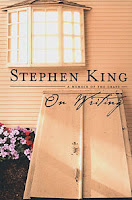 The book I am blogging about today is one I recently read: Stephen King's On Writing: A Memoir Of The Craft (2000). Roger Ebert said it "had more useful and observant things to say about the craft than any book since Strunk and White's The Elements of Style". I also heard it compared favourably to Bird By Bird, so I figured I'd check it out (literally: from the library!).
Plus, I have been on some sort of sideways King kick lately. A month or two ago, I grabbed a couple of paperbacks from the communal book area at work. One was Desperation and one was The Long Walk (which King wrote in one week and published under his Richard Bachman pseudonym). I have not read them, but I've read some literary essays on his work and themes. And my life-long attraction to 1,000+-page books has meant wanting to read either It or The Stand (which King republished in full some years ago, adding hundreds of additional pages) off and on for years.
I read a number of King's books in the early '80s: The Shining, Cujo, Christine, Pet Sematary, and the Night Shift and Different Seasons collections. I have skimmed some of his later work but much of it seems thinly-styled and hokey. I read The Green Mile in 1996, because I thought publishing a novel serially was a fascinating project. But it felt like a first or second draft, as though King needed more time to either tighten things up or fill out his narrative. In some corners of the internet, TGM is cited as one of his best works.
King says On Writing is a guide for how "a competent writer can become a good one". Obviously, he focuses on fiction, which I do not write, but I still enjoyed his uncomplicated love and serious respect for the written word:
But writing in the hopes of publication can also be shitty. It can resurrect - and/or reinforce - your worst feelings about yourself. It can take serious effort to push those voices aside, and carry on. To show up every day - to exercise what talent you have like a muscle. When writing for yourself, or without a deadline, however, it can be hard to keep showing up. No one is waiting for your work. No one will miss it. There is no punishment if you take the day (or week, or month) off. Even thinking that you have to write in order to be a complete person does not make you immune to these other, seemingly contradictory, feelings.
King talks a lot about his own beginning as a writer, though I would not call it a mini-autobiography. He is quite blunt when it comes to addressing his years of drug and alcohol addiction. The most fascinating (and, honestly, hard to believe) statements is when he mentions four books - 'Salem's Lot, Desperation, Dolores Claiborne, and Cujo - and says, "In no case were they plotted, not even to the extent of a single note jotted on a single piece of scrap paper ..."
A first draft - King calls it "the All-Story Draft"; David Foster Wallace labelled his "Zero Draft" (so raw, it comes before the 1st draft) - is banged out as fast as you can, with as little conscious thought as necessary. Otherwise, there's opportunity for self-doubt or self-censorship.
King strives for 2,000 words a day - roughly six double-spaced pages (this post is 1,428 words). Do that seven days a week and you'll have 180,000 words in three months, about the time King says it should take to get a first draft down on paper. King is a rare specimen in that regard. Or maybe that's about right if you've got a clear idea what you want to do and the sailing is untroubled. If you simply want to write an entertaining story, nothing fancy - which is what King does - maybe that's about right. I have no idea. Outside of game stories of athletic events, I have not written anything for publication in that manner. And those rarely topped 750 words. Usually, there are interview transcripts, or microfilm printouts, or internet searches to conduct. I gather a lot of little parts and then try to connect them in a coherent, pleasing order.
Sudden Thought: In many ways, King is like Woody Allen. He's always working, with another book/movie in the pipeline every year or so. This current one may be good, or great, or bad, or boring, but by the time you are reading/watching it, he's already working on the next one. Just wait a bit and see what comes next, maybe it'll be more to your liking.
Three other King quotes from On Writing:
The best book I have ever read in this regard is, hands down, Art & Fear: Observations On The Perils (And Rewards) Of Artmaking (1993), by David Bayles and Ted Orland. It was recommended to me years ago by someone I knew in New York. He said A&F got him through many battles with self-doubt, and waves of excessive and unwarranted self-criticism of both his work and artistic processes. The first half of the book is absolutely indispensable.
Other books I will be revisiting are Anne Lamott's Bird By Bird: Some Instructions On Writing And Life (1994), George V. Higgins's On Writing: Advice For Those Who Write To Publish (Or Would Like To) (1990), and William Zinsser's On Writing Well: An Informal Guide To Writing Non-Fiction (1976).

Plus, I have been on some sort of sideways King kick lately. A month or two ago, I grabbed a couple of paperbacks from the communal book area at work. One was Desperation and one was The Long Walk (which King wrote in one week and published under his Richard Bachman pseudonym). I have not read them, but I've read some literary essays on his work and themes. And my life-long attraction to 1,000+-page books has meant wanting to read either It or The Stand (which King republished in full some years ago, adding hundreds of additional pages) off and on for years.
I read a number of King's books in the early '80s: The Shining, Cujo, Christine, Pet Sematary, and the Night Shift and Different Seasons collections. I have skimmed some of his later work but much of it seems thinly-styled and hokey. I read The Green Mile in 1996, because I thought publishing a novel serially was a fascinating project. But it felt like a first or second draft, as though King needed more time to either tighten things up or fill out his narrative. In some corners of the internet, TGM is cited as one of his best works.
King says On Writing is a guide for how "a competent writer can become a good one". Obviously, he focuses on fiction, which I do not write, but I still enjoyed his uncomplicated love and serious respect for the written word:
If you want to be a writer, you must do two things above all others: read a lot and write a lot. There's no way around these two things that I'm aware of, no shortcut. ...The act of writing, of recording your thoughts, recollections, and opinions, of making them more permanent, fixes them in your mind more concretely than merely thinking about them. Most people have a need to express themselves creatively - writing, painting, cooking, acting, teaching, having a trade, etc. (And I often wonder what works of art we have been deprived of because millions of people have more pressing concerns, like simply living day-to-day.) There is also a concurrent need to be read, heard, acknowledged. But when you write, while you may hope for an audience, you are, at the root, doing it for yourself. Being alone during the creative act - having it play out inside your head - adds to that, I think. And there can be great satisfaction, as King notes, in performing for yourself.
Reading is the creative center of a writer's life. I take a book with me everywhere I go ... the trick is to teach yourself to read in small sips as well as in long swallows. ... [If you watch a lot of TV], it's time to question how serious you really are about becoming a writer. ... Reading takes time ...
[W]hen you find something at which you are talented, you do it (whatever it is) until your fingers bleed or your eyes are ready to fall out of your head. Even when no one is listening (or reading, or watching), every outing is a bravura performance, because you as creator are happy. Perhaps even ecstatic.
But writing in the hopes of publication can also be shitty. It can resurrect - and/or reinforce - your worst feelings about yourself. It can take serious effort to push those voices aside, and carry on. To show up every day - to exercise what talent you have like a muscle. When writing for yourself, or without a deadline, however, it can be hard to keep showing up. No one is waiting for your work. No one will miss it. There is no punishment if you take the day (or week, or month) off. Even thinking that you have to write in order to be a complete person does not make you immune to these other, seemingly contradictory, feelings.
King talks a lot about his own beginning as a writer, though I would not call it a mini-autobiography. He is quite blunt when it comes to addressing his years of drug and alcohol addiction. The most fascinating (and, honestly, hard to believe) statements is when he mentions four books - 'Salem's Lot, Desperation, Dolores Claiborne, and Cujo - and says, "In no case were they plotted, not even to the extent of a single note jotted on a single piece of scrap paper ..."
A first draft - King calls it "the All-Story Draft"; David Foster Wallace labelled his "Zero Draft" (so raw, it comes before the 1st draft) - is banged out as fast as you can, with as little conscious thought as necessary. Otherwise, there's opportunity for self-doubt or self-censorship.
King strives for 2,000 words a day - roughly six double-spaced pages (this post is 1,428 words). Do that seven days a week and you'll have 180,000 words in three months, about the time King says it should take to get a first draft down on paper. King is a rare specimen in that regard. Or maybe that's about right if you've got a clear idea what you want to do and the sailing is untroubled. If you simply want to write an entertaining story, nothing fancy - which is what King does - maybe that's about right. I have no idea. Outside of game stories of athletic events, I have not written anything for publication in that manner. And those rarely topped 750 words. Usually, there are interview transcripts, or microfilm printouts, or internet searches to conduct. I gather a lot of little parts and then try to connect them in a coherent, pleasing order.
Sudden Thought: In many ways, King is like Woody Allen. He's always working, with another book/movie in the pipeline every year or so. This current one may be good, or great, or bad, or boring, but by the time you are reading/watching it, he's already working on the next one. Just wait a bit and see what comes next, maybe it'll be more to your liking.
Three other King quotes from On Writing:
What Writing IsBird By Bird is next.
Telepathy, of course. ... All the arts depend on telepathy to some degree, but I believe writing offers the purest distillation.
[I]f you don't want to work your ass off, you have no business trying to write well - settle back into competency and be grateful you have even that much to fall back on.
You can approach the act of writing with nervousness, excitement, hopefulness, or even despair - the sense that you can never completely put on the page what's in your mind and heart. You can come to the act with your fists clenched and your eyes narrowed, ready to kick ass and take down names. You can come to it because you want a girl to marry you or because you want to change the world. Come to it any way but lightly. Let me say it again: you must not come lightly to the blank page.
Subscribe to:
Comments (Atom)