Sunday, June 28, 2015

Death Merchant #49: Night Of The Peacock

The Death Merchant is in South Yemen, trying to stop Colonel Qahtan al Bin Shaabi (of the People's Democratic Republic of Yemen) from collaborating with various Russian officials on a possible invasion and annexation of North Yemen. Richard Camellion, who claims to abhor racism of any type, is tasked to battle what he refers to as terrorist "sand crabs" in the Middle East.

Night of the Peacock opens with Camellion sneaking up on Rabadh Yahya Tabriz's desert camp. The goal is to assassinate Tabriz, the leader of the Dasni (or Yezidis), who is expected to offer military support to Shaabi. Shaabi needs the Dasni rebels on his side when he attacks North Yemen, and the Soviets need Shaabi and his Marxist goons in an ultimate move against Saudi Arabia. Author Joseph Rosenberger helpfully offers a ton of background information on Yemeni history, outlining the succession of governments, and various coups and actions.

Camellion (as a representative of the CIA) is working with members of Sons of the Falcon, an underground organization in South Yemen, and one that is virulent anti-Shaabi. However, although Camellion and his men kill a few Dasni guards, they are unable to get Tabriz. So they hot-foot it away from the village of Danikil and fly back to Riyadh to discuss their next moves.

Soon, Camellion and eight other men (and 29 camels) are walking across the desert, disguised as Bedouins. They are making their way, over the course of about 10 days, from Al-Lu-baylah (a small oasis on the edge of Rub' al Khali) to the city of Aden. Rosenberger devotes several chapters to the monotonous journey of crossing the "Empty Quarter". They meet other groups of travellers and for awhile you think some violence might break out, but nothing happens.

One thing Rosenberger does in all of these books is provide in-depth descriptions of the cities, the citizens and their customs. They often read like encyclopedia entries - he apparently relied heavily on back issues of National Geographic - and have little-to-nothing to do with the plot, but they do show his high level of research, something that was much harder to do in the early 1980s:
The Death Merchant and his small band, now mingling with a stream of traffic pouring into the city - people of the various Arab tribes riding camels, horses, donkeys; or leading packed camels, horses or donkeys - saw their first Yemeni houses on the northeast side of the city, fortresslike houses built of multicolored stone or brightly painted adobe mud brick, some three stories high. Some houses had tiny windows and crenelated roofs, others layered rows of stone slate jutting out to protect the walls against the seasonal rains.

This was the old spice route and this river of traffic would enter the Crater, the old commercial quarter of Aden. There were three other quarters - at-Tawāhī, the business section, Ma'alah, the native harbor area, and at-Wanani, a small residential section for the wealthy and the influential. ...

There were hundreds of travelers spread out along the stone-paved route, men and women from the various Middle East and African tribes - not all of them Semites as were the Arabs. There were the Hamitic Beja from the northern Sudan, with their copper-red to deep-brown skin; the tall Beraber with their colorful clothes and pretty unveiled women, the arms of the females loaded down with copper and brass bracelets; people of the Zeer, Yafelman, Zemmun and other tribes who spoke the Berber language. And many, many Arabs; the Djerba, the Filala, the kabyle, the Shammar, etc.
In Aden, they meet with Nuri Boustani and his group, Ibn'u Alib Saqr. After learning from Boustani that Shaabi will be departing from the Aden airport in two days, Camellion formulates a plan of attack at the airport. The men with him are not too keen on the idea: "Today we are fire. Tomorrow, we will be ashes."

Nevertheless, the group approaches the airport at night, kills a couple of guards patrolling the perimeters, and steals their uniforms. While wearing the uniforms, Camellion and Colonel bin Maktum are able to commandeer an armoured car, crash a hole in the protective fence and let the rest of the group through. In a repeat of the action described in at least one previous DM book, they drive two armoured cars around the airport, blasting the holy hell out of everything and everyone. With the airport in ruins - Shaabi survives, hiding in one of the hangars - they head towards a Soviet transport plane, in which Camellion aims to have everyone escape.

The action of Camellion flying the plane from takeoff to an extremely bumpy landing in the mountains is pretty suspenseful, even though the reader knows there is absolutely no way that Camellion won't land it safely. (Because this is Rosenberger, Camellion also has random thoughts flitting through his head during the flight, most notably how crime rates have risen in California because of the abolition of the death penalty.) The men meet up with Yadollah I'Zoir, who leads them through the mountains to meet Ali Sa'galli, the head of the Sons of the Falcon. Camellion and Sa'galli have a multi-page conversation about Soviet expansionism, the stupidity of the U.S. government, and the insanity of gun control. The Death Merchant also rants about having to pay five-cent deposits on beer and soda bottles! ("Instead of cracking down on people who litter, they force nonlitterers to pay deposits on beverage bottles to ensure their return.")

Later, the Death Merchant lays out the particulars of Operation Camelback, which will include Sa'galli's fighters, as well as 200 professional mercenaries - Mad Mike Quinlan and his Thunderbolt Unit: Omega. They will be transported to Aden to attack the heart of the capital: the Government House. But Camellion soon receives a message that Shaabi knows their location (his planes have been flying overhead) and is meeting with Tabriz, formulating a plan to attack with a force of 600 men. The Aden attack is aborted and the Death Merchant and Quinlan's and Sa'galli's fighters will immediately attack Tabriz's main camp instead.

Fourteen helicopters transport the men to the site of the attack. First, five of the copters fire tens of thousands of rounds into the village of Danikil. The five copters can fire a total of 36,000 rounds per minute and they lay waste to nearly everyone in the village. All of the copters land and the armed men jump out, ready to finish the attack. Shaabi, his assistant, and the three Russians have taken cover in the Temple of Melek Taus. The fighters go house to house in their slaughter and, eventually, converge on the temple. Camellion blows open the wooden doors with several blocks of RDX explosives and they charge inside. A fierce shootout ensues, with plenty of martial arts fighting. Naturally, the evil doers are killed.

Rosenberger describes the action in exquisite detail, while also telling us the name of every fighter and exactly what type of firearm and ammunition he is using:
Surprise! The atsonished [sic] Dasni were promptly cut to pieces by Manfred "Scarface" Rohde who started raking the area with a Heckler & Koch GMBH G3A4 automatic rifle. With the battered-faced West German, leaning around the broken and jagged wall stones at the south end of the rip in the east wall, were Rashid al-Khaima, firing an Igram [sic] sub-gun, and Carlos Luis Ceron, an Omega merc from Argentina, who was firing short, deadly bursts of 9mm Parabellum slugs from a Belgian Mitraillette Vigneron M2 chatter box; and while the three men saturated the area with streams of high velocity death, other Omega kill experts poured through the ugly gap and stormed forward, running in a crooked pattern. With them came the Death Merchant, ducking and darting, dodging and weaving, an AMP Alaskan in each hand. A 5.45mm AKS projectile spub by his head, only three centimeters from his left temple. Half an eyeblink later, a 9mm Vitmorkin machine pistol slug, fired by Major Vasili Tarasov, almost struck his wrist as his right arm was raised. Instead of hitting flesh and bone and almost tearing off his hand, the flatnosed slug struck the edge of his Seiko, shattered the wristwatch and sent the blown-apart mechanism to the four hot winds.
Etc.:

Camellion's .44 projectile bored into the left side of the Arab's chest and blew open a hole in his body large enough to permit the passage of ping-pong balls.

As happy as a drunken hillbilly with a credit card, Rashid al-Khaima began firing ...

"Well, kiss my transmission!" (this strange expression is actually used twice)

Death Merchant: "I don't want your brain to rush to your head!"

Cooked human flesh has the aroma of a good grade of pork.

Camellion prepared the explosives "all the while wishing he could hear Liszt's Les Preludes - perfect music to kill by".

Sunday, June 14, 2015

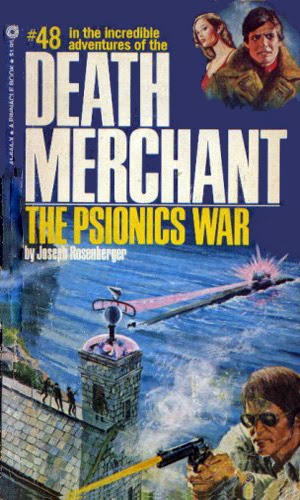
Death Merchant #48: The Psionics War

I miss the goofiness of the earlier Death Merchant books. Joseph Rosenberger's later volumes, while following the same formula, are more serious. They lack the lightness and occasional silliness of, say, the first 20-25 books. But there is still enough to enjoy - and usually enough detailed violence - to keep going.

The Psionics War is a bit light on the carnage, however. Richard Camellion engages in only a couple of small skirmishes before the big finale. For most of this book, we follow the Death Merchant as he plans what he will do later in the book. Chapter after chapter of planning ...

Dr. Wayne Davis is a psionics expert whose research into mind control is of great interest to the U.S. military as a valuable new military weapon. Naturally, his knowledge is also desired by the KGB/Soviet Union. With Davis's Alpha One machine, an operator can focus in on someone miles away and kill him simply by thought. While the U.S. is ahead of the Russians in many aspects of the Cold War, psionics is not one of them. Davis's unit could give them the upperhand if he is willing to share his secrets. The U.S. appeals to his hatred of communism and he agrees. However, the doctor and his assistant (and two CIA men travelling with him) never show up to meet the Death Merchant at Kennedy Airport. Camellion suspects they were somehow kidnapped by the KGB, and it's up to him to find Dr. Davis.

While Camellion walks to his car in the airport parking garage, someone takes a shot at him. He returns fire and ends up killing three men and one woman. Camellion discovers that one of the shooters, a hood named Manny Rich, kept a veterinarian's receipt tucked into a hidden part of his wallet. Camellion plays psychologist and says that Rich kept the receipt safe because it represented his dog, and because he loved his dog, having the receipt represented "psychological comfort".

Camellion and CIA man Merle Duvane talk to the vet who notes that Rich made a strange request. After his dog's operation, he wanted the dog delivered to a different address, to an apartment building in Yonkers. Camellion and a few others go to this building (which Rosenberger calls both the Ark and the Arms at various points) and find KGB agents hustling Arnold Quincy (a friend of Rich's) through the lobby. During and after a brief shootout, Camellion has to kill nine innocent bystanders so there are no witnesses to their presence in the building and nearby alley. (Four of the dead are "black dudes" caught trying to strip their van. One remarks: "Bet they done kidnap that por man they is carryin." Camellion pronounces: "They were trash that interfered. The penalty for that is always death.")

They take Quincy and one of the unconscious Russians to a series of safe houses, including Amityville, New York. They pump the Russian for information, but he isn't cooperating. Camellion, remembering his aversion to rats when chained in the basement of one of the safe houses, devises a coffin-like structure into which the Russian is lain and several rats are let loose on his chest. He freaks out and talks. The Russians plan to take Dr. Davis and his assistant to a farm in Patten, Maine, then to St. John's, Newfoundland, on their way to a weather station on Resolution Island. There is a team of Canadian researchers at that station, but the Russians plan to overpower them.

The Russians plan to conduct an experiment with their own weapon, something called an L-Wave Disrupter, which will cause blackouts in the Canadian capital of Ottawa and also increase murder and suicide rates in the city by means of mind control. They will then take Davis back to Russia.

Camellion and a team of American and Canadian commandos attack a fish oil refinery in St. John's, where Davis was apparently being held. (The Death Merchant is not happy about the set-up: "A white blind honkey in South Chicago would have a better chance!") Nevertheless, they wipe out a lot of the Soviet enemy, and one of the wounded reveals the name of the vessel on which Davis is being transported. After considering all the angles, the Death Merchant decides that they must wait until the Russians take control of the weather station before moving in and grabbing Davis, as well as the Russians' L-Wave Disrupter.

After this decision is made, Rosenberger uses the next several chapters setting the stage. At length. What equipment will Camellion need, how will the various items function, in what order are their tasks going to be completed, what might the Soviets do, and what would each possibility mean, etc., etc. There is plenty of time for this as the men sail to the north. (I have read complaints about Rosenberger's over reliance on planning, and I finally see to what those readers must have been referring.)

The Death Merchant and his team get to Resolution Island at the perfect time - after some of the Russians have taken control of the weather station but before another group has come ashore with four scientists and the L-Wave Disrupter. On the island is "a landscape such as Milton or Dante might have imagined ... inorganic, desolate, mysterious". The Americans and Canadians hide among the rocks and when the Russians come walking along to the station, they open fire. Camellion's group also engages in a healthy amount of hand-to-hand combat. The second group storms the weather station and is able to surprise the Russians so completely that they are overwhelmed.

Having won the battle on the island, Camellion et al. notice that the Soviet submarine is moving straight towards the shore and soon begins shooting 75mm shells at the station building. The men get down to the shoreline, but realize that if they try to travel back to their ship, the submarine will likely target them. At the last minute, a wounded Dr. Davis speaks up - and offers his secret knowledge in order to destroy the submarine. It's pretty nutty resolution. Davis draws an outline of a submarine on a piece of paper and writes the name of the sub (Eugene Origen) on it. Then he asks Camellion to fire a bullet through the crude drawing of the sub. Davis then places the paper with the hole in it in the "well" of the L-Wave Disrupter and begins turning a few knobs. (Rosenberger spends two pages explaining the science behind all of this.) And sure enough, there is soon an explosion from out in the harbour - the submarine has exploded! As one of the men says, psionics "is the weapon of the future, and the future is now!"

The end.

Etc:

While including a bunch of information on government mind control experiments and other parapsychological research (telepathy, precognition, telekinesis, out-of-body experiences, remote viewing), Rosenberger mentions, in a footnote on page 8, that while working as a "Security Officer", he "was forced to kill three men" and he had an out-of-body experience afterwards. He gives no other details.

"People need religion," [Camellion] said. "It gives the little morons the means by which they can halfway triumph over big bad death. The average man fears death because he fears the loss of human identity and integrity in a transient stream of atoms. He doesn't know it but his anxiety over so-called 'death' results from nothing more than the frustration of not being able to have life without death, that is, of not being able to solve a nonsensical problem. ... But the Cosmic Lord of Death gets them all in the end..."

While being held by the Russians, Dr. Davis refers to the Soviet Union as "that big pigpen" - an odd insult, yet similar to Camellion's often-used slur "pig farmers".

"Sweating more than a Black Muslim who had been caught spying at a KKK rally, Brown stopped, threw up his arms and tried to twist his gorillalike face into a friendly grin."

"Like people, neighborhoods change. While Tenth Avenue [in Yonkers, New York] was not exactly a slum area, the neighborhood was not of a type where one found the best people. ... Minority groups had moved into the area."

"Merle Duvane was busier than a one-toothed mouse in a roomful of cheddar."

"You might as well try to convince me that a doughnut is a pregnant Cheerio."

"He looked as oily as a corporate head and as scared as an Arab at a Barmitzvah!"

"I understand," Moan said, "sounding as cranky as an old maid who had discovered a man wasn't under her bed."

The Death Merchant calls out someone for making a racist remark, saying the speaker's mind is obviously not "cluttered up with facts and knowledge". However, after receiving a coded message about his next mission, Camellion muses, "I don't like the desert and I like sand crabs and their Moslem crackpotism even less."

During the final fight, a Russian yells, "Idyi zho ssat ya natyb yahachoo!" Rosenberger footnotes this (presumably nonsense) phrase: "Too vulgar to be stated in English."

Wednesday, June 03, 2015

Stephen King: Cell (2006)

At 3:00 PM on a sunny October afternoon in Boston, graphic novelist Clay Riddell witnesses the beginning of the end of the world. As he later learns, an electronic pulse has been sent out over all cell phone lines, turning anyone who is using a phone into a violent, mindless zombie; people who later use cell phones - such as in response to the ensuing carnage - are also affected.

Stephen King exercises his anti-technology muscles in Cell, a 350-page book that would have worked much better for me as a novella. The main plot concerns Riddell travelling on foot to his home in Maine, hoping to learn the fate of his 12-year-old son Johnny.

Soon after the Pulse (as it is called among the group of survivors we follow), Clay meets up with a middle-aged man named Tom McCourt. At first, they wonder if this is another terrorist attack. Hearing huge explosions coming from the direction of Logan Airport, Tom cries, "The bastards are doing it by plane again." King's description of the air full of "fine dark ash" from numerous fires evokes downtown Manhattan on 9/11. The diaspora after Hurricane Katrina is also mentioned later in the novel.

A little while later, the two men are joined by a teenaged girl named Alice Maxwell. The three self-described refugees head out of Boston on foot to Tom's house in the suburb of Malden - and then head further north from there, as Clay is obsessed with getting back to his house near Kent Pond in Maine.

The theory in Cell is that the Pulse has wiped out the minds of its victims, like a virus wiping out a computer's hard drive. However, the "phone-crazies" seem to evolve quickly and are soon acting in concert and roaming around in packs. The Pulse has removed the thin veneer of civilization from many citizens and they have reverted back to a more primordial state. A university professor tells Riddell and the others that
man has come to dominate the plant thanks to two essential traits. One is intelligence. The other has been the absolute willingness to kill anyone and anything that gets in his way. Mankind's intelligence finally trumped mankind's killer instinct, and reason came to rule over mankind's maddest impulses. ... [M]ost of us had sublimated the worst in us until the Pulse came along and stripped away everything but that red core.
Besides the thinness of the plot and some rehashed ideas from The Stand (characters communicating through dreams, being drawn to something or a force they have been dreaming about), King has a number of annoying tics that ruined what little pleasure I took from the book. He has the habit of repeating facts, events, and descriptions of people throughout the narrative, as though he doesn't trust his readers to remember what has happened or who a character is. This happens dozens and dozens of times in Cell, and this one example will suffice as an illustration: On page 126, "a man with a pair of flashlights rigged to a kind of harness [on his head]" introduces himself as "Mr. Roscoe Handt of Methuen". A mere three pages later, on page 129, King writes: "... and by four o'clock they were nearing Methuen, hometown of Mr. Roscoe Handt, he of the stereo flashlights".

King also writes a lot of sentences along the lines of "Clay didn't know why he thought that, but he did." In addition, the characters spitball theories about the "phone-crazies" and sort of agree on one possibility. That is then used for the rest of the book as a proven fact and the crazies act accordingly. I see this as a sly trick to push the plot forward among a group cut off from everyone else, but it isn't very well hidden - and it happens a lot in Cell.

Online reviews of the book were mixed. Blog Critics stated that "Cell represents a refreshing, grizzly, creepy and often powerful exploration of the nature of humanity ... [T]he brilliance of Cell is how King manages to mix exploration of humanity with a powerful and engaging apocalyptic story." Pop Matters published a glowing rave: King "creates a kind of sickening dread that only gets deeper as the novel continues. ... [T]he overwhelming feeling of helplessness, fatalism and inevitability makes Cell one of King’s most potent page-turners."

Others faulted King for "flat characters and flatter dialogue". Although King is usually quite good at creating full characters, I agree with this last assessment.

Next: Lisey's Story.

Sunday, May 24, 2015

Memorial Day: "Please Don't Thank Me For My Service"

Camillo Mac Bica:
[P]lease do not thank me for "my service" as a United States Marine. I make this request because my service, as you refer to it, was basically, either to train to become a killer or to actually kill people and blow shit up.

Now, that is not something for which a person should be proud nor thanked. In fact, it is regrettable, and for me a source of guilt and shame, something I will have to live with for the rest of my life, as the past cannot ever be undone. So, when you thank me for my service, it disturbs me ... a lot. ...

Where is the honor, glory and nobility in killing and dying for greed, incompetence, and paranoia? ...

[I]f you really insist on thanking me for something, do not thank me for the eight years I spent as a Marine, but for the 45 or so years following my discharge from the military that I have spent as an activist fighting for human rights and social justice and to end the insanity of war. ... [I]f you truly want to demonstrate your good character, patriotism, and support for the troops and veterans, rather than merely mouth meaningless expressions of gratitude for something you don't truly understand or care much about, do something meaningful and real. Do what is truly in the interest of this nation and of those victimized by war.

Make some demands.

Demand, for example, an immediate end to the corporate takeover of our "democracy" and to the undue influence of the military-industrial-Congressional complex. Demand sanity in Pentagon spending and a reallocation of finite resources to people-focused programs such as health care, education and jobs rather than to killing and destruction. Demand an immediate end to wars for corporate profit, greed, power and hegemony. Demand that we adhere to the Constitution and to international law. Demand accountability for those who make war easily and care more for wealth, profit and power than for national interest or for the welfare of their fellow human beings. And finally, demand the troops be brought home now, and that they be adequately treated and cared for when they return.
tazman69er:
There are numerous points I would like to make in this proclamation, yet, if you only take away one thing, please, don't ever thank me for my "service." For when you thank me for my service, you are thanking me for being a dupe, an unconscious human being, engaged in the enterprise of state sanctioned murder to an "other, over there." ...

When you thank me for my service, you are unconsciously re-affirming your belief that somehow we are fighting "them, over there" so we "don't have to fight them here." You are telling me, "thank you for putting on a state sanctioned uniform costume and murdering 'them' for me, while I look away from the awfulness of state sanctioned murder." ...

My service was nothing other than committing state sanctioned murder on behalf of a bunch of old (mostly white) guys and gals with their own agendas, without regard for humanity. I don't want to be thanked for that. ...

Every time someone thanks me for my "service," it only brings back all of the emotion, guilt and shame for having been duped into the enterprise of war in the first place.
Michael Krieger:
[W]henever I find myself in the midst of a large public gathering (which fortunately isn't that often), and the token veteran or two is called out in front of the masses to "honor" I immediately begin to cringe as a result of a massive internal conflict. On the one hand, I recognize that the veteran(s) being honored is most likely a decent human being. Either poor or extraordinarily brainwashed, the man or woman paraded in front of the crowd is nothing more than a pawn. ...

On the other hand, the entire spectacle makes me sick. I refuse to participate in the superficial charade for many reasons, but the primary one is that I don't want to play any part in the crowd's insatiable imbecility. It's the stupidity and ignorance of the masses that the corporate-state preys upon, and that's precisely what's on full display at these tired and phony imperialist celebrations.
Phil Rockstroh:
Rather than continue to memorialize it, let's bury a reeking heap of noxious and obnoxious mythos: US soldiers did not and do not kill and die defending freedom. The soldiers of militarist empires are not sent to war for any noble purpose. They are trained killers and their mission is conquest in the name of power and for the purpose of plunder. And that is the reason that it is imperative for the beneficiaries of said power and plunder to make sacred the obscenities that the soldiers of empire perpetrate.

This is the task of the hagiographers of war: To make noble and heroic mass murder; to banish any lingering trace of the stench of death. All voices of doubt must be shamed and silenced -- for the lie is fragile.

If the mortifying truth was known then fielding new recruits would prove a daunting task. The empire would be hobbled. Empire's patrician class would have to seek honest work. Sounds like a plan to me.

Memorial day is a marketing roll out. If you desire to make meaningful the deaths of those lost to wars then cease believing the lies of those who grow wealthy from the hideous business of waging it.

Saturday, May 23, 2015

Death Merchant #47: Operation Skyhook

After pretty much ignoring the entire plot of Blood Bath, and focusing my attention instead on the various characters' political comments, I'm doing something different with Operation Skyhook. I'll summarize each chapter as I go along.

Back cover: "Out Of Orbit". A test version of a Russian satellite "armed with lasers" crash-lands in Indonesia and the Death Merchant - "the slickest, cruelest saboteur in the business" - must race the KGB (and the Indonesians) to nab the dangerous oktok-1.

Chapter 1: After Richard "Death Merchant" Camellion meets with CIA agent Forrest Dasher at a warehouse a few miles outside of Jakarta, they are ambushed coming out of the building. Dasher is killed; Camellion ducks back inside. He eventually kills two three-man teams of Russians and makes his escape back to the city. He thinks about the mission. (It turns out that the name of the satellite is misspelled on the back cover! It's actually Votok-1.) The US managed to override the satellite's electrical instructions and it parachuted to Earth, landing in the mountains of Indonesia. It is now apparently hidden somewhere near Jakarta. The US must possess the inner workings of the satellite at all costs, as it trails the Russians in the space weapons race.

Chapter 2: Colonel Andrew Uzhgorod heads a meeting the following morning at the Soviet Embassy in Jakarta. The Russians debate the encounter at the warehouse and offer all sort of exposition about how they tracked Dasher to the meeting. They also have an informer in the town who saw soldiers, technicians, and other Indonesians dismantling Votok. One of the Russians suspects that the lone agent who wiped out the six would-be assassins was the Cempt Tobtocpam (the Death Merchant).

Chapter 3: More discussion as Camellion (using the name James George Valdorian, a travel journalist) meets with six other men (CIA, SIS and Western Germany military intelligence) at a Jakarta safe house. They suspect that Uzhgorod is the Chief of Station at the Embassy and Camellion suggests they "blackbag" him at his house. (The men recoil in surprise, calling it a "high-octane hazard" and "suicide"). Camellion also requests a map of the city's power generating plant.

Chapter 4: Camellion and Lester Cole are near Uzhgorod's house. Cole is setting up "Mister Fuck-Up", a Microwave Impedator that renders all audio and motion detectors and alarms, etc. useless. When a diversionary explosion at the power plant plunges Jakarta into darkness, the Death Merchant goes to work, cutting a hole in a chain-link fence, killing a guard with a 2-inch steel needle coated with pure nicotine, picking the front door lock, and going inside the house. But it's a trap! Uzhgorod and four KGB attempt to take him alive, but Camellion, using martial arts and his Browning, manages to escape, but he has to kill Uzhgorod to do so.

Chapter 5: Camellion and Cole are on their way back to the getaway car when the Death Merchant has a strong hunch they might be walking into a trap. They use some listening devices and it turns out there are seven members of the Secret Police Agents hiding near the car. C&C split up and circle around and wipe out the goons with bullets and thermate. Three other cars approach and they eliminate them, as well. They steal one of those cars and drive away.

Chapter 6: Major-General Mashuri and Colonel Thojib Sadli of the Indonesian Army discuss events and suspect the two Americans are CIA agents. Although Valdorian and Cole are unlikely to return to their hotel rooms, there are agents waiting just in case. They suspect the explosion at the power plant was a distraction before the kidnap attempt. They must find the Americans, but also suspect that they might be the Americans' next target.

Chapter 7: On a balmy fall day in Tjikini Market, an elderly Chinese man (Camellion in disguise) walks around. Camellion planted listening devices in his hotel room and as they get close to the building, they can hear conversations from the waiting assassins. ("Screw a crippled crab!") He and Cole go instead to the Brass Palace to meet with Chao Bing Thepkok and his assistant. It's unclear why they go to this place, but Thepkok says the local police (GROB) were in asking about Valdorian and Cole, and they had photographs. GROB agents are returning and the four men make their escape through a tunnel accessed from the back room. Camellion leaves behind some explosives to destroy the building and kill the agents. The tunnel exits in a garage owned by Thepkok. Cole kills Thepkok and his assistant and he and Camellion escape in a Toyota. More planted RDX destroys the garage, killing 67 people who live nearby.

Chapter 8: At Soi-Simokk safe house. Pessimism over not finding Votok. The likelihood of nabbing Kdija or Sadli, who are very well-guarded, is small. Maybe they could grab one of their underlings. Camellion needs information on the men surrounding Kdija and Sadli. (Also a quick narrative diversion to call Indonesia food "slop".)

Chapter 9: The Death Merchant decides to get Captain Kuwloon at his apartment in the Morning Rose apartment complex in the middle of the night. GROB has agents across the hall and in the adjoining room and has planted listening devices throughout Kuwloon's apartment. Camellion and Cole sneak in the back of the building, while three others go in front of the apartment house and kill the desk clerk. "Sleeping peacefully, the numerous residents of the apartment house didn't realize that the Cosmic Lord of Death was about to descend on the Morning Rose ..."

Chapter 10: Up the elevator to the 9th floor. Camellion and Cole break into the apartment and quickly kill the 2 half-asleep GROB agents acting as guards. They head for Kuwloon's bedroom and gather him, his wife, and children in one room. Cole has found listening devices and tells Camellion. Camellion takes his Auto Mags and fires through the walls into the adjoining apartments, killing several men and confusing the others. Cole comes out of the bedroom saying that GROB has hidden Votok "in the temple of Pura Besakih on Bali". It turns out he has also killed the entire family; Camellion is upset because Cole disobeyed orders. The surviving GROB agents from the other apartments attack, but they are stopped by a greenish gas ("diphenycyanoarsine") and shot.

Chapter 11: Alkenazy, the next day, discusses the attack on the apartment. The KGB also has information on Votok, as a female agent slept with Indonesia's Minister of the Interior. Now, with the KGB and CIA knowing the true location of Votok, the race is on! It is thought that both sides will use helicopters to bring troops to the side of the mountain.

Chapter 12: The CIA doesn't want to use any American personnel for this mission, so Camellion calls on Mad Mike Ryan and his Thunderbolt Unit: Omega (who apparently will make future appearances in the series). Nine Boeing-Vertol CH-49 copters head towards Mount Agung. They pick up 12 aircraft to the east on radar - Russian copters! But they decide not to fire on them, choosing to have the battle on Gunung Agung, near Pura Besakih, the fabled Hindu temple.

Chapter 13: Fighter jets start the battle from the air, raining down missiles on the temple and the surrounding area. The Indonesian army - a force of 3,000 - is in the clearing around Pura Besakih, but are undertrained and uncertain about firing their weapons. They are summarily slaughtered by both the US and Soviet fighters jets and by the guns aboard the helicopters.

Chapter 14: The Indonesians believed that only the Americans would be attacking and are stunned when the Russians also appear. After jumping out of their copters on opposite sides of the temple area, both the Americans and Russians begin firing missiles at the closest wall of the temple, as whoever gets inside the temple first will have a great advantage in finding the satellite. Both sides plan to lay down a cover of smoke grenades and make a straight-in charge.

Chapter 15: On the DM's side, they race to the temple and are not fired upon by what remains of the Indonesian force. Tossing in grenades and firing machine guns, both sides pour into the temple at nearly the same time. The US has an advantage as they have specially-rigged crossbows that can carry grenades - which they fire across the Sanctum area to where the Russians are. "Two Black Berets and a Soviet Marine became an assortment of arms, legs, and bloody, twisted entrails."

Chapter 16: Camellion, Cole and six mercenaries are hiding behind a huge statue of Siva when they realizes there may be Indonesians hiding inside. There is: Kdija, Sadli, and three others. The DM tosses in a couple of grenades, blowing them apart. Upon inspecting the damage, he spies a door to an underground room and surmises this is where the satellite is being hidden. He plants explosives - and blows the statue apart. When it comes crashing down, it crushes 74 Russian troops. Then Camellion places five blocks of HBX on the underground crates, set the timers, and make their escape. "Once more World War III had been avoided. There would be peace ... for a time ..."

The climatic battle in Operation Skyhook is pretty weak, with Rosenberger offering very little violent interaction between the two forces. Each side goes about its business without much interactions from the other. And the ending comes too abruptly, as though Rosenberger had reached his page limit and wanted to quickly wrap things up.

Etc.:

"Nothing ever came easy in this business - except dying, and I won't be lucky enough to die by a bullet. I'll probably end up broke and living to be ninety, spending my days counting mule fritters!"

..."blowing a hole in the man the diameter of an averaged-sized orange".

"[Camellion fired] seven rounds, three of which struck Sibramanian, killing him faster than a Jew travelling through Damascus on a pogo stick."

"Killing the sons-of-bitches would be as easy as using a shotgun to shoot a baby whale in a bathtub ..."

"Ever look into those eyes of his? I mean really look? It's like a dozen ice picks playing 'Chop Sticks' on your spine."

Rosenberger continues to flip-flop as far as how much information about the Death Merchant is known to foreign governments. Sometimes Camellion is infamous in the spy underworld; other times, like in Operation Skyhook, his identity is not known to any KGB/GRU agents.

Rosenberger mentions Jeff Cooper, who runs something called The American Pistol Institute in Paulden, Arizona. Cooper is quoted several times during the DM's attempted kidnapping of Uzhgorod. Like the oft-mentioned Lee Jurras, Cooper and his Institute are real. Now called Gunsite Academy, it "offers firearm training to elite military personnel, law enforcement officers and free citizens of the US".

Sunday, May 10, 2015

Three Books Examining The Writing Of David Foster Wallace

Here is some information on three books examining the writing of David Foster Wallace. The first one was published last month and the other two will be published in early 2016.

Freedom and the Self: Essays on the Philosophy of David Foster Wallace
The book Fate, Time, and Language: An Essay on Free Will, published in 2010 by Columbia University Press, presented David Foster Wallace's challenge to Richard Taylor's argument for fatalism. In this anthology, notable philosophers engage directly with that work and assess Wallace's reply to Taylor as well as other aspects of Wallace's thought.

With an introduction by Steven M. Cahn and Maureen Eckert, this collection includes essays by William Hasker (Huntington University), Gila Sher (University of California, San Diego), Marcello Oreste Fiocco (University of California, Irvine), Daniel R. Kelly (Purdue University), Nathan Ballantyne (Fordham University), Justin Tosi (University of Arizona), and Maureen Eckert. These thinkers explore Wallace's philosophical and literary work, illustrating remarkable ways in which his philosophical views influenced and were influenced by themes developed in his other writings, both fictional and nonfictional. Together with Fate, Time, and Language, this critical set unlocks key components of Wallace's work and its traces in modern literature and thought.
The Unspeakable Failures of David Foster Wallace: Language, Identity and Resistance
This book examines the writing of David Foster Wallace, hailed as the voice of a generation on his death. Critics have identified horror of solipsism, obsession with sincerity and a corresponding ambivalence regarding postmodern irony, and detailed attention to contemporary culture as the central elements of Wallace's writing. Clare Hayes-Brady draws on the evolving discourses of Wallace Studies, focusing on the unifying anti-teleology of his writing, arguing that that position is a fundamentally political response to the condition of neo-liberal America.

She argues that Wallace's work is most unified by its resistance to closure, which pervades the structural, narrative and stylistic elements of his writing. Taking a broadly thematic approach to the numerous types of "failure", or lack of completion, visible throughout his work, the book offers a framework within which to read Wallace's work as a coherent whole, rather than split along the lines of fiction versus non-fiction, or pre- and post-Infinite Jest, two critical positions that have become dominant over the last five years. While demonstrating the centrality of "failure", the book also explores Wallace's approach to sincere communication as a recurring response to what he saw as the inane, self-absorbed commodification of language and society, along with less explored themes such as gender, naming and heroism.

Situating Wallace as both a product of his time and an artist sui generis, Hayes-Brady details his abiding interest in philosophy, language and the struggle for an authentic self in late-twentieth-century America.

This title will be released on February 25, 2016.
The Gospel According to David Foster Wallace: Boredom and Addiction in an Age of Distraction
The Gospel According to David Foster Wallace is the first book to explore of key religious themes - from boredom to addiction, and distraction - in the work of one of America's most celebrated contemporary novelists.

In a series of short, topic-focussed chapters, the book joins a supercut of key scenes from Wallace's novels Infinite Jest and The Pale King with clear explanations of how they contribute to his overall account of what it means to be a human being in the 21st century. Adam Miller explores how Wallace's work masterfully investigates the nature of first-world boredom and shows, in the process, how easy it is to get addicted to distraction (chemical, electronic, or otherwise). Implicitly critiquing, excising, and repurposing elements of AA's Twelve Step program, Wallace suggests that the practice of prayer (regardless of belief in God), the patient application of attention to things that seem ordinary and boring, and the internalization of clichés may be the antidote to much of what ails us in the 21st century.

This title will be released on February 25, 2016.

Sunday, May 03, 2015

Death Merchant #46: Blood Bath

It would be wrong to call the first half of Blood Bath a pro-apartheid tract, but it is tempting.

First, as he did in Operation Thunderbolt (DM #31), author Joseph Rosenberger provides an explanatory note about the language he will be using:
"In this book there will be certain words and phrases, terms and racial vulgarisms, that are in current usage among white groups in the Republic of South Africa. These words and terms are not meant as racial insults to any group. We use them only for the effects of realism."
Then, the quotation at the beginning of the book is from none other than the Death Merchant himself, Richard J. Camellion of Votaw, Texas:
"The fight of the South Africans against Communist-motivated terrorists such as the Southwest Africa People's Organization [SWAPO] can be compared to the struggle of the Israelis to keep their homeland from being flooded by a tidal wave of Arabs."
This sentiment is 180 degrees from past comments made by Rosenberger's main character. Not that long ago, Camellion was mercilessly ripping the Israelis for their racist and violent policies towards the Palestinians. But now, Israel is the suffering underdog.

In Blood Bath, the Death Merchant is brought in to assist South Africa's Bureau of State Security ("BOSS") in assassinating Samuel Nujomo of SWAPO and KGB Colonel Josef Markevski, both of whom are fighting for equality in South Africa and an end to apartheid.

Although the book's boilerplate states, "All the characters ... portrayed in this book are fictional, and any resemblance to real people ... is purely coincidental", Nujomo is clearly meant to be Samuel Nujoma, a Namibian anti-apartheid activist. (In fact, the text on the back of the book gives the character's name as "Sam Nujoma"!) Likewise, another character is South African Prime Minister Bitha (a stand-in for the actual PM from 1978-84, P.W. Botha).

Since Camellion is working closely with white nationalists, the reader gets a steady diet of pro-apartheid and anti-black rhetoric, including a 7½-page (!) conversation early in the book. A small sampling of the discussion:
Pieter derMeer (BOSS): "Blacks are cheeky in any country; it's their nature. But I guess you Americans think we Afrikaners behave like SS men toward our natives?"

Frank Stockwell (CIA): "Not at all - at least I don't. Our American blacks have chased us out of our cities. Of course, the real fault lies with the do-gooders and other dreamers in our government. It's their preposterous theories that have resulted in bussing and integration. ... Whites are ever discriminated against in jobs. You see, our damn fool lawmakers are 'minority happy.'"

Earl Moorland (BOSS): "You can't mix the races and have any kind of culture, any kind of values."

derMeer: "In South Africa, we have more common sense. ... That is why we have apartheid."

Moorland: "Some races are prone to extreme violence. The black race heads the list. The Mexicans invading your [US] southern borders are another example."

derMeer: "On a weekend there are maybe a hundred thousand drunken blacks in Soweto. ... And you'd have us make those savages our equals! ... Do you know what would happen to us if we made them our equals? Hundreds of years of civilization would collapse overnight."

derMeer: "Another thing you don't know - most foreigners don't - is that we whites didn't create the black states. Neither did our ancestors. The black states were determined by the settlement patterns and migratory movements of the black races in past centuries, more or less in the same way the location of countries in Europe was determined."

Moorland: "The worst charge against us is that we are fostering institutionalized segregation. The foreign media have twisted the real meaning of apartheid beyond recognition. ... The foreign press insists on confusing apartheid with discrimination , and the more we try to explain it, the more we're accused of modern slavery."

Nick Vister (BOSS): "It's the implementation of apartheid that actually permits us to safeguard the national identity of the various black people within our borders."

Camellion: "I really couldn't care less what you South Africans do in your own country, or for that matter on the continent of Africa. Neither does the average American. It's the liberals of the world you have to worry about. Their approach to most problems, especially to the problem of crime, is the infantile assumption that the identifying of a problem can immediately be solved by a solution, usually through government action. They have had the solution to the 'South Africa Problem' for years. All you do is make everyone equal ... Naturally your society would fall apart."
After Camellion's comment: "The three BOSS agents smiles. Here was a man who was a realist."

During the discussion, CIA agent Robert Duigen offers a different view: "Sure, the blacks over here are explosive, but in a sense you can't blame them." And he mentions a section of the Bantu Urban Areas Consolidation Act, requiring blacks to carry passbooks, proving they had a right to be wherever they were. But it's merely a blip during the long, one-sided conversation. (Late in the book, Duigen shows his racist side, referring to Cubans as "chili peppers" and bemoaning the hordes of immigrant "trash" allowed into the United States.)

It is not until halfway through the book that Camellion offers somewhat of a rebuttal to the steady flow of pro-apartheid comments - but his comment is immediately dismissed.
One has to analyze the situation from the standpoint of the colored people. As far as they're concerned, they're still second-rate citizens. Right after I arrived in South Africa, I recall a mulatto telling me, "They bring in these goddamned Italians and Greeks here who can't begin to speak any of the languages of the country and treat them equal, like white men. I speak English, Afrikaans and a little Xhosa and have lived here all my life, yet I can't even ride on the same bus with those bastards. Don't give me any propaganda bullshit about apartheid preserving a culture or nationalism!"
Arnaud van Wyk replies: "Whoever told you that is a good-for-nothing liar. Most of those half-breeds are nothing but a bunch of drunks. ... We whites must preserve our identity and culture."

Throughout the book, the anti-black asides pile up: Blacks are "existing in one long night of ignorance" despite Afrikaners' "attempts to educate them". ... "Whoever heard of a bunch of dumb niggers being able to rule themselves intelligently?" ... "Sadists, savages and murders who would turn this nation into a Marxist hell."

At one point, derMeer states: "There's every indication that your President Reagan and his administration are on our side." (But we still get Camellion thinking about Jimmy Carter's "Girl Scout leadership" during the Iranian hostages situation. "The Iranian camel lovers released the hostages because they wanted to get rid of them. They were frightened stiff of our new President." The Death Merchant then thinks how he'd like to use nerve gas on the entire country of Iran and slit the throat of every Iranian living in the United States.)

It is clear that Camellion has been hired to execute Nujomo because Nujomo has become too popular and is seen as a threat to the pro-apartheid rulers. Nujomo is planning a nationwide revolution and must be stopped before he broadcasts the day and time of the revolt via radio. The end of apartheid would be "a severe [economic] setback for the west, especially the United States" as there are vital minerals that can be obtained only from South Africa. Camellion thinks: "I'll be damned if I'll see Namibia fall into the hands of black commie savages controlled by these damned pig-farmers in the Soviet Union."

Etc.:

"To the Death Merchant the Reverend Verkramptes and his wife were the same kind of simpletons who had been well on the way toward wrecking the United States before the 1980 presidential election. In the US it was halfwits like the Verkramptes who would deify a murdered rock star [John Lennon, presumably], all the while forgetting that he was nothing more than a non-talent Pied Piper who helped lead millions of teen-agers down the wide road of drugs, rebellion and purposelessness. The same kind of liberal morons would hand the republic of South Africa, the most stable and advanced nation in all of Africa, over to millions of ignorant, bloodthirsty savages."

"Getting the Verkramples to tell all they knew was easier than making a wino accept a fifth of 'Sweet Lucy'".

"We should put him up in a suite at the Hotel Stupid!"

"Vaguely wondering why lovers close their eyes when they kiss - the psychological explanation is self-annulling - Camellion fired both Backpacker Auto Mags."

Two Camellion quips, before wasting someone: "You silly slob. You couldn't steal a banana from a drunken monkey!" & "You couldn't outdraw a crayon, you poor halfwit!"

Saturday, May 02, 2015

On Urban Riots

Urban riots must now be recognized as durable social phenomena. They may be deplored, but they are there and should be understood. Urban riots are a special form of violence. They are not insurrections. The rioters are not seeking to seize territory or to attain control of institutions. They are mainly intended to shock the white community. They are a distorted form of social protest. The looting which is their principal feature serves many functions. It enables the most enraged and deprived Negro to take hold of consumer goods with the ease the white man does by using his purse. Often the Negro does not even want what he takes; he wants the experience of taking. But most of all, alienated from society and knowing that this society cherishes property above people, he is shocking it by abusing property rights. There are thus elements of emotional catharsis in the violent act. This may explain why most cities in which riots have occurred have not had a repetition, even though the causative conditions remain. It is also noteworthy that the amount of physical harm done to white people other than police is infinitesimal and in Detroit whites and Negroes looted in unity.

A profound judgment of today's riots was expressed by Victor Hugo a century ago. He said, 'If a soul is left in the darkness, sins will be committed. The guilty one is not he who commits the sin, but he who causes the darkness.'

The policymakers of the white society have caused the darkness; they create discrimination; they structured slums; and they perpetuate unemployment, ignorance and poverty. It is incontestable and deplorable that Negroes have committed crimes; but they are derivative crimes. They are born of the greater crimes of the white society. When we ask Negroes to abide by the law, let us also demand that the white man abide by law in the ghettos. Day-in and day-out he violates welfare laws to deprive the poor of their meager allotments; he flagrantly violates building codes and regulations; his police make a mockery of law; and he violates laws on equal employment and education and the provisions for civic services. The slums are the handiwork of a vicious system of the white society; Negroes live in them but do not make them any more than a prisoner makes a prison. Let us say boldly that if the violations of law by the white man in the slums over the years were calculated and compared with the law-breaking of a few days of riots, the hardened criminal would be the white man. These are often difficult things to say but I have come to see more and more that it is necessary to utter the truth in order to deal with the great problems that we face in our society.
Martin Luther King, Jr., September 1967


Friday, May 01, 2015

40 Years Ago: Stones Play "Brown Sugar" On A Flat-Bed Truck On Fifth Avenue

Forty years ago - May 1, 1975 - the Rolling Stones played "Brown Sugar" while on a flat-bed truck driving down Fifth Avenue in New York City. News of the band's "Tour of the Americas" was announced later that day.


Brown Sugar (with radio DJs)


News report


More footage

Friday, April 24, 2015

Death Merchant #45: The Rim Of Fire Conspiracy

In The Rim Of Fire Conspiracy, Joseph Rosenberger reworks the plot of The Bermuda Triangle Action (DM #37), in which the Russians attempt to plant hydrogen bombs in the fault lines off the Atlantic coast, hoping to cause unimagined destruction to the southern and eastern United States.

This time, the "pig farmers" are drilling deep into the various fault lines off the west coast. Indeed, the U.S. determines that the May 1980 eruption of Mount St. Helens was likely caused by the testing of a Russian nuclear device buried nine miles deep in the Earth, along the Pacific Plate. Future (and more powerful) explosions could trigger hundreds of now-dormant volcanoes along the Cascade Range, a stretch of 700 miles from British Columbia to northern California (referred to here as the Rim of Fire).

When Rosenberger switches to the Russian POV, we learn how the Soviets are digging the holes (with a laser) and planting the devices.

At the CIA's main station in Los Angeles, Richard Camellion is in a meeting during which a lot of information about Plate Tectonics Theory, volcanoes, and earthquakes is being discussed. Camellion asks several questions, specifically, what if multiple hydrogen bombs were buried deep in fracture zones and detonated (i.e., exactly what it turns out the Russians are planning to do)?

Through an unbelievable coincidence, the U.S. discovers a KGB agent in an Anchorage, Alaska, drug store. It turns out there is a KGB cell in the town, possibly monitoring the seismic waves from the various Soviet bomb tests. Camellion and a team of commandos head to Anchorage and invade a hotel run by Harry and Sally Bella, who are hiding the Russians (disguised as a group of British businessmen looking to buy some land).

After the raid on the hotel, someone notes that Sally Bella was injured. (This is a good example of how Rosenberger's personal opinions (I assume) get inserted into the narrative.)
"What about the woman?"

"Oh, she's all right. She has a swollen jaw, but it's not broken. She's mumbling about 'suing' us for 'invasion of privacy'! Have you ever heard anything more silly and ridiculous?"

"Yes, I have," Camellion snickered. "Like, Lee Harvey Oswald shot John F. Kennedy or that 'Deep Throat' in Watergate was a 'patriotic citizen' only doing his duty for 'the nation,'" He became serious. "We'll have a doctor check them at Elmandorf [Air Force Base] before we take off for California."
On the next page, the Death Merchant reveals that Deep Throat "was actually a KGB mole, a money-loving son-of-a-bitch that the Company managed to turn around".

After the Alaskan hotel raid, Camellion is on a nuclear sub, the Albatross. Questioning the captured Russians gives the U.S. information about two Soviet bases, one in Roca Oneal, in the Revillagigedo islands, and another in San Cristobal, one of the Galapagos islands. The Roca Oneal base is attacked and destroyed by a separate military group, so it's up to Camellion and 150 others to storm the San Cristobal island base and destroy it.

Three days after that mission, they are on another sub on their way to invade the top submarine in the Russian fleet, the Aleksandr Pushkin. After five helicopters riddle the sub with shells, the Death Merchant and the other men rappel down onto the sub and blast their way in. (I'm not sure why the Russian sub did not simply dive down into the ocean when it heard the copters approaching rather than stay on the surface and get shelled. Or perhaps wait until the men were on top of the sub, and then submerge.) A huge storm is on its way so the DM and his force have to make their way down four levels to the laser room in the very bottom of the vessel, destroy the laser, and get back up to the hovering copters before the weather gets too rough.

There is fierce fighting on the sub, of course, with both sides finally coming "eyeball to eyeball" in the close quarters. "What made the difference was attitude. The United States is a nation of freedom. In contrast, the Soviet Union is a nation of sheep."

In the early volumes of the series - written in the mid-70s - Rosenberger had Camellion make numerous insults about Richard Nixon. Now, in 1981, Nixon's criminal activities are apparently a-okay with the Death Merchant. Working under the name Alex Preston, Camellion is given papers listing his address as 143 East 65th Street in Manhattan. He muses to himself: "Only a block from where Richard Nixon lives. I'm in good company. Nixon didn't do anything that other Presidents didn't do. He just got caught at it."

As usual, it's the Carter administration that the Death Merchant cannot stand: "peanut minds from Foggy Bottom" led by a "Bible-quoting idiot", and "jackass fools who don't even know we already have another Pearl Harbor in the Caribbean". (I don't know to what event(s) this refers.) There is a reference in the next DM book to ex-President Carter, so we'll soon see how Rosenberger feels about Ronald Reagan.

We are told that Camellion is a necessary force in an evil world. "The man was a machine ... But the way to the Holy Grail of Freedom was filled with such men ... men fighting to keep the United States free of communist domination." ... One Navy man on the sub admits his dislike of CIA agents like 'Preston'. "But I suppose we need such people to keep the nation safe."

We also learn that Camellion hates CIA Executive Officer Fred DeRose because "he had heard DeRose mention to another officer that he enjoyed going to Tijuana to watch dog fights. To Camellion's way of thinking, any man (or woman) who enjoyed watching pitbulls tear at each other with their fangs was a no-good ten times over, on level with lice who beat children or battered their wives." ... The Death Merchant is also suspicious of DeRose's personality because he has long fingers; however, no further explanation is given.

Camellion actually comments at one point: "I dislike violence of any kind ..." (!!!) It doesn't appear to be a joke. Obviously, it's more than a little strange to have this coming from Camellion, who has killed thousands of people and has no compunction about killing innocent people if they happen to be in the wrong place at the wrong time and need to be "removed" so he can complete his mission without messy complications.

Even more amusing is that after someone refers to some "spic commies", Camellion considers letting the bigoted description slide by, chalking it up to "the worldwide disease of racism", but he decides he must confront the speaker, because "racism was the hallmark of a fool". However, Camellion is interrupted before he can speak out. (Of course, in every other book, Camellion himself uses similarly racist terms.)

Etc.:

"At the same time, [Harry Della] attempted to pull a .38 Charter Arms revolver from his right rear pocket. He might as well have eaten a pound of navy beans and have attempted to fart his way across the Pacific."

"As far as the CIA agent was concerned, it was Graham Cracker Day and Mogatovski was the big crumb."

"'Well, it won't be long now, as the man said when he caught his pecker in a buzz saw ...'"

"[Camellion's] left leg shot out and he employed a Kogan Geri top of the foot slam that landed directly where he wanted it to land - between Sergei Piriev's legs, the instep wrecking the Russian's sexual apparatus, crushing his testicles the way a power press would squeeze together two oranges."

"Surprisingly, Colonel Havilland sounded as calm as a sleeping oyster."

"Crap and cream puffs." (This faux obscenity is actually uttered three times!)

Monday, April 20, 2015

Death Merchant #44: Island Of The Damned

The premise of Island of the Damned makes absolutely no sense.

Yuri Mkrtchyan, a Russian doctor studying DNA, has an hypothesis that the genes in every human being "carr[y] the memories of the hundreds and hundreds of millions who had lived and were now dead".

He is working on a Bio-Memory Scanner, a machine that would be able to unlock this massive amount of information supposedly stored in a person's DNA, giving a person access to the emotions, thoughts and memories of the countless philosophers, musicians, writers, statesmen, and ordinary people that have ever lived. However, in the few tests the Russians have performed, the data overload has simply driven people insane.

Now, how can the emotions and memories of someone on the other side of the world can be encoded into my DNA? This possibility is explained a bit more at the end of the book, once the Death Merchant has destroyed the Russian lab.
According to some theoreticians, the activity of thought extended beyond the physical body and partook of a "field of mind" surrounding the planet and extending into space for . . . how far? This mind field was composed of the collective experience of the human race: our thoughts, our feelings, our actions.

"All these trillions of thoughts exist in one vast thought field," Camellion said, "the equivalent of what Carl Jung called an archetype experience. The totality of this thought field, or archetype, constitutes an 'atmosphere' of thought energy coextensive with the earth's physical atmosphere and beyond."
Whatever. It's ridiculous any way you slice it. (And the fact that I'm criticizing a Death Merchant book because it's not believable is equally ridiculous!)

But, anyway, the Russians are working on the Bio-Memory Scanner in a secret laboratory in a mountain cave on a privately-owned Hawaiian island called Tukoatu. The island is owned by a Japanese billionaire and the Russians are blackmailing him into being allowed to do their scientific work on his island. Why the Russians have invested so much time and money constructing this lab on American soil is somewhat unclear.

The Americans have detected "faint wave ducts" from "wave-form amplitude distortion" and believe that the Soviets have set up a base somewhere and are trying to monitor U.S. satellites. (The U.S. rules out the Chinese as possible perps because they don't have the necessary technology). The U.S. has been searching for this mysterious base for three months. In a secret meeting, Camellion throws out the suggestion that the base might be a mountaintop "on some privately owned island". What a guess!!!

Earlier, Camellion was ambushed after meeting with a contact in Honolulu and one of the gunmen was allegedly a strong arm for the Renton mob. The Death Merchant decides to storm Archie "The Owl" Renton's beachfront property, kidnap him and question him for possible info. Renton offers very little, but then, almost as an afterthought, he says, "something's not right on the island of Tukoatu". The owner of the island recently fired four employees and even though one of them had stolen $75,000 in artifacts from the house, Nagai never reported the theft. Camellion wonders if the two events are connected. (Of course, they are.)

After six TE-15 Eagles fire two dozen air-to-surface missiles at the underwater cave that serves as one entrance to the secret Russian lab and then demolish the house ("a downpour of steel death"), the Death Merchant's team drop in to the island house via copter - and after an epic shootout, emerge victorious.

Rosenberger's description of the Bio-Memory Scanner is pretty lame: "a large contraption that resembled something from a Grade B science-fiction movie. ... There were enormous coils and circuit breakers, and a long control panel filled with dials, knobs, switches, and rows of multicolored lights."

DM Factoids: Camellion has light-sensitive eyes and is "by temperament and biorhythmically a night person". He has a 36-inch waist. He eats fried SPAM. He is described as "a fatalist who was neither in awe of God nor afraid of the Devil, a dispassionate pragmatist who could realize that there were situations which only a Final Solution could solve."

We also get a description of our hero: "a lean, tough-muscled man with a firm jaw, off-blue eyes, and a brown crewcut. Looking at him, the two [FBI] agents were reminded of George Peppard, the motion picture actor". (At the time of the book's publication (April 1981), Peppard had yet to star in the TV series, The A-Team. That show began in 1983.)

Camnellion also remains prone to breaking off into political or social thoughts at any time. At one point, he outlines the many germ warfare programs being conducted by various nations:
And fools worry about nuclear warfare!

There were problems. Already certain concerned people in the United States were stirring up a stink about the U.S. Government's germ warfare and nerve gas program.

It's unfortunate. Peace-loving men and idealists have always been naive fools who will never learn that peace can only come through strength of the military. . . . And wait and see the result when the public learns that UFOs are top secret U.S. military craft, begun by the Nazis and perfected after the war by German and American scientists. Or if the American public ever learns that cattle mutilations are the result of nerve gas experiments. But so far the public have been fools. The Company's "disinformation" people have seen to that. Damned clever, too. By cutting out the tongues and sex organs of the cattle, the technicians have made the public believe that the mutilations are the work of cults, devil worshippers and other kooks . . .
One of Camellion's aliases in this book is "Albert Cosgrove" although at one point, he is referred to as "Osgood". There were more than the usual amount of typos in this book, including one that had the Russians drinking "yodka".

Etc.:

"Bazzziittttttt. Three 9mm round-nosed slugs zipped through Sherill's left clavicle, shot perpendicularly through his left lung, tore through the end of his liver and the upper portion of his stomach, bored through a section of the taenia coli and came to a bloody, skidding halt in the satorius muscle of his left leg."

"An amateur would have died without knowing how he had been killed, but Camellion could spot approaching death when he was asleep!"

"Such an installation would stand out like a twelve-inch erection on a midget!"

"Grinning from ear to ear, Krestell was as excited as a ghetto child getting off the bus at summer camp. 'Hot diddle damn!'"

"This is one mell of a hess!"

"What was really needed inside the building was automatic shotguns. But no! None were available in Honolulu. Washington was on another "let's-all-save-money" binge as the dear, dumb liberals (who would soon be dear, dumb, and dead liberals) pretended that a world of mega-death didn't exist."

"... one ivan had such a long nose that his mother must have been an anteater!"

"One explosion tore mutter-mouth's head from his shoulders and sent it rolling west like a bloody bowling ball."

"A bedbug in a test tube couldn't get out of that cave."

As Grojean and Camellion talk in the epilogue, the CIA chief shows the Death Merchant an 8x10 photograph and asks, "Do you know him?" Camellion says, "Sure, he's that ding-a-ling the press calls The Penetrator. I hear he's very intelligent and has a lot of savvy." Then they change the subject. (The Penetrator was an action-adventure series written by Mark Roberts and Chet Cunningham under the name Lionel Derrick.)

Saturday, April 11, 2015

Stephen King: The Colorado Kid (2005)

This short novel (163 pages) is a paperback original from Hard Case Crime, a small publisher specializing in both old and new hardboiled crime novels.

From the original press release:
"Steve is an extraordinary writer, and as much a fan of classic paperback crime fiction as we are," said Charles Ardai, Hard Case Crime's editor. "We originally contacted him to see if he'd be willing to write a blurb for our line, and he decided that what he really wanted to do was write a book for us instead. We're thrilled that he wanted to be part of Hard Case Crime and we're very excited to get to introduce the world to the baffling mystery of The Colorado Kid."

"This is an exciting line of books," Stephen King commented, "and I'm delighted to be a part of it. Hard Case Crime presents good, clean, bare-knuckled storytelling, and even though The Colorado Kid is probably more bleu than outright noir, I think it has some of those old-fashioned kick-ass story-telling virtues. It ought to; this is where I started out, and I'm pleased to be back."
The Colorado Kid is hyped on the back cover as an "investigation into the unknown", a story "about the darkness at the heart of the unknown and our compulsion to investigate the unexplained", a tale "whose subject is nothing less than the nature of mystery itself". That's giving this thin story far more credit than it deserves.

Oldtimers Dave Bowie and Vince Teague run the small newspaper serving the seaside community of Moose-Lookit, Maine. Stephanie, who is from Ohio, is an intern they have hired for the summer. As the book begins, a writer for the Boston Globe has asked around for any information for a series of articles on "unexplained events" in New England, but he has left empty-handed. Stephanie, knowing the two men have been in the news business for decades, says they must have heard of something strange and "unexplained" over the years.

Instead of a straight story, we hear about the tale of the Colorado Kid as remembered by the two men, who stop periodically so they and Stephanie can talk about various aspects of the tale. Dave and Vince insist that there really is no "story", nothing with a well-defined beginning, middle, and end. That's what newspapers want and that's why this tale is no good for the Globe.

One morning in 1980, a pair of teenagers discover an unidentified dead man on the beach. It is later determined that he choked to death on a piece of food. He is not identified and nothing much happens until about 16 months later, when a young man who had been working with the two detectives assigned to the case, has a flashback to the tax stamp on the bottom of the unknown man's pack of cigarettes. It turns out the stamp says "Colorado".

Dave and Vince mail a copy of the man's picture, taken shortly after he was discovered on the beach, to 78 newspapers in Colorado. In short order, they hear from a woman named Arla Cogen, who turns out to be the man's wife/widow. She gives the two newspapermen details about James Cogan's life (including the fact that he was never a smoker). Her information raises several questions: How did Cogan get from Denver to a small coastal Maine town in only a few hours on the day he died? And why? And what's up with the pack of cigarettes?

Dave, Vince, and Stephanie run through several possibilities, teasing each one out, trying to construct a probable narrative. But the truth cannot be known in this case - and guesswork is as far as they get. And this is also as far as King gets. The book ends with the Kid's appearance and death just as shrouded in mystery as before.

In an afterword, King acknowledges that readers will either love or hate the story. "Mystery is my subject here," he writes. "I'm really not interested in the solution but the mystery." King can count me among those who did not like the story - or thought that there wasn't enough of a story to like or not like. When King was producing his best work, he likely would have realized TCK was going nowhere and simply filed it away. Or, if he was intent on exploring the essence of mystery, he would have come up with a more engaging premise. We are told several times how excited and intrigued Stephanie is by this mystery, but we never get that feeling ourselves.

Also, King's use of Maine slang/dialect gets in the way of the story's flow. The two newspaper men repeatedly say "Ayuh" and "Gorry!", drop the "g"s from the end of words, and often remind themselves (and us) that Stephanie is "from away" (i.e., not a local). King did a masterful job capturing an authentic Maine voice in Dolores Claibourne, but he strikes out here. King even interrupts the storytelling to explain that "fair" is pronounced fay-yuh, "bury" rhymes with furry, and dinnah is the meal you eat around noon time.

Next: Cell.

Friday, April 10, 2015

Death Merchant #43: The Devil's Trashcan

News flash from The Devil's Trashcan: Richard Camellion was once married!

Through 42 titles, Joseph Rosenberger has provided next-to-nothing about his hero's background. From scattered scraps gathered from the earlier books, we know Camellion is originally from St. Louis where he was a high-school teacher. In #43, Rosenberger drops the bombshell, when Camellion remarks, "A wedding is really a funeral where you get to smell your own flowers. I tried marriage once. I almost had a nervous breakdown from boredom." (But, sadly, Rosenberger provides no additional information.)

"The Devil's Trashcan" is the nickname Rosenberger has given to Lake Toplitz in the Totes Gebirge (Dead Mountains) of Austria. He describes it as a "dark and sinister body of water".

In the final days of World War II, Nazi leaders allegedly sunk waterproof metal cases in the lake. According to Wikipedia, "Millions of counterfeit pound sterling notes (£100+ million) were dumped in the lake after Operation Bernhard, which was never fully put into action. There is speculation that there might be other valuables to be recovered from the bottom of the Toplitzsee." In addition to possible treasure, Rosenberger suggests there could be documents exposing some world leaders as former Nazi collaborators. There have been actual dives made over the decades, one as recently as 2005. Last year, the nephew of senior Nazi SS officer Ernst Kaltenbrunner (a character in The Devil's Trashcan) stated, "I can guarantee there is a lot of gold and vast treasures inside."

There are not too many plot twists in The Devil's Trashcan. It's all a matter of driving to the lake and getting to work. Which also means that there are minimal gunfights. There is a perfunctory ambush of the Death Merchant's caravan, but after that there's only the big, book-ending battle with Odessa, a group of ex-SS men who want to reclaim the buried cases. During the fight, Rosenberger mentions in one sentence that Camellion killed nine men by various means, and still provides nine pages of hand-to-hand combat. We get a steady dose of Yon Hon Nukite spears, Sangdon Chirugi punches, Hiju Uke elbow blocks, and plenty of Shuto chops. We even get "a right Chungdon Sudo Yop Taerigi middle knife hand side strike"! Yow!

Because of the lack of action, Rosenberger spends dozens of pages painstakingly going through the planning and preparation for the dive, giving readers way too much information about diving depths, decompression chambers, minutia about the construction of the diving platform, background information on the various Nazis, etc. Because the main characters are often sitting around, there are several discussions, similar to the political conversations in the previous book, High Command Murder. It's the usual stuff about the degradation of American society, which is blamed (mostly) on immigrants. I don't agree with these sentiments, but I find their existence fascinating. There is no reason to have them in any of these books; they are not germane to the plots in any way. Plus, they are often awkwardly stuck into conversations, offtopic and unprovoked. (Did other action-adventure authors include similar pontificating in their books?)

For example, the Austrians ask Camellion where he calls home. The Death Merchant says simply, "Home is wherever I happen to be." But it's obvious that he's an American.
A sly glint crept into the eyes of Gerhart Kausch who was sitting to Camellion's left. "I should think our American friends would be happier in this part of the world than in their own United States," he said with deceptive gentleness. "Most European news magazines are in agreement that American society is becoming more mongrelized. Your government lets in 150,000 Cubans and blacks from Haiti, not to mention a few hundred rice farmers from southeast Asia, all of whom breed faster than rats." He laughed harshly. "If the American government doesn't change its ridiculous policy, twenty years from now the trash on welfare will outnumber the hard-working European-Americans supporting them with their tax dollars."

Franz Ritter, on the sofa across from Camellion, chimed in happily.

"Everyone agrees that Castro made a fool out of President Carter, whose refugee policy was costly, unrealistic, a spit in the face of the American unemployed, and gave the whole world a big laugh. And if our own intelligence reports are correct, Castro intends to swamp the United States with another hundred-thousand of his scum to relieve chronically disastrous and rapidly worsening economic conditions in Cuba. Frankly we Europeans find it all very amusing. Now the North Vietnamese and Castro have fifth columns in the U.S. - all of them disguised as economic refugees."
Camellion is usually quick to correct anyone - and sounds like a smug, know-it-all in the process (even his friend Vallie West (who has come out of retirement) feels like slugging him in annoyance at times), but all he does here is make a joke about what an "unrealistic idiot" Carter was for trusting "the Soviet pig farmers". But then a CIA case officer takes offense to blaming Carter. "You should have mentioned that any bill the President might want can be vetoed by Congress. I suggest you put the situation in perspective and quit putting all the blame on any President." Camellion, in an apparent contradiction from his attitude on the previous page, has these internal thoughts:
Right on, Junior! Right on! The hell of it is that Blotz and the two krauts are right. Our transport protection system is ripped apart. Our borders are indefensible. Our weather is being tampered with by the pig farmers. We're at the mercy of the Arab blanket riders and doing nothing about our national defense. Our measuring system is all that's holding us together. Convert to total metric - which is another ripoff and the product of Washington paperpushers - and the world will swallow us alive in one gulp.
WTF? The avoidance of the metric system is the only thing that is saving the United States from total collapse?!?!? Hoooo kay ...

Elsewhere in the book, Camellion explains that thanks to affirmative action, "if a white American even whispers that any Black is less than perfect, he's labelled a racist." ... He refers to Koreans as "pajama clad gooks". ... Camellion also offers his informed opinion on the inevitability of an imminent third World War. Camellion's words are chilling to Vallie West because he knows that "Camellion had a track record of being right."
"This war you spoke about," Duckworth said. "Why all the concern, if we Americans and the Chinese are going to annihilate the Soviets?"

"I didn't tell you the rest of the sad tale," Camellion said. "After the Russians are destroyed, the Red Chinese will sweep across Asia into Europe. With that will come the total destruction of the United States - a full-scale nuclear war. History will sweep the world clean and the survivors will begin all over again. It's all part of a cycle. It has happened before. It will happen again."
Camellion, a serious misanthrope with few kind words for anyone, chides mankind for killing defenseless animals. After a shootout, someone remarks that now "there's a little less evil in the world, not much less, but a tiny bit less".
The Death Merchant, reloading the AMPS did not reply. Damned little! Even the "nice people" are ruthless savages. Sixteen million cats and dogs will be put to death this year because nobody wants them. A hundred and eighty thousand baby seals will be clubbed to death - and many skinned while still alive - this year, simply because they have beautiful fur! To hell with the human race!
In addition to discovering the one-time existence of a Mrs. Camellion, we learn a bit more about the DM: He drinks "carrot juice laced with Deidesheim, a rich German wine" and "ice coffee laced with a jigger of brandy". We learn what some of his vitamins are: choline and procaine. (Why would Camellion take an anaesthetic, often used by dentists?)

Vallie West has fought alongside Camellion several times over the years, but the Death Merchant remains a stranger:
West gave Camellion a long, speculative look. There was never any way to glean a clue of Camellion's thoughts. His body language was always mute and his expression usually inscrutable. Vallie often sensed that he really didn't know Camellion. He never had. Neither did anyone else. The Death Merchant had always been totally self-contained, a man who needed no one, a man who loved no one, a man who was a stranger to his own species; and maybe that was the way it should be.
And even for a supposed friend of the Death Merchant, the mysterious Camellion can be too much:
There were times when West felt like belting Camellion in the mouth. Rick was too intensely analytical, his mind too probing. Too damned intellectual! Vallie told himself. Superstition? Vallie thought of the time he had visited Camellion's Memento Mori Ranch in the Big Thicket region of southeastern Texas. Never again! During the week too many mysterious things happened. Vallie had heard strange noises in the night . . . subtle whispering, and shadows, caught for only a moment from the corner of the eye, shadows that didn't behave like shadows. Vallie was positive that Camellion dabbled in certain ancient and secret sciences. He didn't know what these sciences were, nor did he want to know.
West shares Camellion's avoidance of curses, exclaiming "Hippo crud!" and "Crocodile crap!" on two occasions. Also, here are these three wisecracks that West and Camellion yell at various Nazis before sending them into the blackness of eternity:
"Take a slow bus to Disneyland, you dip-stick dummy!"

"You should drink buffalo scrotum wine, boob-boy!"

"You're a piece of dirty trash. Your mother was a slut and your father was a growth of slime from a dung heap. What are you going to do about it, you son of a diseased bedbug?"
An interesting final note. During a conversation with Camellion, West remarks:
He reminds me of a joker I know back in the States. Hell, if you say "Good Morning" to Rupt Rosenberger, he'd end up giving you a national weather report.
Is "Rupt Rosenberger" meant to be author Joseph Rupert Rosenberger?

Tuesday, April 07, 2015

Death Merchant #42: High Command Murder

The set-up: Towards the end of World War II, a group of American soldiers under General Patton's command stole 100 crates of Nazi gold bars and, with the assistance of members of the French resistance, hid the gold in an abandoned mine shaft in northern France.

The Nazi treasure has been hidden for nearly 40 years, but information about its existence recently came to light thanks to an interview by one of the Frenchmen. He was soon found dead. Now several groups of French terrorists, an association of ex-SS men, and the CIA are in a frantic race to find the gold, now worth upwards of $500 million.

But even before the story begins, we get a unique dedication from author Joseph Rosenberger: "To the best friend humanity will ever have - the Cosmic Lord of Death." (Also, Pinnacle changed to a different (and less appealing, to me, at least) cover layout with High Command Murder, published in December 1980. Dean Cate is still doing the artwork.)

Richard Camellion begins his work in Paris, meeting with members of the ARC (Action pour la Renaissance de la Corse). The CIA says they will pay the ARC $5 million for its assistance in finding the gold, and the group believes it has discovered another man who helped hide the gold and that he may be willing to talk. Camellion is forced to work what he terms a terrorist organization because the other group looking for the gold is Odessa, a group of ex-Nazis who have thrown in with the FLB, who are also trying to find any Frenchmen who assisted the American gold thieves).

Before that, though, the Death Merchant has to fight his way out of a gunfight at a safe house in Montmartre. (Rosenberger provides nice descriptions of both Saint-Villeneuve and Montmartre.) After escaping the mayhem, they drive to Place de la Concorde and meet three ARC members, who they take to another Parisian safe house. Their next move is a long drive to Lamballe to meet the top leaders of the ARC. (The town is frequently misspelled Laballe in the book.)

The 250+-mile drive - which for some reason is spread out over two whole days - gives Rosenberger the opportunity to have the eight passengers engage in wide-ranging political discussions, always voicing right-wing opinions. The narrator - speaking from Camellion's point of view - notes:
[T]here is an international group of power brokers working toward a one-world government.

The evidence was all there, particularly in the new patterns in political corruption and subversion affecting the United States and its Western allies. Bribery of elected and appointed government officials with money, gifts and sex had long been a staple of American political life. A sizable minority had been for sale to the highest bidder, as proved by the FBI's ABSCAM operation. In the past that bidder had been American-based corporations, labor unions, wealthy families and other well-heeled groups with interests to serve and money to spend.

Camellion's face became hard, ruthless. But now, the rise of international corporations has led to a situation where American politicians are now being bought to protect interests that are outside the U.S. and are seldom compatible with the voters. Analyses of political trends show that multinational corporations operating at the level of the Trilateral commission believe national governments are obsolete and cannot be trusted to create a stable world order. This loose international group, based in the USA, Europe and Japan, will attempt to handpick all party candidates for president, prime minister, etc. - Dummies who can be manipulated toward international ends. While the taxpayer is still saddled with the enormous expense of a feeble bureaucracy, every attempt will be made to condition the voter that the government is powerless to act decisively. This will preserve cushy political jobs and ensure support from those in office. What a setup! The present coalition of blacks, women, homosexuals, and all the rest of the minority crap is over fifty percent, and will keep this disaster going for years. Only at the ballot box can this trend be reversed. But it won't. The average voter is too damned stupid to realize that all current officeholders should be voted out, regardless of party.

Personally, the Death Merchant didn't give a damn. In his opinion, the whole human race was just one big pack of savages - Too bad a cosmic Hitler can't wipe out all three billion of them.
So even though Camellion's face turns hard and ruthless as he ponders these thoughts, he actually doesn't care at all? That seems odd. And the ballot box is supposedly the answer, yet the people running for election are being handpicked by the international ruling group, which would seem to make voting irrelevant, so ...

Then, two pages later, after someone refers to the French people as "a bunch of lice" that couldn't hang onto Vietnam, Camellion (who is using the alias Leonard Kidd) notes: "We didn't do so well in Vietnam ourselves."
Jordan glanced at the Death Merchant and grinned. The dour Gerstung [a CIA agent] was not amused. "Remind me to laugh in the year 2000," he growled. "We lost in 'Nam for the same reason we're losing everywhere else in the world. Because of the greedy politicians, the moronic do-gooders and the half-witted unrealists who refuse to see the handwriting on the wall. Screw the American government. It's composed of idiots, traitors, gun-grabbing hypocrites and first-class swine. Fuck the American government ten times over." ...

[Jordan pipes in:] "Did you know that there are more than fifty Soviet-backed 'front' committees operating in Washington? And the majority are located on the one hundred block of Maryland Avenue in Capitol Hill. Most are funded from U.S. taxpayers' dollars through 'study grants' procured by witting and unwitting dupes in Congress. Systematically, their propaganda and lobby efforts - and many of these organizations are allied with the anti-gun groups and would dearly love to see all of America totally disarmed - attack the FBI and the Company for 'civil-rights violations and invasions.'"

Gerstung, who had just taken a slug of wine, belched loudly. "I'll tell you something, Kidd. If you think we in the Company have it rough, you should see what those poor bastards in the FBI have to contend with. The commie front people scream like hell about 'civil-rights violations' every time a poor fed questions one of the slime balls about a federal crime; then the media picks it up and the feds get another black eye." ...

The realistic Death Merchant, who couldn't have cared less about American sheep and their Judas shepherds in D.C., changed the subject ....
Again, the Death Merchant supposedly cannot be bothered with these thoughts. However, in most other books, he often leads these types of discussions.

After having fought an ambush along the way, the group reaches their destination. The ARC states that it knows one of the men who helped hide the gold, a man named Philippe Castile. The location is deep in an abandoned mine shaft near Saint-Brieuc. (As it turns out, the Odessa/FLB team is also converging on the site of the mine.)

The Death Merchant's group finds the gold - behind several walls of rock and wood - and hauls it up. They are in the process of loading it onto boats to take out to a submarine when the Odessa/FLB team arrives at the beach. A fierce shootout ensures, and Camellion and the ARC prevail.

There are two other subplots mentioned a few times in the book: the possible murder of Patton by his own troops because he found out about the gold heist and disapproved and a cryptic comment made by Castile. Rosenberger does not return to these story strands at the end of the book.

Regardless, High Command Murder is well-paced, though I miss the goofiness of the first 20 books (or so) of the series. And once again, of more interest to me than the main plot are Rosenberger's odd turns of phrase and his political/social offshoots.

Camellion talks some more about being able to see people's auras and, judging by what colour they are, knowing if they are going to die soon or not. (Black is a bad colour!) As one footnote states: "The human aura can be seen with a photomultiplier tube under certain conditions. Psychics can see the human aura with the 'mind's eye.' So can men and women who have lived very close to death." (I presume Camellion falls under that final category.)

Etc.:

"And Grojean, he's so paranoid about security, he's more close-mouthed than a clam with lockjaw."

"This is about as bad as trying to plow a potato field with a dull-bladed plow."

"[E]veryone - except Camelllion - was, nonetheless, surprised with the suddenness of the assault when it did come. The Death Merchant wouldn't have been amazed is Adolf Hitler had pedaled by on a tricycle."

"It was the same with Jordan and Capeau, slugs buzzing around them like bees enraged with bronchitis."

"Those morons in England are so dumb they think the Bermuda Triangle is a musical instrument."

"What we need is a rabbit's foot, but not the kind that was carried by General Custer."

"If I wanted to talk to a fruitcake, I could have gone to a bakery!"

"I'll be a jackass on rollerskates! ... If I had half the sense of a moronic doodlebug I wouldn't even be here!"