Wednesday, November 19, 2014

Dylan: Tangled Up In Blue, Rolling Thunder 1976

This is my new favourite song: Bob Dylan and his Rolling Thunder Revue unleashing a seriously rocking nine-minute version of Tangled Up In Blue.

This was played at the rain-drenched, tour-ending show at Fort Collins in Colorado in May 1976. The show was taped and an hour was broadcast on NBC. It featured a Shelter From The Storm that is firmly in my Dylan Top 10 and an incendiary Idiot Wind.

Whenever I want to hear some RTR, I instinctively go to the fall of 1975. The spring tour in 1976 had a somewhat different sound and, considering my love for the Fort Collins performance, I should explore it more.

Tangled Up In Blue (not broadcast - and apparently no footage of it circulates) just flat-out smokes, especially when the band kicks back in at about 4:10. Download and listen here.

Monday, November 17, 2014

Death Merchant #23: The Budapest Action

The United States Defense Intelligence Agency has learned that Russian scientists, working in Hungary, have developed a new chemical weapon (Nusocynikamine Hithoalide-4):

"NK-hk-4, an hallucinatory gas that didn't kill, but kept its victims deranged for as long as two weeks, reducing them to the level of idiots. Colorless, tasteless, and odorless, NK-hk-4's value lay in its power and its worth as a weapon of war. One liter (1.06 quarts) would suffice to immobilize a city the size of New York. The possibilities were more than fantastic: they were mind-boggling. An aircraft could spray the gas over the city. Within a few hours at the most, millions of people would be staggering around like drunks, unable to think, slobbering, crawling on their hands and knees, having lost even their individual identities. The second terrible potential of NK-hk-4 was that it wouldn't damage the hardware of the city attacked. Not a single building would be affected."

The DIA has asked Richard Camellion, the infamous Death Merchant, to obtain the NK-hk-4 formula and destroy the laboratory of Dr. Imre Meleter at Karolyi Castle.

Camellion enters Hungary with a West German passport as Brother Helmut Krim, of the Catholic monastic order of Benedictines. According to his cover story, he has traveled from Cologne and is making the pilgrimage to Shrine of Our Lady of Bakony. The Death Merchant is working with the Society of the Double Cross, an underground outfit in Hungary. The plan is to smuggle various weapons in their vehicles and blend in with the thousands of other people making the pilgrimage. When they get close enough to the castle, they will attack.

With Camellion impersonating a priest, I was all set for a ton of anti-religion comments, but I was disappointed. The Death Merchant keeps his opinions to himself for the most part in this book, although he does discuss good and evil, faith, and miracles with the men of the cloth. Camellion notes: "All men have faith in something ... his field of endeavor is his own personal kingdom of faith."

When Father Csoki says that he is "convinced that demons walk this earth, that Communism is but the prelude to the coming of the Antichrist, to the end of the world", Camellion replies "with his usual perceptiveness" (and sounding like a jumbled encyclopedia entry):
The Jews refer to this figure as Armilus, that is, he's an eschatological figure found in the literature of the Gaonic Period. Other sources - Midrash Va-Yosha, Nistarot de-Rabbi Shimon ben Yohai - call Armulis the successor of Gog and depict him as a monstrosity, who claims to be the Messiah or even God, and is accepted as such by the sons of Esau, but is rejected by the Jews. In the ensuing struggle the Ephraimite Messiah and a million Jews are killed, but Armulis is destroyed by God or the Davidic Messiah. The composite Armulis legend appears to have been influenced by older concepts such as Ezekiel's Gog and Magog, the Persian Ahura-Mazda, and Ahriman. It all forms part of the eschatological aggadah that visualizes the messianic era as the ultimate victory of the forces of good, represented by the Messiah, over the power of evil.
Then he starts talking about how the Antichrist "just might be the weather". According to Camellion, "wars, revolutions, economic depressions, even tastes in art and musical expression" can be predicted by five-hundred year weather cycles throughout history. There will be "a heat climax" around 2040 after which "glaciers will begin to advance again" until a cold climax is reached around 2500.

Elsewhere, Camellion restates his thoughts on life and death, telling one priest:
Father, the entire purpose of life is to reach death. As a man of God, you should know that birth and death and joined together by life, by a short period of time. So the only reason for our existence must be to prove that time exists. One might say that the only positive thing we discover in life is that time is eternal. The irony is, though, that in eternity time doesn't exist. It's all the forever now.
As always, there are plenty of Rosenberger's unique turns of phrase:
"looked as startled as a snake with a sudden backache"

"appeared to be twice as surprised as a subversive termite trapped in the beam of a searchlight"

"as tricky as playing baseball with a blowtorch in a fireworks factory"

Saturday, November 08, 2014

Death Merchant #22: The Kondrashev Chase

If this is the third book in the trilogy that includes Hell in Hindu Land and The Pole Star Secret, Joseph Rosenberger has dropped the alien subplot completely. In #22, he has Richard "Death Merchant" Camellion travelling to (or being smuggled into) East Berlin and Czechoslovakia to locate a missing Russian colonel who had been a double agent, feeding information to the CIA.

Colonel Vladimir Boris Kondrashev disappeared with a lot of valuable information: the names of KGB agents and their contacts in Europe, the U.S. and South America. He is trying to get to the West, but many governments in Europe would love to get their hands on him (and his info). It's up to Camellion to find Kondrashev and then ferry him safely to the U.S.

Camellion teams up with a group of ex-SS members called Silent Help, a group supported by the CIA. This story is pretty dull, with a minimum of action. Rosenberger spends far too much time with descriptions of towns, extended conversations about what to do, and details of how Camellion and the Silent Help people get from place to place. There are a few shootouts, including a climatic scene in which Camellion, Kondrashev, and two others hijack a Russian T-62 tank at the famed border crossing known as "Checkpoint Charlie" and, after blowing away scores of Germans, head across the bridge to safety.

With the bare limit of shootouts, Rosenberger's gift for describing each bullet's trajectory and the damage done is seriously curtailed. And instead of simply using the word "slug" all the time, he's now often using "projectile", which doesn't work as well, especially in the middle of a tense shootout.  Plus, "slug" sounds exactly like what it is.

The Kondrashev Chase is dedicated to "the Cosmic Lord of Death", who is also mentioned several times in the text by the Death Merchant. The book begins with a epigraph from none other than R.J. Camellion:
Tyranny often establishes itself by choosing first an unpopular victim or by pleading that massive invasion of privacy is necessary. No matter the form of government. Call it a republic. Refer to it as a democracy. Call it socialism or communism. But make no mistake about it, Victim: the name of the game is power ...
At one point, the Death Merchant is hiding out in the basement of an East German church. One of the priests mentions his joy at being able to "strike a blow for God against the Satanic forces of atheistic Communism". Camellion is "too tired to argue with the hypocritical priest" and merely nods ... and then Rosenberger continues with half a page of what Camellion would have said had he bothered to reply to the priest!
Over the centuries, organized religion had done its diabolical work in stealing the wills of the weak-minded and in making moral slaves of millions by threats of eternal damnation. In the Western world, where the Church was supreme, there was always oppression for the "moral good" of the people. For example, there was no divorce in Spain. The sale of contraceptives was also forbidden in Spain, as well as in Italy and in Ireland. Ireland was also afflicted with the disease of censorship of the press: anything that Church authorities disapproved of could not be printed, spoken over the air or put on television. All of it was nothing more than a dictatorship of the priesthood - And why not? The citizens of the Pope's kingdom are morons who believe in a man-made god!
Camellion's ill-timed love of fruit juice makes a strong comeback! In many of the early volumes, during a shootout or when Camellion is otherwise pinned down, he often would express a desire for a cold glass of fruit or vegetable juice. In this book, he wishes for pineapple juice twice and grape juice once.

Kondrashev mentions that Russia's Special Services Two has a "very thick" file on Camellion. In some of the previous DM books, Rosenberger has had various KGB agents and officers express confusion and ignorance about who Camellion is and/or who the "mysterious" Death Merchant is. It's as if Rosenberger cannot decide if Camellion is widely known throughout the world's spy network/underground or is more of an enigma.

As usual, Rosenberger sneaks in his political opinions, or rather - since he does it without any subtlety whatsoever - dumps his beliefs in the middle of the room. One character details how the United States has assisted (and refused to deport) certain German war criminals. And it falls to Knodrashev to voice this book's indictment of the U.S. as a nation that benefits only the rich:
In America, it is the tax loopholes who protect the rich. It's the working man who pays the taxes. Do you realize that since the end of World War II, your government has paid out about two hundred and twenty-one billion dollars in foreign aid; yet there are hungry people in the United States. In many respects, Death Merchant, your people in Washington are no better than mine in the Kremlin.
And Camellion delivers a mini-rant against religion (with a strange twist):
If a Christian god existed, we wouldn't have world hunger and daytime television. Religion is nothing more than the invention of the people of the future for the control of humanity's present. The Dark Ages represent a thousand years of religious repression of inquiry, a period that was forced on us by malicious time travelers, who have been with us even before Biblical times.

Friday, November 07, 2014

Death Merchant #21: The Pole Star Secret

A few months after his adventure in India, Richard Camellion is headed to the North Pole, in search of a second complex built by the Sandorians, a race of aliens that arrived on Earth more than 10,000 years ago.

The Pole Star Secret is the dull continuation of the story begun in DM #20: Hell in Hindu Land. Two scientists have been kidnapped from a Russian weather station near the North Pole and are now being questioned aboard the Halsey, a U.S. nuclear submarine. They claim there is a miles-long undersea tunnel that opens up into a hollow area 100 square miles in diameter under the polar ice caps. A small artificial sun makes it possible for a rain forest climate to flourish. And there exists a domed building that was apparently built by the aliens.

The CIA men are incredulous, but Camellion, because of his mission in India in which he saw the bodies of more than a dozen aliens, knows the Russians are likely telling the truth. (Fashion Alert: When we first see the Death Merchant, he is "dressed in a scarlet jumpsuit, black Wellington boots, and ... eating raisins"!) Camellion asks if the artificial sun shines with a blue light and he is told, from one of the surprised scientists, that it does. He realizes the light is similar to the one he saw glowing in the secret room at the monastery in India. So with the help of the Russian scientists, the Halsey locates the tunnel, travels through it, and come out in what the Russians have dubbed Thulelandia.

The Death Merchant and 14 others leave the sub and travel in rafts to the shore and start exploring the "island". The air is normal and the temperature is a constant 74 degrees, with no wind. There is a "ceiling" 3,000 feet above them, dotted with giant stalactites. (It's never stated whether the aliens created Thulelandia or whether it was some natural phenomenon that they discovered and exploited/expanded.)

Suddenly, Camellion spies a lone Russian soldier on the trail ahead and quickly shoots him. This kicks off a battle between the DM et al. and roughly two dozen Russians. Camellion and the others wipe out the "pig farmers" (of course), but he feels there is a larger Russian force somewhere on the island, probably at the dome. And so one Halsey crew member climbs a tree, spies the dome in the distance, and off they go. At the dome, there is a very long fight sequence (14 pages) that includes a lot of hand-to-hand combat. Rosenberger describes it all in painstaking detail, and in his unique style. Various "boobs", "half-wits" and "Siberian stupids" are unceremoniously "kicked into Deathland". Rosenberger refers to one dead Russian as "the ding-dong from vodkaville".

After killing all of the Russians, Camellion and the others approach the domed building. But there is some kind of force field around it. They toss a hand grenade at the building and as it nears one of the sides, it simply vanishes! At this point, Rosenberger totally cops out and has Camellion simply decide to turn around, contact the Halsey, and leave Thulelandia. He says, "I think we had better get out of here ... [It's] too much for us." Camellion would rather go back and attack the Russian weather station because there might be some information there the U.S. can use. So, without even a perfunctory attempt to enter the domed building, that's the end of the aliens subplot!

While Camellion and his group are attacking the weather station, the Halsey goes back, sinks a second Russian sub, and then uses 11 torpedoes to seal off the tunnel to Thulelandia forever with millions of tons of rock. They burst in with maximum firepower, slaughter a bunch of Russians, grab a few hostages, and head back through the freezing cold and snow ("colder than the bare ass of a Canadian well digger") to the waiting sub. Rosenberger never mentions Camellion getting any papers or information of any kind from the weather station.

Throughout the book, and especially in the beginning, Rosenberger offers way too much information on the operation of a nuclear submarine, the various jobs to be done, how crew members communicate, what missiles are on board, etc. He also includes a lot about deep-sea diving, including too much talk of what clothing needs to be worn. And Rosenberger's obsession with Lee Jurras continues. The book is dedicated to him and he is mentioned several times throughout the story, including a two-page conversation (!) Camellion has with a submarine crew member about Jurras's various amazing firearm inventions.

Here and there, Camellion gets deep and profound.
"The purpose of life is to reach death. Birth and death are joined together by life, a period of time. So the only reason for our existence must be to prove that time exists. But the only positive thing man discovers in life is that time is eternal. It's like the logics of mathematics. The irony is, though, that in eternity there is no time."

"Death is the ultimate of all experience - or the birth of one into eternity, depending on what brand of metaphysics one believes in."

"Too many symbols can and do cloud the face of reality, just as too many saints can cause sanctity to fall into disrepute!"
Camellion, musing to himself about prayer:
How foolish were the bipeds crawling around on the speck of a planet called Earth. Since Cro-Magnon days a divinity of some sort, either perceived by mankind's sapience, deliberately created in his own image, or inspired by respect for what he cannot comprehend, has been man's primordial and primary object of special prayers. But for most people a divine auditor is essential to psychological self-confidence - Just as little children need Santa Claus. And so throughout the relatively brief period of recorded time, prayer has become an approach to suprahuman deity in word or thought, and this custom has been reinforced by centuries of tradition. Yet I and others know better, don't we, old buddy Death?
In the book's intro, a quote from Camellion mentions a "partnership with Azrael", who is (according to Wikipedia) the Archangel of Death (or retribution) in some traditions and folklore. ... Camellion also comments on his nickname: "I dislike that term. It would imply that one could sell death, which is impossible."

Rosenberger also has members of the Halsey blurt out political/social comments completely out of the blue:
Slipping on a camouflaged head net, Earl Wolfe muttered as if talking to himself, "Come to think of it, I don't know why we're down here risking our butts for Washington. Those shit-ass politicians aren't much better than the dudes in the Kremlin. Bullshit to all the propaganda jazz about the 'land of opportunity'! Even a moron can see that the U.S. is a rich man's nation. The rich get richer, the little guy keeps paying higher and higher taxes, and the poor keep getting hungrier! Screw 'em all!"
No one comments on this outburst, not even Camellion. The scene simply continues as though he had said nothing. Then, thirty pages later, there is this exchange:
"I hope the brass in Washington will appreciate what we've accomplished here today," [Colwin Storms] said, "especially our Fearless Leader in the White House. Naturally he won't. That would be expecting too much of the half-wit. He's so damned stupid he actually thinks the Soviet Union will keep its agreements."

"Yeah, it's a great country," Earl Wolfe laughed. "While senators retire on fifty-thousand-dollar-a-year pensions, millions of old people have to eat on a buck a day! But hell, it's still the land of opportunity. In what other nation can a dumb slut shack up with a U.S. senator and then become a celebrity by bragging to the public how often she rolled in the sheets with the dirty old fart?"
(I have no idea to what specific event Wolfe could be referring; the book was published in March 1977.)

And 18 pages after that:
Colonel Hurdbetter burst out laughing. "Claffin, you should be president of the United States! You're an absolute genius at being out of touch with reality. The idiot in the White House makes speeches about prosperity while conveniently ignoring the fact that twenty million Americans haven't enough to eat."
Rosenberger even has the Russians get into it, with one of the soldiers guarding the dome against the approaching Americans thinking:
Damned Amerikanski pigs! But what could one expect of a nation who didn't take care of its poor but discriminated against its white population in favor of black storskyi! Christian hypocrites! They professed to pray but never practiced those prayers. Stupid God lovers. Savages with dollar signs in their eyes!
The idea of blacks getting everything handed to them for free while whites are discriminated against has been expressed in several previous Death Merchant volumes. It seems like a core Rosenberger belief.

Saturday, November 01, 2014

Death Merchant #20: Hell In Hindu Land

Hell in Hindu Land begins a trilogy that concerns a bunch of alien beings who visited the Earth approximately 10,000 years ago. These Other World Creatures constructed three bases on Earth - one in India, one at the North Pole, and one off the U.S. coast in the general area of the Bermuda Triangle. (With any luck, this is the beginning of author Joseph Rosenberger's high weirdness.)

The CIA has learned through a spy in the KGB that the Russians are planning an expedition to a Buddhist monastery in the mountains of Rajmahal, in northeast India. Supposedly, in this centuries-old monastery is a secret room, "a vault that contain[s] the corpses of a dozen alien astronauts, each body in a glass casket". The room also contains "many scientific secrets" known to the aliens, some of which could be used to create deadly weapons. So the CIA wants to send a expedition to the monastery, get there before the Russians do, and claim the alien secrets for the U.S.

The Death Merchant is tasked with heading up a 15-man expedition party. In addition to possibly having to battle the Russians if the two groups meet, the DM et al. will have to trek through the territories of two murderous jungle tribes: the Sauria Paharias and the Thugs. Also, the monks at the extremely private monastery practice a deadly form of martial arts called "Zen-Kisba". As Rosenberger puts it, the Death Merchant should be prepared for "the unexpected impossible".

Hell in Hindu Land was a bit more complex (everything being relative, of course) than the last few books in the series. Besides being escapist entertainment, Rosenberger's goofiness is a big reason why these adventures are so much fun to read. When the Death Merchant's group meet up with the first group of savages, the natives are overmatched by the expedition's firepower and stand less chance of survival than "a midget trying to drink beer at the wrong end of a bowling alley". I have absolutely no idea what that means. Someone else is shot and looks "as surprised as a man who has just discovered that someone had stolen a Twinkie from his lunch box". Other gems: "as dead as the British Empire", "faster than an Israeli going through Damascus on a pogo stick", "wearing the expression of a man who had just seen a dinosaur", and "This is worse than going to church with dirty socks!"

Each day when the expedition makes camp for the night, Camellion lays out an acoustic radar system (similar to his EID devices), so he will be alerted if anyone approaches the campsite during the night. One night, he is awakened by the noise of the radar and realizes that one member of the expedition is sending a signal of their location, likely to the Russians.

After the Death Merchant's group is ambushed by a group of Russians but comes out on top, we switch perspective over to the group of Russians. It turns out that the "pig farmers" know Camellion is leading the group but they believe he is merely a rancher from Texas and a friend of anthropologist Dr. Gopi Randuhabaya. This makes little sense. Considering the many battles Camellion has fought against the Russians and how many "pig farmers" he has killed, how could any Russian KGB agent or an agency higher-up not know his identity and reputation? It's nuts.

The Death Merchant's party eventually gets to the monastery and battles it out with the monks to reach the secret room. The tales are true: there are 14 aliens in glass caskets. But Camellion and the others don't make much of a fuss about it. In the climatic shoot-out with the Russian group, Camellion is the sole survivor. He takes with him a pale-green book of cuneiform-like writing - a history of the aliens (known as the Sandorians) and why they came to Earth thousands of years ago. Perhaps this book, or its information, makes an appearance in #21, The Pole Star Secret (in which Camellion travels to the aliens' second base at the North Pole).

Rosenberger has had a three-book (and counting) obsession with a gun designer named Lee E. Jurras, who I discovered is a real person and is still alive. Hell in Hindu Land opens with Camellion walking through the airport in Calcutta and spotting Jurras, who was on a hunting expedition. They talk mostly about guns for about four pages.

DM #18: Nightmare in Algeria:
... two twin Auto Mag pistols, M200/International models. Along with the weapons were boxes of .357 AMP Magnum cartridges and specially designed shoulder holsters to accommodate the seven-shot automatics, which had a 12.5" barrel length. Designed by Lee E. Jurras, the noted ballistician, international handgun hunter, and author, the Auto Mag, which was also manufactured in .41 and .44 calibers, was the most powerful autoloading pistol in the world. (pages 19-20)

Hidden under the burnous, in special shoulder holsters designed by Lee E. Jurras, the Death Merchant carried two Auto Mag autoloading pistols, the long weapons, with their 12.5" barrels, reaching to his hips. (36)

"You'd better believe it!" Camellion shot back. "A good friend of mine, Lee Jurras, the designer of those weapons, gave them to me." (115)
DM #19: Armageddon, USA!:
Camellion moved back six feet, pulled one of the .41 JMP Auto Mags from its special Jurras-designed shoulder holster ..." (30)

Unfamiliar with firearms, Griffiths had no way of knowing that he was staring into the muzzle of a .41 JMP custom-built Auto Mag pistol designed by L.E. Jurras, the famed ordnance specialist." (71)

Seeing McAulay's intense interest, the Death Merchant explained that while the "Backpacker" Auto Mags had been designed by L.E. Jurras for those individuals who preferred a smaller version of the A-M system, there were various other kinds of the famed and fabled Auto Mag. (146-47)
DM #20: Hell in Hindu Land:
As Camellion hurried through the terminal to pick up his baggage, he spotted Lee E. Jurras sitting in one of the lounges - the very same man who had designed and developed his line of Auto Mag Pistols. Almost at the same time, the noted ballistician, pistolsmith, and international handgun hunter looked up and saw Camellion, a look of surprise and pleasure crossing his tanned face. (2)

A moment later the bandit didn't exist; the Death Merchant having put a .41 Jurras Magnum Pistol slug through his stomach ... (48)

Camellion adjusted the focusing knob of the binoculars and recalled what Lee Jurras had said about going into deep brush after a dangerous animal that had been wounded - "believe me, it can be a living nightmare." Richard believed Jurras. It was the same when hunting the most dangerous game of all - MAN! (106)
And - looking ahead - the dedication page to DM #21 (The Pole Star Secret) reads: "Dedicated to Lee E. Jurras - whose Auto Mags have saved my life scores of times. R.J.C."

So a fictional character is providing the dedication for his creator's book? Or is this a meta situation where Camellion is a real person, but is writing the books in the third person under the name Joseph Rosenberger? I've read that Rosenberger envisioned the Death Merchant as a fantasy version of himself - Camellion's middle name is Joseph - so perhaps the lines between author and character are blurring a bit.

I have become more than a little fascinated with Rosenberger after reading all of these books, but there is next-to-nothing about him online.

Friday, October 31, 2014

"The Basement Tapes Complete" To Be Released November 4

Next Tuesday, Columbia will release the 11th volume of its Bob Dylan Bootleg Series: The Basement Tapes Complete. Six CDs - 139 songs! - of music from Dylan and The Band at Big Pink in West Saugerties, New York, during the summer of 1967, presented in as close to chronological order as is known. (A two-CD set of 38 songs will also be available.)

The Basement Tapes, a double album of songs released in 1975, purported to be from those informal sessions, but many of the songs featured overdubs added years later, and there were eight songs recorded at a later date by The Band without Dylan.

There have been collections of these songs available as bootlegs for decades, most notably on the superb A Tree With Roots. However, this new 6-CD set includes thirty uncirculating tracks.

A number of songs have been posted online as pre-release teasers. Here they are:

Odds And Ends (Alternate Version)

Dress It Up, Better Have It All

Don't Ya Tell Henry

Lo and Behold (Take 1)

Yea! Heavy And A Bottle Of Bread

Tupelo

Ain't No More Cane (Take 2)

900 Miles From My Home

I Shall Be Released

NPR is streaming 12 tracks:
Edge Of The Ocean (Disc 1, Track 1)
You Ain't Goin' Nowhere (Take 1) (Disc 3, Track 17)
I Shall Be Released (Take 1) (Disc 3, Track 19)
Quinn The Eskimo (Take 1) (Disc 4, Track 4)
This Wheel's On Fire (Disc 3, Track 21)
Johnny Todd (Disc 2, Track 1)
Don't Ya Tell Henry (Disc 4, Track 21)
I Don't Hurt Anymore (Disc 2, Track 19)
Silent Weekend (Disc 5, Track 12)
Crash On The Levee (Take 1) (Disc 3, Track 10)
One Too Many Mornings (Disc 5, Track 2)
I'm Your Teenage Prayer (Disc 2, Track 8)
And, finally, Pono has 30-second samples of all the songs on the six discs.

For more on the Basement tapes, check out Greil Marcus's Invisible Republic (later retitled The Old, Weird America) and Sid Griffin's Million Dollar Bash: Bob Dylan, The Band, and The Basement Tapes. Griffin wrote the liner notes to the upcoming Columbia box.

Thursday, October 30, 2014

Death Merchant #7: The Castro File

In Death Merchant #7, Richard Camellion - supreme master of disguise, deception, and death - is sent to Cuba to prevent the assassination of Fidel Castro. The Russians want Castro to assist them in overthrowing existing governments in South America, but Castro, feeling the need to throw off Soviet influence, is unwilling. So the Russians plan to assassinate him and substitute a lookalike in his place, and gain complete control of Cuba.

Camellion travels to Cuba with a Canadian passport in the name of Milton F. Sessions, a left-wing sympathizer who works for The Voice of the People, a radical newspaper operated by the CIA in Toronto (!). We learn a bit more about the mysterious man known as the Death Merchant. He is described as "ruggedly handsome" and is an "agnostic". He hates bugs and has an "absolute horror" about rats. His love of raisins is mentioned twice.

Rosenbegrer describes Camellion as "a man with a computer for a mind .. a man with nerves of pure ice who killed more efficiently than most men could spit on the sidewalk." He is a "dealer in instant oblivion", a "one-man circus of Death and Destruction", and a "vendor of mayhem and violence".

Camellion is ambushed on his fourth day in Havana, and realizes there is probably a spy within the Cuban Revolutionary Council who outed him to the government. He kills all eight of the Army intelligence agents sent to capture him and escapes to a safe house. But the spy has also tipped off the DIER agents about the safe house and so there is a big shootout, with Camellion escaping through a tunnel in the floor of a back room.

He ends up high in the Sancti Spiritus Mountains, where the CRC has its headquarters. A plan is hatched to kidnap two Russian officers who frequent a Havana whorehouse. Under threat of torture, the officers reveal that the Castro double is due to arrive by ship in a few days. The Death Merchant and CIA agent Vallie West attack the cargo ship - Camellion disguises himself as a Russian military officer to gain access to the ship - and grab the double, thus foiling the Russians' plan. They end up hijacking an armoured car outside of an arena where Castro is speaking, then drive straight into the arena and dump the drugged double's body near Castro's box.

At one point, Rosenberger has Castro reflect on the differences between Cuba and the U.S.:
He was very proud of what he had accomplished. Unemployment was nonexistent in Cuba. Illiteracy had practically vanished. Schools and medical care were free, and rents were fixed at no more than a tenth of one's income. Hunger had been vanquished, and children with bloated bellies were now impossible to find.

Castro's jaw knotted in determination. Let the Yankee imperialists call him a brute! Let the wealthy pigs call him a communist! The world still defined his achievements by the schools, roads, housing projects and hospitals that had already established Cuba's preeminence in Latin America for mass delivery of social services. That's more than the Yankee imperialists could say for the United States, where five million were unemployed, eighteen million were on welfare, and the average worker couldn't afford to be sick!
When the mission has been completed, someone thanks Camellion and the U.S. government for its help. This gives the Death Merchant a chance to rant about
the idiots who occupy very high places in Washington ... peanut-minded men who should be running filling stations. Instead, they're governing the United States. This explains why Billy Graham leads the White House in prayer to a 'God' who applauds napalm, and why Washington leads us in worship of a corporate self whose body we do not perceive!"
When told he sounds bitter and is asked "don't you love your country?", he replies:
If I didn't, I wouldn't give a damn! I wouldn't criticize Washington's crazy politics! But I don't like living in a blind tribe led by Lilliputians who stupidly mistake power for greatness and mechanical aptitude for holiness!

Saturday, October 25, 2014

Death Merchant #19: Armageddon, USA!

It's only a few weeks since his adventure in Algeria, and Richard Camellion (aka the Death Merchant) is in Missouri, attempting to break into the seemingly impenetrable compound of the Sons & Daughters of the Stars and Stripes, a right-wing organization funded by pharmaceutical millionaire Harrison Garfield Motts and dedicated to overthrowing the U.S. government.

Camellion is also worried about a shadowy group calling itself the George Washington Brigade, which is demanding the president and vice-president resign - with a GWB member taking control of the US - or it will set off atomic bombs in three American cities. The group has already exploded an A-bomb deep in the Gulf of Mexico to demonstrate its seriousness.

Armageddon, USA! (published in November 1976, the sixth DM book published that year) is somewhat different in that early in the story Camellion runs down two dead ends in which he gains no valuable intel or makes any headway in the case. He first goes to the SDSS building disguised in a beard and shoulder-length blond hair ("both as false as the Communist Manifesto"). He pole vaults over the eight-foot high barbed-wire fencing in the rain and blasts his way in. However, Camellion is unable to get any information on the A-bomb locations because a code is needed to open the safe in which the info is likely kept. (Wouldn't he have realized any safe would be locked before attacking?) Then the Death Merchant and a CIA agent try to reach Motts's mansion but come under heavy gunfire while on the estate and have to retreat.

It turns out that SDSS is indeed behind the bomb threats, but it's by pure chance that the group was singled out by the US Government out of hundreds of fanatical and/or possibly terrorist groups. So why was the FBI suspicious of SDSS? Because the group doesn't do much of anything - its members take some target practice at their main building and criticize the government in their newsletter - so Camellion and others assume they might be simply laying low and planning something big!

Eventually, Camellion et al. kidnap one of Motts's executives and threaten him (1984-style) with snakes, and he blabs about everything. Once again, our heroes are on the water (Puget Sound) and like two other DM books (#s 8 and 15), Camellion has his boat move up alongside the other one so he can leap aboard the enemy vessel and attack. This time, there are only four goons to deal with.

In the end, the locations of the bombs are learned and they are dismantled. Everyone is glad the threat has passed, but Camellion, in his usual Mr. Know-It-All tone, reminds them that this is only "round one".
[E]ven now the American people are sitting squarely on a nuclear time-bomb. At the present time there are sixty nuclear plants operating in the United States. Each plant produces several hundred pounds of plutonium yearly, along with the same amount of enriched uranium. Yet as far back as 1971 the Atomic Energy Commission admitted that one percent of its plutonium was missing; and only a few months ago the Nuclear Materials Enrichment Corporation said it could not account for  percent of the fissonable materials it handled over a six-year period. All of this amounts to thousands of pounds of nuclear materials, enough to make hundreds of bombs. Sooner or later, another nut group will come along and make itself a thermonuclear bomb, and we'll have to go through the same hunt-and-find business all over again.
In at least two previous books, Rosenberger mentioned that Camellion (about whom we have little biographical information) grew up in St. Louis. And yet, in Armageddon, USA!, even though Camellion sets up his base of operations in St. Louis - the SDSS compound is located outside the city - Rosenberger never mentions that Camellion has returned to his home town. It's truly bizarre. Did Rosenberger simply forget? (The narrator does note that St. Louis "had become a jungle" thanks to various Supreme Court cases that had delivered the city into the hands of "two-legged scum" and other types of "human garbage".)

Rosenberger also includes his first real instance of gun porn - a staple of many action-adventure books - when he stops describing a shootout and devotes two long paragraphs about how a certain gun works:
The Death Merchant dropped the C.O.P. into his pocket and reloaded his twin Auto Mags. This was the first time he had used the tiny C.O.P. and was pleased with the smooth operation of the weapon which had been designed around the century old pepperbox style multi-barrel concept. Of all steel construction and boasting double action lockwork, the Compact-Off-duty Police weapon was only 5 1/2 inches long and weighed only 25 ounces. The gun had four barrels and "broke open" like an old-fashioned revolver, this tip-up being accomplished by first unlatching the spring-loaded locking lug. As the barrels were manually tipped up, an automatic extractor lifted hulls or loaded rounds far enough out of the chambers for easy withdrawal.

The trigger was double-action only Each time the trigger was pulled it cammed the striker assembly 90 degrees to line up on and strike one of the four firing pins in a clockwise sequence. The system was very dependable. Should a misfire occur, the shooter simply pulled the trigger again to line up a fresh cartridge in the next chamber. The striker assembly was always locked in the rebound position until the trigger reached its rearmost point of travel. Yeah, the C.O.P. was a very damn good hide-away gun.
And then it's right back to the action! During one gun fight, we learn a little bit about anatomy, as one slug "cut[s] through the long saphenous vein" and another bullet "lodged in the Quadratus femoris muscle".

In addition to Camellion's usual anti-religion rants, a CIA associate, George McAulay, gets several pages to vent about Catholics, abortion, and income inequality in the U.S. When another agent notes that "there aren't any religious wars in the U.S.", McAulay goes off:
The antiabortion people, that small but loud-mouthed group of morons who want to take away women's rights - that's who I'm talking about. Since Roman Catholic groups are leading the fight for the antiabortion amendment to the Constitution, I say it's nothing more than a Catholic attempt to enshrine its own religious doctrine in the Constitution, where it would be safe from attack even from the U.S. Supreme Court. ... Catholics have a right to their beliefs, just like any other religious group, but they don't have a right to force their beliefs on the rest of the United States.
And later in the conversation:
Let's take the two sanctimonious candidates running for president! What kind of program does either one offer for old people? Have you heard either candidate go into detail about some kind of National Health Insurance, or making the rich pay their fair share of taxes. You haven't, and you won't, because this is a rich man's country; and anyone who votes for either idiot is a damn fool, because it doesn't really make any difference who's president. It's the rich who run and control the U.S., and no matter who the president is, the poor will always become poorer and the rich will always get richer.
The evil Motts is also anti-Catholic. At one point, he rattles off a series of bullet points, showing how the U.S. government wastes millions of taxpayers dollars. And like the DM, he's not all that keen on Israel, either.

All of this is fairly interesting to read in this type of book, even though the conversations spring up out of nowhere and come off as incredibly stilted. It makes me very curious about Rosenberger, who I had read was pretty conservative. Camellion and the other characters state these opinions as facts - and there have been negative comments about Nixon and the Vietnam War in several DM books - and Rosenberger doesn't have anyone refute them, or even argue against them all that much.

Saturday, October 11, 2014

Friday, October 10, 2014

Death Merchant #18: Nightmare In Algeria

Richard Camellion (the Death Merchant) is undercover in Algeria as "Christopher Landsdowe", a missle guidance expert wanted by the US for sedition. He's meeting with members of the Black Avengers, who have formed an alliance with the Blood Sons of Allah , a Palestinian terrorist organization. The groups are plotting to kill the U.S. President and Secretary of State, and the President of Egypt. The Death Merchant's mission is to wipe out both Algerian groups.

Camellion's cover is blown when he is recognized by Russian spy Irina Golbov, who has infiltrated the Avengers. (Golbov previously appeared in DM #5: Satan Strike. When she is asked later how she knew who Camellion was, she lies and says she was at the Mountains of the Moon, from DM #15: Vengeance of the Golden Hawk.) The Death Merchant escapes a wild shootout and retreats back to the house of Israeli agent Roger Chauvel and his wife.

Nightmare in Algeria is the fifth of six (!) Death Merchant books that Rosenberger published through Pinnacle in 1976. The hectic pace of banging out these adventure novels must have been exhausting, and Rosenberger makes several obvious errors. Only Dr. Umari knows Golbov's true identity; the Black Avengers know her as Leila Shukairy. However, in a strategy meeting with the Avengers, Umari calls her "Irina" four different times over two pages. Late in the book, Camellion has someone who has been quite dramatically shot to death about 12 pages earlier return to life and appear in a different scene. Rosenberger usually refers to the Sons of Allah is S.O.A., but sometimes he uses O.A.S.

Rosenberger is amusingly transparent when it comes to giving information to the reader:
"Then I'll have to go to the Casbah [dressed] as an Arab, perhaps as an old Berber," Camellion countered slyly.

"No, not as a Berber," Marie said softly, "since the name Berber is derived from the Latin barbari, which means 'barbarians.'"

"Very well, then as an Imazighen, the Berbers' own name for themselves. I believe the name means 'man of noble origin.'"
Later, Major Mohamet Arida explains "his master plan" to the terrorist group:
As all of you already know, the missles will be carried by trailer. From here, we shall proceed to the ruins of Timgad. As you already know, this ancient Roman city is on the coast, between Algiers and Oran.
Additional information is provided when various members ask Arida a few leading questions.

And when Camellion arrives at an olive oil processing plant to attack a meeting of the Sons of Allah, Rosenberger shares some of his extensive research with us:
The olive itself is a small, pretty evergreen tree. Growing between twenty-five and forty feet tall, the tree has white flowers and a small, shiny fruit that is purplish-black when ripe. But some olives are picked before they are ripe, or when they have developed a dull or yellowish green color; these olives are treated with special preparations and are sometimes pickled. To obtain the olive oil, unripe olives are pressed by a machine, the result a clear, yellowish oil that has many values. Not only is the oil used as a dressing for salads and for cooking, but many medicines contain olive oil, which is valuable as a laxative. It is also used in making soaps and dyes.
Camellion (as usual) is not shy about his anti-religion views. When a compatriot says, "God had better be with us", Camellion sneers:
God? Do you mean the Old Testament God, who garnered such an impressive list of atrocities - the God who demanded and sanctioned human sacrifices? As I recall, Jehovah himself was fond of directly exterminating large numbers of people, usually through pestilence or famine, and often for unusual offenses. ... No, my friend. We don't need the help of any cosmic Adolf Hitler!
The Death Merchant states he is fighting this mission "only for money", not to benefit Israel, which he calls "a nation of pious thieves who go about stealing Arab lands in the name of ridiculous superstition".

When asked if he is afraid of dying, Camellion says, "There is no such thing as death. Dying is only a brief illusion in a universe full of life, a universe of constant transition. Most things are illusion. What was reality only a moment ago is now obsolete." (He's deep, man.)

Odds and Ends:

Poetic, if slightly ungrammatical:
A tried red sun, preparing for sleep, chinned itself on the horizon, its feeble light falling on Algiers. In the daytime, the white buildings of the beautiful city which lay in a green amphitheater of hills, with the blue Mediterranean washing its shores, glitters [sic] in the bright sunlight. ... The Old Quarter, which centers on the Casbah, or citadel, is on a large hill and its "streets" are frequently stairs. Here are old houses with nail-studded doors and latticed balconies overlooking the narrow lanes.
A bizarre mention of Richard Nixon, whom Rosenberger/Camellion hates:
... his chances for life were less than those of Richard Nixon's being elected pope of the Hazy Hexagon Church of Homely Homosexuals!
Rosenberger name-drops Mack Bolan, Don Pendleton's action-adventure hero!
Poor Shafik Jamil had neither the reflexes nor the experience of Richard Camellion. With the exception of Mack Bolan, another deadly crime fighter known as The Executioner, very few men had.
Then, on the next page, Camellion is described as a "killmaster", the name of yet another action series (Nick Carter). Rosenberger actually wrote one of the Carter books: #125, Thunderstrike in Syria, in 1979.

One character tells another: "Don't get your balls in an uproar". According to The Concise New Partridge Dictionary of Slang and Unconventional English, this phrase dates back to 1961 and is of Canadian military origin.

Saturday, September 27, 2014

Death Merchant #17: The Zemlya Expedition

The Russians have constructed an experimental underwater "city" above the Arctic Circle. The Death Merchant's mission is to infiltrate the city (known as Zemlya II) and smuggle out Dr. Raya Dubanova, a Russian-born scientist who "has a secret so important it affects the entire planet". The Russian government does not take her claims seriously, so she has covertly alerted the CIA.

Control of the world's oceans is posited as the next battle in the Cold War between the U.S. and the Soviet Union. Joseph Rosenberger offers a lot of mumbo jumbo about weather modification and a country's apparent ability to wipe out its enemies by altering tides and causing storms. There is not a lot of action in first 100 pages of The Zemlya Expedition, with Rosenberger offering long, in-depth descriptions of the undersea city, both what its various domes look like and how the massive structure can withstand the tremendous water pressure.

There are also long conversations. One exchange in particular is interesting. Camellion has been captured aboard a Russian vessel, but before he is sent to Moscow for execution, he is brought before General Vershenky at Zemlya II (thus taking care of the problem of how to get the DM into the underwater city). Vershensky has no desire to torture information out of Camellion and is quite amiable, sharing his vodka, for example, while assuring Camellion that the Russians will get the full truth from him on how the CIA learned of Zemlya II. After Camellion makes a crack about the Russians using inhumane "mind control" techniques - typical "pig farmer" behavior, in his mind - Vershensky opens up a file that includes piles of evidence of U.S. "mind control" experiments.

Vershensky reads directly from an article in the November 1975 issue of Argosy: "The Unsavory Business of Mind Control", by Dick Russell. "Controlling human behavior with drugs, brain surgery and electronic stimulation may sound like 'Brave New World," but it's not. It's America, 1975." The article - which mentions Dr. Arnold Hutschnecker (who acted at one time as Richard Nixon's therapist) - actually ran in the magazine.
"'But consider a Hutschnecker proposal, first outlined in a 1970 memo to Nixon's White House, which proposed mass psychological testing of all six-to-eight-year-olds "to detect the children who have violent and homicidal tendencies." On a compulsory basis, those who were found to be "severely disturbed" would then be assigned to "camps with group activities." There they would learn "more socially acceptable behavior patterns.'"

The Death Merchant shifted uncomfortably on his chair. "The plan was never implemented. The American people wouldn't have stood for it."

"Oh no!" exclaimed Vershensky, sounding as if he were congratulating himself. "Let me quote the following from the same article in the magazine known as Argosy." His eyes flashed down to the page, and he began to read.

"'Yet Hutschnecker's basic formula is now coming to pass. The Ervin Report discloses a California program, "not yet fully confirmed," to computerize files on "pre-delinquent" children, so that early behavior problems can be watched and "the individuals who exhibit these tendencies can be checked for the rest of their lives." Prepared without the consent of the parents, these files are linked up to those of various law enforcement agencies.'" ...

"There is more, Gentlemen Camellion. I quote directly: "The fact remains that Hutschnecker's plan is not unlike one proposed in Nazi Germany. A 1943 memo of the Gestapo's Crimino-Biological Institute suggests: 'The task is to identify as early as possible the criminally inclined person. Those with continual character failures who are fully capable of work will be put into a youth protection camp.' "
Hutchnecker died in 2001 at the age of 102. In his obituary, the New York Times reported: "In 1970, Dr. Hutschnecker achieved notoriety as the author of a confidential White House report on crime prevention. In news reports of the time, the report was cited as urging that all 7- and 8-year-olds be tested for violent and homicidal tendencies, and recommending that the most serious juvenile offenders be treated in camps."

Interestingly, Camellion does not respond to this information in a jingoistic manner. The Death Merchant admits (though only to himself) that Vershensky is completely correct. ("The damned pig farmer general had been right!") But at the end of the day, it is of no consequence to the Death Merchant if the United States becomes a third-rate nation. "[I]f Uncle Sam wanted to try for a police state, that was Sam's business."

The Argosy article serves no purpose in the larger story. I'm guessing Rosenberger read the article in late 1975 and wanted to spread the news to a wider audience (The Zemlya Expedition was published in July 1976).

After Dr. Dubanova - the person Camellion is supposed to bring out to the US - actually helps Camellion escape from the cell the Russians have him held in, the two of them have a quick, stilted conversation about religion.
[Camellion's] derogatory remark brought a quick but quiet condemnation from the Russian scientist, who said in a low, soft voice, "Mr. Camellion, it is a mistake to condemn a belief because you yourself have doubts. In the West, the present Christian tendency to suspect divine power as immoral and to emphasize Christ as the principle of love is partly the consequence of the decline of belief and is partly responsible for it ... I am aware that like Marx you equate religion belief with weakness. ... If religion is a crutch, it is a very necessary and stabilizing one."

"Millions of people say the same thing about alcohol, tobacco, and drugs," Camellion cut in viciously. "As far as I'm concerned, religion is the worst moral evil on the fact of the earth, next to Communism. It's an evolution towards debasement, with the survival of the unfittest! Personally, I don't give a damn if you want to worship the moon, but I don't like to think of myself as being the victim of either a sardonic joker or a whimsical tyrant; and I despise any system that forbids man to think and to reason. That's what your damned Christianity does, in all its forms; it makes man a moral slave and would deny him his right to reason!"
Later in the book, Camellion is riddled with slugs during a shootout. But this time, thankfully, he is bullet-proofed from wrists to ankles, including wearing "Kelvar-Thermacoactyl underwear". The only time in these books that Rosenberger mentions any type of protection is when Camellion gets whacked with a bullet. (Perhaps he wears it all the time and Rosenberger simply doesn't mention it. More likely is that Rosenberger feels Camellion has to catch a bullet once in a while, but he is conveniently protected whenever he does.)

Rosenberger engages in his usual name-calling silliness, having Camellion refer repeatedly to all Russians as "pig farmers", though he also uses "dumb corn pickers", "hog callers", "Commie creeps", "Lenin louses", "Stalin stupids", and "Russian fig newtons".

At one point, Vershensky tells Camellion: "Worry is nothing more than today's mouse eating tomorrow's cheese." ... Rosenberger writes: "The 9mm bullet banged into Nardrokin's skull and broke his brain." ... Late in the book, Rosenberger gives us our fruit metaphor: "His skull popped open like an overripe orange as Richard's two 9mm pieces of steel stabbed into his forehead and scattered his think-tank in assorted directions."

Friday, September 19, 2014

In Gaza, Israel's Genocide Continues ...

Omar Robert Hamilton, London Review Of Books, September 12, 2014:
On 26 August a ceasefire between Israel and Hamas was agreed, bringing a fragile end to a war that killed 2150 Palestinians (mostly civilians) and 73 Israelis (mostly soldiers). Since then Hamas has not fired a single rocket, attacked an Israeli target, or done anything to break the terms of the ceasefire. Israel has done the following:

1. Annexed another 1500 acres of West Bank land

2. Seized $56 million of PA tax revenue

3. Not lifted the illegal blockade (as required by the ceasefire)

4. Broken the ceasefire by firing at fishermen on four separate occasions

5. Detained six fishermen

6. Killed a 22-year-old, Issa al Qatari, a week before his wedding

7. Killed 16-year-old Mohammed Sinokrot with a rubber bullet to the head

8. Tortured a prisoner to the point of hospitalisation

9. Refused 13 members of the European Parliament entry into Gaza

10. Detained at least 127 people across the West Bank, including a seven-year-old boy in Hebron and two children, aged seven and eight, taken from the courtyard of their house in Silwad – and tear-gassed their mother

11. Continued to hold 33 members of the Palestinian Legislative Council in prison

12. Continued to hold 500 prisoners in administrative detention without charge or trial

13. Destroyed Bedouin homes in Khan al Ahmar, near Jerusalem, leaving 14 people homeless, and unveiled a plan to forcibly move thousands of Bedouin away from Jerusalem into two purpose-built townships

14. Destroyed a dairy factory in Hebron whose profits supported an orphanage

15. Destroyed a family home in Silwan, making five children homeless

16. Destroyed a house in Jerusalem where aid supplies en route to Gaza were being stored

17. Destroyed a well near Hebron

18. Set fire to an olive grove near Hebron

19. Raided a health centre and a nursery school in Nablus, causing extensive damage

20. Destroyed a swathe of farmland in Rafah by driving tanks over it

21. Ordered the dismantling of a small monument in Jerusalem to Mohamed Abu Khdeir, murdered in July by an Israeli lynch mob

22. Continued building a vast tunnel network under Jerusalem

23. Stormed the al Aqsa mosque compound with a group of far right settlers

24. Assisted hundreds of settlers in storming Joseph’s Tomb in Nablus

25. Prevented students from entering al Quds University, firing stun grenades and rubber bullets at those who tried to go in

26. Earned unknown millions on reconstruction materials for Gaza, where 100,000 people need their destroyed homes rebuilt. The total bill is estimated at $7.8 billion

Death Merchant #16: Invasion Of The Clones

Richard "Death Merchant" Camellion heads to the African nation of Korlumba for his 16th "incredible adventure". Dr. Blore-Lewellyn has perfected the science of cloning and is determined to create a super fighting force for Marswada Garbu, Korlumba's maniacal dictator. Camellion has been hired by the CIA to foil those plans.

Early on, Camellion is captured and a skin sample is taken. Dr. Blore-Lewellyn plans to create a whole regiment of Death Merchants, all of whom will have the same cunning and skill of the original. (Fortunately, for the time frame of the book, the doctor has also perfected a way for the clones to grow into adults in only three weeks!)

Invasion of the Clones is a below-average entry in the Death Merchant series. The evil doers are not very evil, the fight scenes and shootouts are pedestrian, and the climax of the adventure is perfunctory. It's Rosenberger-by-the-numbers. (The book is also littered with typos.) The promising idea of Camellion battling five clones of himself never gets off the ground, fizzling as Camellion dispatches them almost immediately upon seeing them.

But Rosenberger does let Camellion ramble on about various aspects of American society, in what I presume is an echo of the author's right-wing views. In a conversation with Dr. Mbiti of the Freedom Fighters, a group opposing Garbu, Camellion "[gives] it to Mbiti with both verbal barrels":
Many people in our government in Washington are so black-oriented that the blacks can do no wrong. The situation is often unrealistic, with white workers, holding years of seniority, being laid off in preference for blacks. Brilliant white students are being turned away from college and universities in preference for blacks with mediocre scholastic ability. All in a quest for balance. . . . You've called me a racist, Dr. Mbiti. I'm not. I'm simply a guy who believes that the concept of equality must also imply equal responsibility. But "equality" doesn't mean that in the U.S. It means handouts and preferential treatment for any person whose skin is black.
One of Garbu's henchmen, a Nazi war criminal named Gerhard Boldt, holds similar views. Boldt is described as "an extremely intelligent man" who muses about "black loafers ... and other violence-prone minority trash" and refers to the the U.S.'s "black-ape-loving government" whose civil rights programs have wrecked society. (The book was published in 1976.)

Examples of Rosenberger's goofy writing style are (sadly) minimal, but here are a few:
"[I]t is characteristic of the human self to reflect upon experience and to use its precepts as material for the construction of a concept."

"Just as no man can kill time without injuring eternity, so it is that men who do not stumble over mountains but over mole hills of unpreparedness."

"In five times the amount of time it takes to say 'The ragged rascal ran around the ragged rock', the underground resistance fighters swarmed over the machine gun nests ..."

"A truly wise man never plays leap-frog with a unicorn."
Also: During a shootout early in the book, Rosenberger stops in the middle of the action to go off on a tangent about myrrh and frankincense (both of which are exported by Korlumba). Rosenberger also describes various cuts of lumber (1½ x 8 x 12 and 1 x 3 x 6).

CIA man Vallie West (who has appeared in previous DM books) flies weapons and ammo into the jungle for Mbiti's Freedom Fighters, and at one point comments to Camellion: "You remind me of a man caught with his pecker in a meat grinder." ... I did like one of Camellion's quips: "The narrower the mind, the broader the statement".

In addition to the shootouts, Camellion also engages in some hand-to-hand combat, assaulting various goofs and boobs with martial arts: "a jabbing multiple-finger Nukite ax-stab" and a "Kaiko Ken open-knuckle strike". (Rosenberger also alludes twice to a character from one of his other action series: a Kung Fu expert named Mace, who is "half-Chinaman, half-white man".)

Monday, September 01, 2014

Books Read, Partially Read, Or Attentively Thumbed Through: August 2014

The Joy of Pain: Schadenfreude and the Dark Side of Human Nature, by Richard H. Smith
The Complete Calvin & Hobbes: Book One, by Bill Watterson
Computer: A History of the Information Machine, by Martin Campbell-Kelly and William Aspray
Computing: A Concise History, by Paul E. Ceruzzi
E=mc2: A Biography of the World's Most Famous Equation, by David Bodanis
The Devil's Snake Curve: A Fan's Notes from Left Field, by Josh Ostergaard
Conspiracy of Silence: Sportswriters and the Long Campaign to Desegregate Baseball, by Chris Lamb
Blood Sport: Alex Rodriguez, Biogenesis, and the Quest to End Baseball's Steroid Era, by Tim Elfrink and Gus Garcia-Roberts
The Dark Tower VI: Song of Susannah, by Stephen King
The Dark Tower VII: The Dark Tower, by Stephen King
Death Merchant #14: The Vengeance of the Golden Hawk, by Joseph Rosenberger
Death Merchant #15: The Iron Swastika Plot, by Joseph Rosenberger
Death Wish, by Brian Garfield
Maps and Legends, by Michael Chabon
The Vast Fields of Ordinary, by Nick Burd
The Fault in Our Stars, by John Green
Top of the Heap, by Erle Stanley Gardner (writing as A.A. Fair)

Sunday, August 17, 2014

Death Merchant #15: The Iron Swastika Plot

The secret Nazi organization known as The Spider returns! Camellion had battled them in #6: The Albanian Connection.

In The Iron Swastika Plot, the Spider is searching for a German submarine that was sunk off the coast of Argentina near the end of World War II. It was carrying $2 billion in gold and diamonds, as well as some important Nazi papers. The Spider wants the jewels in order to finance its operations.

The overall plot of The Iron Swastika Plot is fairly mundane. In fact, we don't find out who excavated the sub until an "Epilog" at the end of the book. Also, Rosenberger repeats himself. As he did in #8: Billionaire Mission, Rosenberger has Camellion involved in a fierce shoot-out at sea, before the DM jumps aboard the enemy boat and raises hell. Rosenberger also packs in a ton of information on diving suits, water pressure and issues with breathing at various depths, etc., as well as the workings of an undersea camera.

The true highlight of this book is Rosenberger's unique writing style: the bits of purple prose, the bizarre turns of phrase, and the detailed descriptions of nearly every bullet's passage.

First of all, while some characters use expletives, the Death Merchant does not. In previous books, he sometimes yelled "Fudge!" when things were not going his way. Here, Camellion uses the term "Donkey dust!" no less than five times.

Awesomeness:
"[Captain Skittone] quickly looked away, thinking of how Cain had called Camellion 'Death Merchant.' To Skittone that mean that Richard Camellion was the Michelangelo of anxiety and the da Vinci of Death."

Nazi Ludwig Baber: "Who else but the Death Merchant kills with uncanny speed? What other man in the world thinks faster than lightning?"
Camellion's cold stare:
"Cain suddenly had the feeling that he was the guest of honor at a party given by a firing squad, as he stared at the two funeral processions marching in the Death Merchant's glittering blue eyes. ... The tough Lieutenant Commander [Mangrum] had heard vague rumors and whispered stories about the lean man standing before him, this quick-moving individual who talked like Western Union and in whose blue sharp-shooter eyes one could envision newly cut tombstones. Was Camellion actually the fabled Death Merchant?"
"He gave Camellion a long, penetrating look, and suddenly, not liking what he saw, felt a chill. Here was no ordinary man. There were ten thousand future funerals in the depths of those freezing blue eyes, and a resilience, an unearthly springiness that abhorred the sterility of the normal, of all equilibrium."
Carnage:
"One grabbed him low in the groin and put two brand new entrances in his colon. The second poker-hot 9mm bored into his midriff, mangled his pancreas, and went bye-bye through his back."

"Fish-Face got the business from the Death Merchant a tenth of a second later. His portal vein cut in two, the mesentery of his small intestine a mess from a Bushmaster .223, Fish-Face corkscrewed to the floor, unconscious and almost dead ..."

"The tall, thin Valles was only thirty years old, but the daily pursuit of women and liquor had taken its toll over the years, and he looked forty. Now he looked dead, both of the Death Merchant's slugs having torn apart his heart and lungs."

"Gunther Busch - a sawed-off Kraut-head who had the appearance of a man who took a daily bath in dishwater - had even less of a chance at life. Camellion's left Magnum exploded again and vomited a slug which was almost as huge as the end of a man's index finger. It cut through Busch's upper lip, knocked out three of his front teeth, blew out the back of his head, and kicked him into Deathland. He feel faster than overcooked sauerkraut, the Haenel submachine gun slipping from his hands."

"The hitman, his life expectancy zero, pulled the trigger of the Walther submachine gun just as Camellion's two 9mm slugs struck him in the chest and in the stomach. He cried out, danced a short waltz that wasn't the 'Blue Danube,' and fell backward ..."

"She was centered between the baby buggy and the Walther chopper, still firing her small pistol, when the Death Merchant kicked her into hell to join Hitler, putting a P-38 9mm slug into her left side. The former call girl made a noise like a chicken being plucked alive ..."

"He burned them so fast their nervous system didn't have time to register the agony generated by the .223 steel tearing through their organs and snapping their bones. The two Germans twisted like pretzels and died in a spray of blood, falling to the floor in front of Alfonso de Beche, a flat-faced Brazilian gunmen who looked like the kind of a moron who'd think an avalanche was a mountain getting its rocks off! A red-hot .223 slug tore off de Beche's left hand, and for a minimoment he stared in profound horror at the stump of his wrist jetting a thick stream of red. Another .223 bored into his gut. He crashed to the floor, made a noise like a pig snorting in mud, gave a final grunt, closed his eyes, and found out what death was all about."

"Firing short bursts to keep the opening clear, he stormed in low through the jagged hole, the Bushmaster roaring, tossing out steel annihilation in a great, wide arc. ... Diego Maximo Rubicaba, the other Spanish idiot in the room, got the big business in the belly - four slugs that made his colon think the entire universe had collapsed."

"In contrast, Camellion's Bushmaster slugs stitched Gutierrez from the base of his neck to his tail bone, each .223mm slug blasting apart his spine and making a mess of his insides. Gutierrez shriveled up like a piece of bacon in a too hot skillet and quietly began frying in hell."
Whaaa?:
"The Death Merchant was not a happy man. In fact, he felt lower than the belt buckle of a deep-digging mole."

"Walking quicker than a crippled flea tap-dancing on a hot brick, he thrust the nozzle of the extinguisher toward the doorway ..."

"The corridor was as empty as an old maid's dream ..."

"While a closed mouth gathers no foot, it can acquire a .357 Magnum slug."

"In spite of his shattered wrist, [Raul Cano] tried to reach down and retrieve the precious 9mm Llama, but his chances for success were less than those of a crippled turtle trying to outrun a bolt of summer lightning."

"Camellion finished the man off with a mule-kick to the scrotum. Looking like an idiot who had just discovered that ice cream cones are hollow, the man melted to the deck, pathetic moans coming from his throat."

"The [train] car became a madhouse, the blossoms of calm blooming into flowers of hysteria ..."
Deep Thoughts:
"Experience is a hard teacher. She gives the test first, the lesson afterward."

"Eternity was only a dimension in time and space and had nothing to do with the affairs of man."

Sunday, August 10, 2014

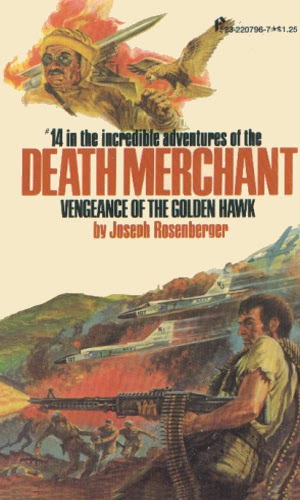
Death Merchant #14: Vengeance Of The Golden Hawk

Richard Camellion (aka the Death Merchant) infiltrates a Palestinian terrorist group known as Vengeance of the Golden Hawk, in order to locate and destroy a nerve gas missile the VGH is planning to detonate over Tel Aviv. It could kill upwards of 300,000 people, and if that happens, Israel will retaliate with nuclear weapons, and that would be the start of World War III.

The book begins with Camellion and a Jordanian agent named Yassine Bahnassi being placed in an Amman jail cell that also houses three members of the VGH. Camellion engineers a breakout (when he explains his plan, one of the men says, "The scheme is so crazy it might work" (!)), and the five men stick together in a safe house on the outskirts of Jordan.

Camellion's cover story is that he is a semi-rogue US military explosives expert and is looking to sell some stolen weapons. The three VGH members are impressed with Camellion ("The organization could use a man of your unique talents") and agree to take him and Bahnassi to the Mountains of the Moon, the VGH's headquarters in Syria - which is also (handily) were the missiles are stored.

At this point, it's clear that the main action of the book will be when Camellion gets to the Mountains of the Moon and swings into action. But author Joseph Rosenberger has pages to fill, so we get a couple of shootouts as the five men, in disguise, make their way to Damascus, where they are ambushed in Mina Square. They also fight a bunch of PLO soldiers while crossing a wadi. Finally, they get to MotM, where they meet the head of VGH: Faraq al-Khatid. Some of Al-Khatid's men believe Camellion is a "Jew spy", but the story the three men tell of Camellion's bravery during their travels is convincing.

Camellion and Bahnassi are supposed to meet up with a Harquad agent who has infiltrated the VGH, but it takes six days for Assaf Budny to make himself known. Finally, the three men begin their raid on the radio control room, the first step towards destroying the arsenal. The initial shoot-out was pretty convoluted. Honestly, it would have helped if Rosenberger included a map of the cliff dwellings. There are buildings above and below - and to both sides - of the arsenal from which the DM and his two cohorts are fighting off the VGH. Since Rosenberger is intent on describing every bit of action from every angle, it gets a bit confusing.
The Death Merchant and the two Jordanian Harquad agents with him could see quite clearly by the tunnel's upper opening from the northwest window of the arsenal's rear room. While Camellion and Budny held down the fort in the front room, in the arsenal proper, Yassine Bahnassi took a position by the northwest window ...

Budny, who had taken a position by the west wall, by the center window. Assaf was watching the west side balcony of the building above the arsenal. ... Budny had a clear view not only of the east side porch but also a portion of the steps [from the east balcony to the arsenal] ...

[A] roar of gunfire from the back room and from the first house to the west of the arsenal. ... [T]he Fedayeen in the west side house had begun to toss automatic rifle and submachine gun steel at Assaf Budny. A moment later, Fedayeen in houses to the east of the arsenal opened fire. ...
Rosenberger is on clearer ground when it comes to describing the gore, as Camellion sends an assortment of VGH fanatics on a "one-way passage to deathland":
Three guerrillas, butchered by slugs, danced a quick jig of death and fell over the railing of the long balcony. A man on the steps took a slug in the gut, one in the chest, and three more in the face. Without a head, his brains flowing down ahead of him, he pitched off the steps, hit the west edge of the roof, bounced off, and kept falling, trailing a stream of blood like the red tail of a comet.
(Rosenberger often gives names to all of the bad guys, even if they get "cowboyed" in the same paragraph. I suppose since he's intent on describing the layout and how everyone is shooting, it helps to identify people if they have a name.)

After they get out of the arsenal and climb down the cliffs, the Death Merchant still has to contend with a French Panhard armoured car with a 60mm turret cannon and a Soviet BTR-40 personnel carrier. Fortunately, he's carrying some blocks of RDX explosives.

Finally, Rosenberger delivers his expected mention of fruit, though he waits until page 173, seven pages from the end of the book: "Kaouki died faceless and brainless. The Death Merchant's chain of 7.65mm slugs exploded his head, which flew apart like a rotten melon."

Friday, August 01, 2014

Death Merchant #13: The Mato Grosso Horror

In The Mato Grosso Horror, Richard Camellion heads an "archeological expedition" that is trying to locate a group of former Nazis, headed by Doctor Klaus von Linderbock, who have constructed a laboratory in the "hell-hot" Brazilian jungle and are working on a powerful mind control drug. They have been secretly testing the drug on the Carajas natives. With the drug, the Nazis plan to unite Germany and regain Europe - and then the world!

From various reviews of the Death Merchant series, I know that author Joseph Rosenberger filled more of the later books with his own political and social beliefs, from straight American ultra-conservatism to the occult. (His anti-religion stance has been crystal clear since the first book. Here, Camellion dismisses missionaries who venture into the jungle - "one of the most unexplored regions on earth" - armed with little more than Bibles as "idiots to begin with".)

Early in the book (published in September 1975), Camellion opines on the feminist movement while the members of the expedition are double-checking their cache of supplies. The narrative suddenly stops after Major Ryan refers to Monica Belone, an anthropologist, as "Miss Belone". She replies that, "if you don't mind, I prefer to be addressed as 'Ms.'"
[Major] Ryan looked startled. Then he looked as if he wanted to laugh.

"Oh, that 'Ms.' business!" He grinned broadly. "To me that means either 'manuscript' or 'multiple sclerosis!' but if you want to be called 'Ms.,' that's okay by me."

Monica didn't appreciate Ryan's comments, and her brown eyes flashed in anger. She folded her arms over her breasts (which were slightly larger than two fried eggs) and said stiffly, "It's gratifying to know that some men have the good sense to realize male supremacy is on its way out in all the industrialized nations, that it was just a phase in the evolution of culture."

Relighting his cigar, Ryan did not reply. But Camellion did.

"Maybe so, but I'm not very optimistic about the net results of the democratization of sex relations," he said, his eyes on the planes, rather than on 'Ms.' Belone. "The death of male supremacy may simply mean that the sexes become equally powerless, rather than equally powerful. For example, if we continue with the present economic system, the sexual democratization of the labor market will result not in women improving their position, but in a period of worsened conditions for both sexes."

The Death Merchant turned and raked Monica with his icepick-like gaze. "To be specific, the kinds of advantages that have been obtained by women act against the better interests of black women and poor women. I say that because mobility for women depends on education; and it is middle-class women who get the best educations, the most opportunities, and the best jobs."

"Apparently, Richard, you are not familiar with the work of Claude Levi-Strauss and the French structuralists. The emic-etic debate has . . ."

"I'm not interested in self-appointed messiahs who prefer theories and ignore facts. One of those facts is that middle-class families will have both marriage partners working, and that will pull their incomes even farther away from those of working-class families. In short, Ms. Belone, the opening up of certain jobs for limited categories of women may actually mean more economic deprivation for poor people in general!"

He smiled at the angry but subdued young woman. "But all that doesn't have anything to do with this expedition, does it?"
And with that dismissal, the main story continues.

Also, Rosenberger must have done a ton of research on the jungles of Brazil - and he was clearly determined to put it all into the book. The Mato Grosso Horror is packed with information about Brazil, its wildlife and plants. However, Rosenberger isn't really able to integrate his research materials smoothly into the narrative. Here is some info snakes and other hazards of the jungle:
There were more than thirty species of poisonous snakes in that special kind of Hades, divided into two general families: the colubrids and the vipers, such as the corals, short-fanged, which caused them, to hang on and chew after striking. The pit vipers were much worse - two subfamilies or genera; first, the many tropical cascabelas, like bushmasters (aggressive, extremely vicious, no rattles to warn you with); the fer-de-lance, a long-fanged killer, called the jararaca, a night rover and 94 percent fatal; and, of course, the yacu maman, or anaconda, so huge it could swallow a man whole!

The forest would be denuded of game and other foods. There was El Tigre, the man-eating jaguar, hunting in singles or in pairs; crocodiles; pana - two varieties, first cousins of the meat-eating piranha; the ten-foot cannibal zungaro or tiger fish; and giant electric rays capable of electrocuting a man. There were scores of jungle diseases. Ants whose single bite could cause blindness. In short, just staying alive and halfway healthy was a full-time job in the Mato Grosso!
Besides the snakes and other dangerous animals, there are also two tribes of "savages" to contend with. The Carajas are cannibals and "the most warlike tribe in South America". While providing pages of information about the fictional tribe, what they wear and how they paint their faces, Rosenberger helpfully notes that the women are "attractive for savages ... some of them were quite shapely".

At one point, Rosenberger has one of the Carajas alert the Nazis as to Camellion's group's progress: "Drums they say white man-devils close to the land of the Muraitos. Drums they say Muraitos plenty mad and make chop-chop-kill of white devils." Rosenberger also indulges in some casual racism, having the explorers battle the "jungle lollipops", "painted gooks", and "South American jungle bunnies".

The death count in this book is well over 1,000. The various battle scenes are more one-sided than usual, as the DM and his cohorts have automatic weapons and grenade launchers, while the Muraitos and Carajas natives have only spears and arrows. (The Carajas guarding the village in which the Germans are located have modern weapons, however.)

As they make their way through the jungle, our heroes have to take refuge in a cave while battling two bands of Carajas warriors. The Germans then set off some explosives, sealing off the cave's entrance with tons of rocks! It's the end of a chapter - and when the next chapter begins, the group is out of the cave and has made several days' progress towards the Germans' village. ?!?! It's a total cop-out by Rosenberger, as he explains how they escaped being buried alive in only a few sentences.

The Nazis are found, and the DM and his team of 10 men split into two groups and attack the compound from two sides. (Ms. Belone does not participate in the final battle.) During the all-out fire-fight, Camellion narrowly survives a hail of slugs (naturally):
The Germans open fire! In the center of a hurricane of hot steel, he reached the top, jumped over the rim, and zigged and zagged, moving at a left angle on a one-way route for life. A nine-millimeter Heckler & Koch slug sang sinisterly by his left ear. Hot steel from a 7.92mm Krieghoff automatic rifle came within half an inch of drilling a couple of bloody tunnels through the top of his cap-covered skull. Damn! I should have gone into the hardware business with my father! A loud zinggg as steel smashed into steel and his right hip felt as if it had been hit with the head of a hammer. But it hadn't been. A 7.92mm from a St.G. Mauser assault rifle had cut through the metal sheath and had struck the steel blade of his M-4 bayonet-knife. Another 7.92 blob of steel barely raked across his left hand.
Also, Rosenberger adds to his list of food used to describe carnage: "Three more [Walther slugs] opened up his chest and split his skull the way a macana would chop apart a kisva melon!"